
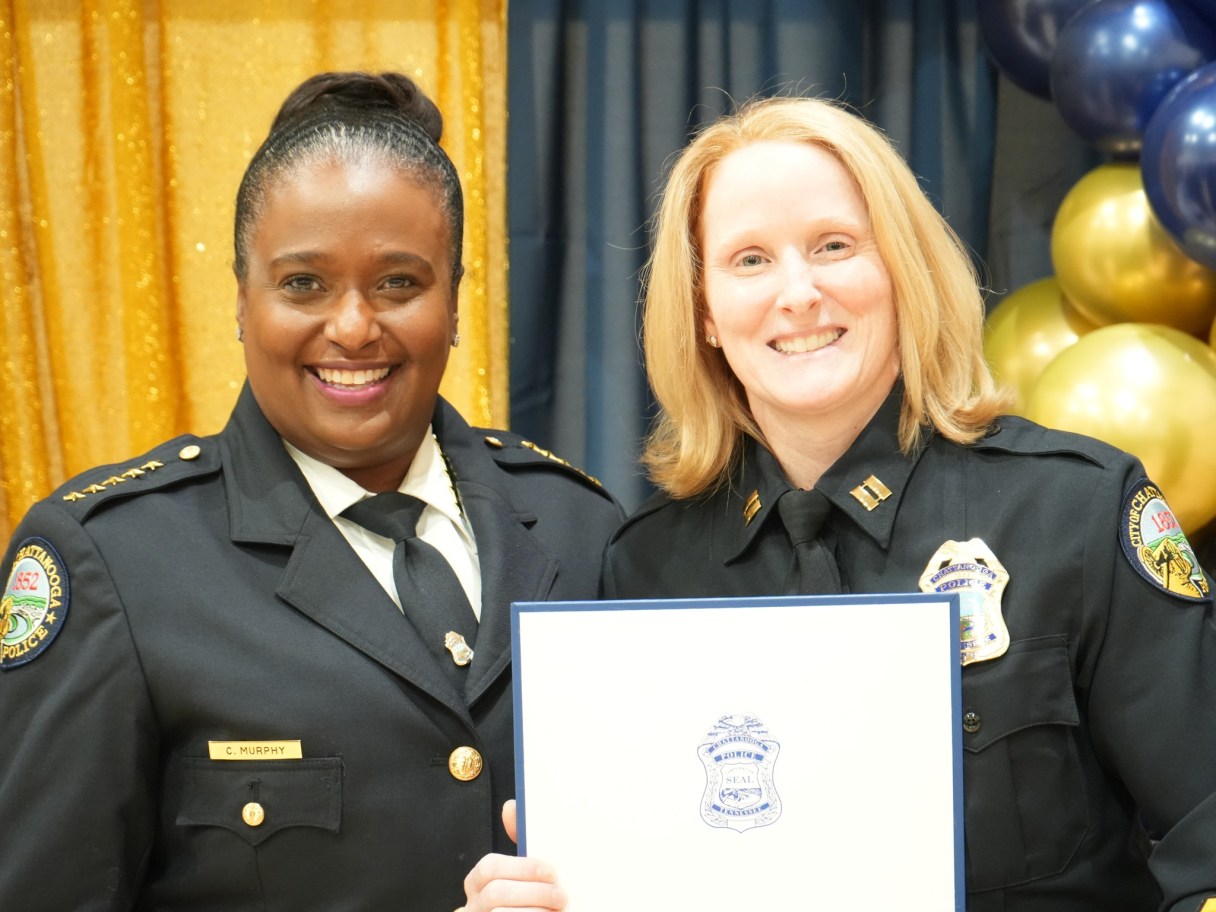
After more than 20 years with the Chattanooga Police Department, Capt. Heather Williams is taking the reins of the department’s Special Operations Bureau.
Special Operations includes traffic responses, special event monitoring, the K-9 unit, SWAT team, hostage negotiation, bomb squad, crisis intervention, property, records management, court liaisons and technology.
Williams, who started the new position in March, was officially promoted in a ceremony Friday. On Tuesday, she sat down with the Chattanooga Times Free Press for an interview, which has been edited for brevity and clarity.
Q: Tell me a bit about your time in law enforcement — how did you start your career?
A: I went to the University of the South, Sewanee, and I was really interested in forensic work. I was approached and they wondered if I’d be interested in the FBI. I was like, “Yes, but I’d like to get my master’s degree first.” So I came back home, went to UTC (the University of Tennessee at Chattanooga) and worked on a master’s degree in criminal justice. And while I was there, I needed to do an internship, so I joined the Police Department, and while I was in the academy, I finished up my master’s degree. And I was like, “Yep, I guess I’m going to stay.” I loved it so much.
I was like, I don’t want to be in a lab all day long. I want to actually be out with folks. You know, the camaraderie, the backing each other up, talking to community members.
I was on for about six years and then applied for the crime scene unit. The same year, I was also on our perimeter team. It’s kind of like the JV before you get moved up to SWAT. That’s where you see most of your training and experience.
Then I was on SWAT for 13 years, and I was also an investigator in crime scene, probably about 10 years. Then once I got promoted to lieutenant is when I came out to patrol. I was there for just over six years.
Then I was promoted to captain and moved over to the Special Operations Bureau. We have a great chain of command and a lot of folks that already know what they’re doing. I just don’t want to get in their way.
Q: What is important to you as a leader?
A: It’s important to have that trust in them, let them take the reins and run with it. And just provide them with support, make sure they’ve got their mental health and wellness taken care of. I’m one of the peer support coordinators. We developed our policy and procedure for our peer support groups, and it’s been instrumental with helping our officers to make sure they’re taken care of. It seems like almost every day now there’s something new. If it’s a child death or injury, we want to make sure we’re checking in on those officers.
If we’re not taking care of each other, we’re not going to be good for our community members. I like to know each individual person, how they operate. If you don’t know them, you don’t know when something’s wrong.
Q: What are some crime scenes or responses that have stuck with you over time?
A: The Woodmore bus crash was a big one. I had just been promoted that weekend and assisted traffic with processing that scene. It was a very complicated, technical scene, you know. There’s a lot involved, a lot of manpower, a lot of hours, days, a couple of weeks.
Also processing the scene of the July 16, 2015, terrorist attack. Initially I responded to that as a SWAT operator, and then once we got the scene secured, I took off the SWAT hat and put on the crime scene hat.
There’s a lot, especially dealing with children, that have had a big impact. There’s certain things that happen that you can’t explain. But you can always find meaning in something.
I never could figure out with the bus crash, how in the world could this happen? But then there was another bus crash that happened in Meigs County a few years later, and I was able to go and help those officers and first responders, EMTs and Fire Department personnel.
Tim Chapin, we just had his line of duty death anniversary on the 2nd (of April), that was huge. I was working in crime scene at the time, processing that scene. Those things stick with you. I remember I was watching a show, and there was a scene in it where an FBI agent was shot in the face. And that was an immediate trigger for me. It brought me back to Tim Chapin’s death and seeing him. I had to turn off the TV and take a moment.
Q: How has being a woman in law enforcement shaped your career?
A: I’ve always been one of those that I don’t want you to treat me any differently. I don’t want different standards. Especially early on, I did feel that I couldn’t be a mediocre officer. If you had an average guy, it’s, “Oh, he’s a great officer.” I always felt that if I was just average, I was not going to be as good as the average male. So I always wanted to make sure that I did 110%.
I don’t want to be judged just because I’m a female. Judge me based off my capabilities and my knowledge, my ability to perform and get the job done. And the stuff that you experience, it does help you. You pick up on things that others can’t, and you can mentor and be a role model for other females especially.
Q: Who were your role models and mentors?
A: My husband (Mike Williams). He’s chief of police on Signal Mountain. He was captain over the training academy when I was going through the academy. And a couple years later, he was riding a motorcycle, I was riding a motorcycle. And then we got married in 2011. He became a mentor because he’s very supportive of females. You still had to work for it, but he didn’t judge you based off of rumors.
(Former) Chief David Roddy was also one of my mentors. He was SWAT commander when I was going through tryouts.
I tried out five times, I passed the PT (physical) test every time, the firearms qualification, then it would always come down to the interview. There was always someone that didn’t want you on the team, and it had to be a unanimous decision. It was a struggle for a little while. Finally, there was a policy change that the SWAT commander made the final decision instead of the unanimous decision.
It was hard. I was like, “Okay, give me that opportunity to prove myself. By gosh, if I can’t handle it, if this isn’t for me, I will turn my stuff in. But at least give me the opportunity.”
Jeannie Snyder, Chief Danna Vaughn, the females that were here, I could go to and talk to, they were good role models that have paved the way for the rest of us.
Contact Ellen Gerst at egerst@timesfreepress.com or 423-757-6319.