
More than 1,000 pounds of expired and unused medications were collected at Hamilton County drug takeback events in April, according to the nonprofit Hamilton County Coalition.
Disposing of prescription and over-the-counter drugs that are expired or going unused helps keep them out of the wrong hands, Calandra Smith, a coordinator with the coalition, said by phone Friday.
(READ MORE: Drug related deaths spike in Hamilton County)
“Overdoses are continuing to rise, substance use disorder is also on the rise,” Smith said. “People are still becoming addicted, and a lot of times, unfortunately, it starts with something they got from a friend or family member right out of the medicine cabinet.”
On April 22, the coalition set up 16 takeback sites in Hamilton and surrounding counties during National Prescription Drug Take Back Day.
Hamilton County sites alone collected a little more than 700 pounds of medication that day, Smith said. The week before, 386 pounds of drugs were collected at a takeback event at the Coca-Cola facility off of Highway 153, according to the coalition.
(READ MORE: Animal tranquilizer drug xylazine becoming more common in Chattanooga area, police say)
Most of those came from individuals clearing out their medicine cabinets, Smith said.
“Or from parents, or seniors, or someone who has passed away,” she said. “Even pets.”
The takeback sites receive everything from prescription drugs like Xanax, OxyContin and other painkillers to over-the-counter medicine like expired Tylenol and Pepto Bismol, Smith said.
After the medication is collected, the Drug Enforcement Administration takes the load to a facility in Alabama, where it can be disposed of in an environmentally-friendly way, Smith said.
The coalition holds takeback events in and around Hamilton County twice a year, Smith said, and has for more than 13 years. The highest volume of drugs collected at one of those events was more than 1,300 pounds, Smith said.
“We started this to make people aware and remind people how easy it is to access medications in your own home,” she said.
Smith said a decrease in the amount collected may be a good sign that people are using drug drop boxes and disposing of their medications other ways throughout the year.
The coalition provides free medicine lock boxes that can secure drugs from unintended users. It can also provide Deterra drug disposal pouches, which use water to deactivate medication and can be thrown in the trash, Smith said. Residents in Hamilton and surrounding counties can request boxes and pouches on the coalition’s website.
“We always say, lock up your guns, right?” Smith said. “You don’t want your children getting into that. I just wish we could see more campaigning on that around medication.”
(READ MORE: Hamilton County expects to receive $1.5 million for opioid abatement, remediation)
Permanent medication drop boxes are also available at police stations in Hamilton County, Smith said, including in the smaller towns and cities around Chattanooga. The Hamilton County Sheriff’s Office also has boxes at its offices on Dayton Boulevard and Hickory Valley Road.
“Sometimes medicine ends up in the wrong hands, whether it’s by theft when someone breaks into the house, or it’s by young people who take it not medicinally, but recreationally,” Chattanooga Executive Police Chief Harry Sommers said during a Thursday media briefing. “Unfortunately, many of those drugs are highly addictive. And depending on who you are, addiction can happen very quickly.”
Walgreens locations that are open 24 hours also have drop boxes available, Smith said. A map maintained by the Tennessee Department of Environment and Conservation shows drop boxes at the University of Tennessee at Chattanooga Police Department on Palmetto Street and at CVS Pharmacy locations in Hixson and on Dodson Avenue.
Police warn residents against flushing old medication down the toilet, where it joins the water system. Smith said even small traces of medicine in the water makes it harder to purify.
“If enough people do it, it can affect that system,” Sommers said.
To avoid the possibility of prescription drug misuse in the first place, Smith said people should ask their doctors about alternatives to opioids for pain relief, lower doses or lower frequency prescriptions.
Contact Ellen Gerst at egerst@timesfreepress.com or 423-757-6319.
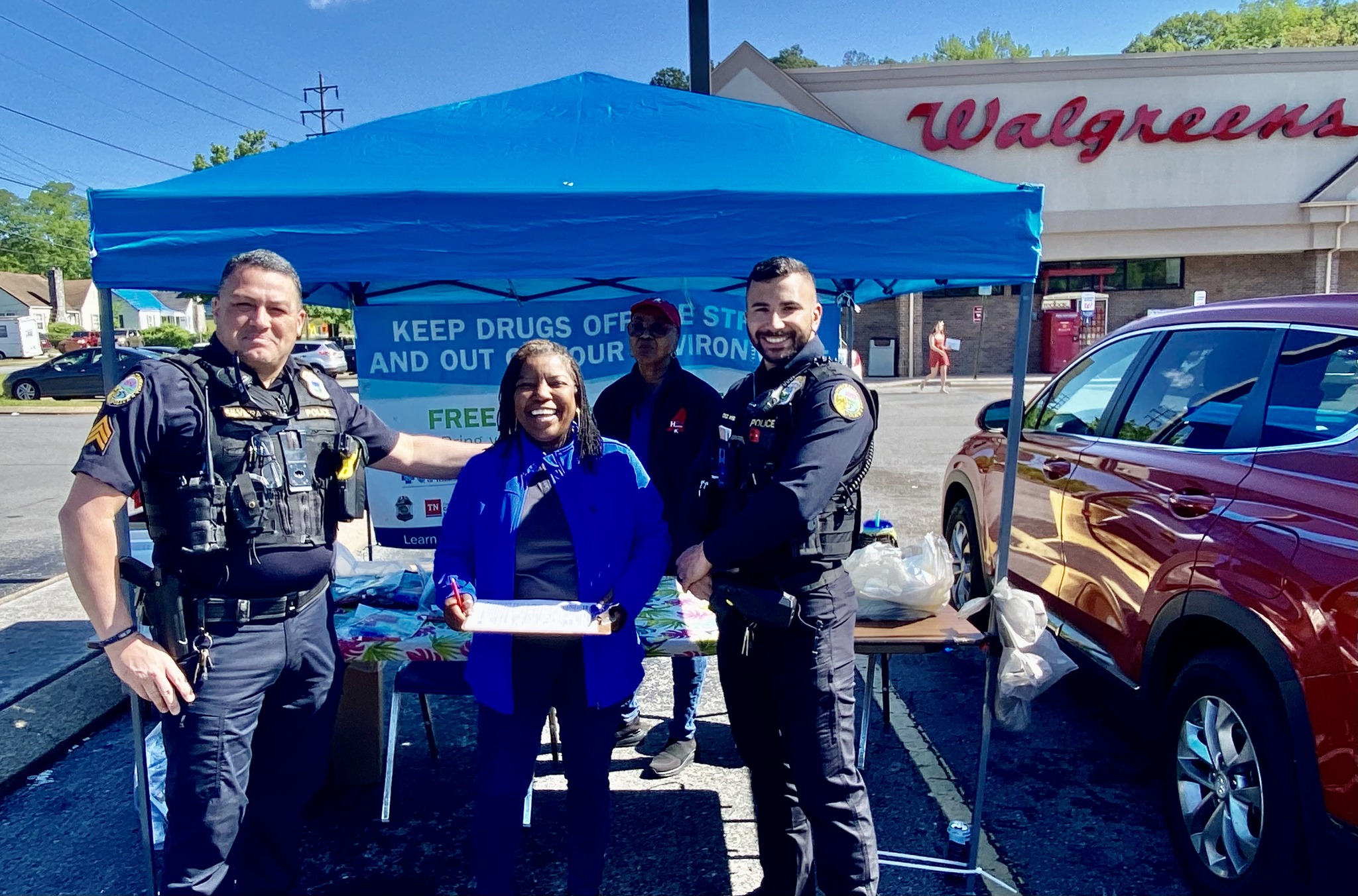 Contributed Photo / Chattanooga police officers participate in a drug takeback event April 22.