
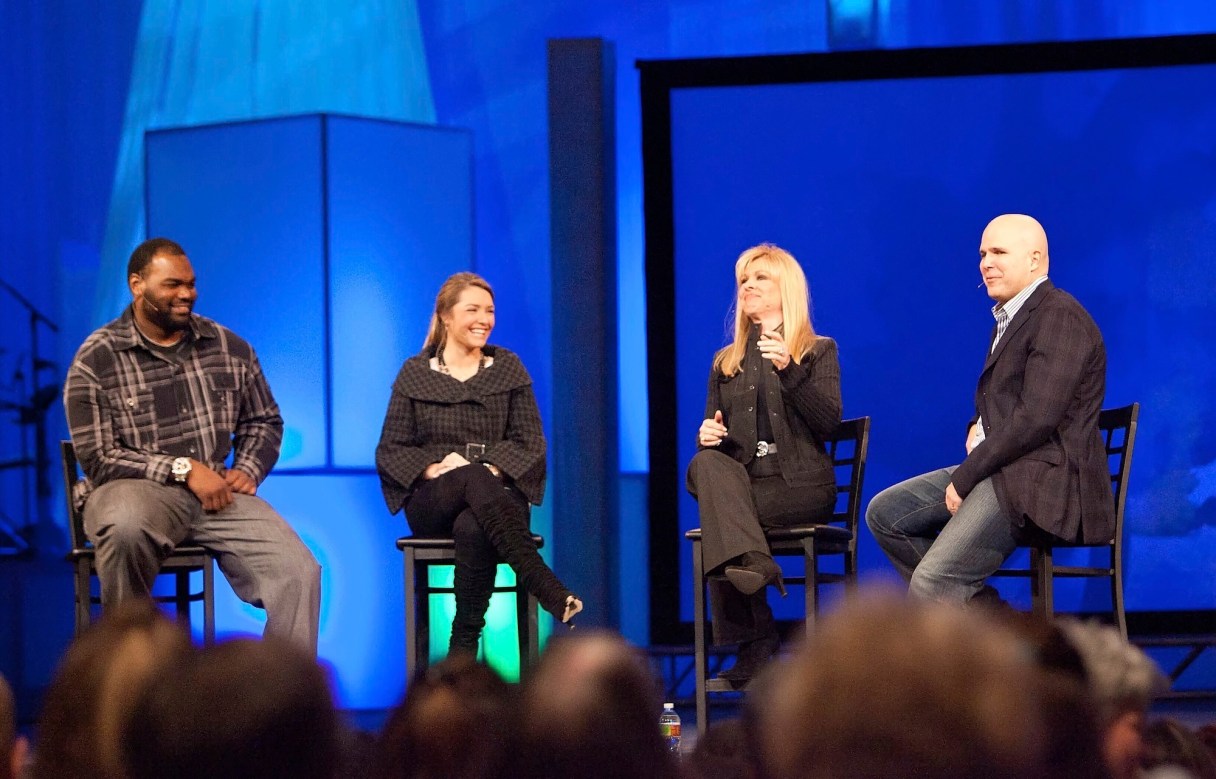
Watching the Michael Oher story unravel has been difficult.
Dropping a bombshell, Oher, a former NFL star and subject of the 2009 Oscar-winning movie “The Blind Side,” called the film a lie and alleges that the Tuohy family who took him in made millions from the movie, but he didn’t see any of the money.
In 2004, Oher claims the family fooled him into signing a conservatorship, which gives a judge-appointed guardian the power to manage the personal or financial affairs of a person who is deemed unfitting to do so themselves.
The Tuohys have responded to the allegations, saying that the conservatorship was a way to satisfy the NCAA when Oher was set to play at Ole Miss, depicted in the 2009 movie. The family’s attorney said Oher tried to threaten them with going public with these allegations unless they paid him $15 million.
The movie’s theme of love, empathy and family above all else has been tarnished with this legal battle. Even before Oher’s allegations surfaced, he was not a fan of the movie, saying that it portrayed him as dumb.
In certain respects, Oher and I share a parallel path: I also experienced homelessness at age 18 and a family took me in. But from reading about the current conflict between Oher and the Tuhoys, I’m grateful for the differences our paths took.
Starting my path
My journey out of homelessness wouldn’t have been possible without my church family back in Tullahoma, Tenn., specifically the pastor of the church and my adopted-through-faith father, Randy Davis.
In the first month of my time at the homeless shelter, Shepherd’s House, I wasn’t in contact with my family — or anyone, for that matter.
Until one day a visitor dropped by.
“Hey LeBron!,” a roommate shouted while getting the door, “some white guy is here for you!”
Sitting on my bed, I closed my Green Lantern comic book and went to see who it was, confused why anyone would be looking for me.
It was Randy, pastor of the Wilson Ave Church of Christ that I attended as a child. We kept in contact but I never thought he’d be at the door.
“I heard that you were here and wanted to check on you. I would like to help you,” he told me.
I agreed to let him in my life, and I am better for it.
Since I was 18 when our father-and-son relationship began, we both agreed that anything resembling a conservatorship would not be best.
So we like to say that I was adopted through faith.
Randy believed that he was simply setting me on my path, not desiring anything in return.
Having honor in what you built
At a Chick-fil-A in Tullahoma, I sat in a booth next to my adopted brother, Aaron, with my adopted father Randy, both white. It was about a month after I got my driver’s license.
I had no clue why we were there, outside of getting a mediocre chicken sandwich (yeah, I said it).
“Aaron would like to give you his car,” Randy said. I shot up with excitement. At age 19, his ’94 Plymouth was more like a luxury car to me. “But you need to pay for it like he did.”
I sat there for a minute and thought, “why couldn’t they just give me the car for free?” But I agreed to pay my brother because I really needed that car.
There were other instances when Randy made me pay for things and, at that time in my young life, I didn’t yet understand that he was actually supporting me by not paying for everything and making everything too easy for me.
It’s now in hindsight that I realize that Randy was teaching me about the honor of having built something for yourself. Just in my 29 years of life, I can say that I have two degrees, became an award-winning journalist and got to experience the rest of the country, all on my own.
Reminiscing about those experiences, I decided to call him and hear what he had to say after all these years.
“I just had to sit back and watch you fly,” Randy said last week.
My heart warmed after hearing those words. To think all it took was him coming to my door.
There’s always someone at the door willing to help.
I understand that after seeing the conflict between Oher and the Tuhoys, a once-close family now on opposite sides, faith in humanity seems low. The conservatorship that was used to make Oher a part of the family may have been well-intentioned but is a drastic measure that should only be used in very specific situations.
The biggest lesson I learned from Randy is that humanity is best when we choose to give from our hearts, knowing our reward isn’t material.
Kindness is abundant but space for indivudual growth is important. Kindness is not power and shouldn’t come with strings attached.
As sure as the sky is blue, an act of kindness can make all the difference in somone’s life.
For me, it was a knock at the door. For you it might be a smile and a wave from a neighbor. We always need the kindness from strangers or people we thought were removed from our lives. Don’t give up on it.