
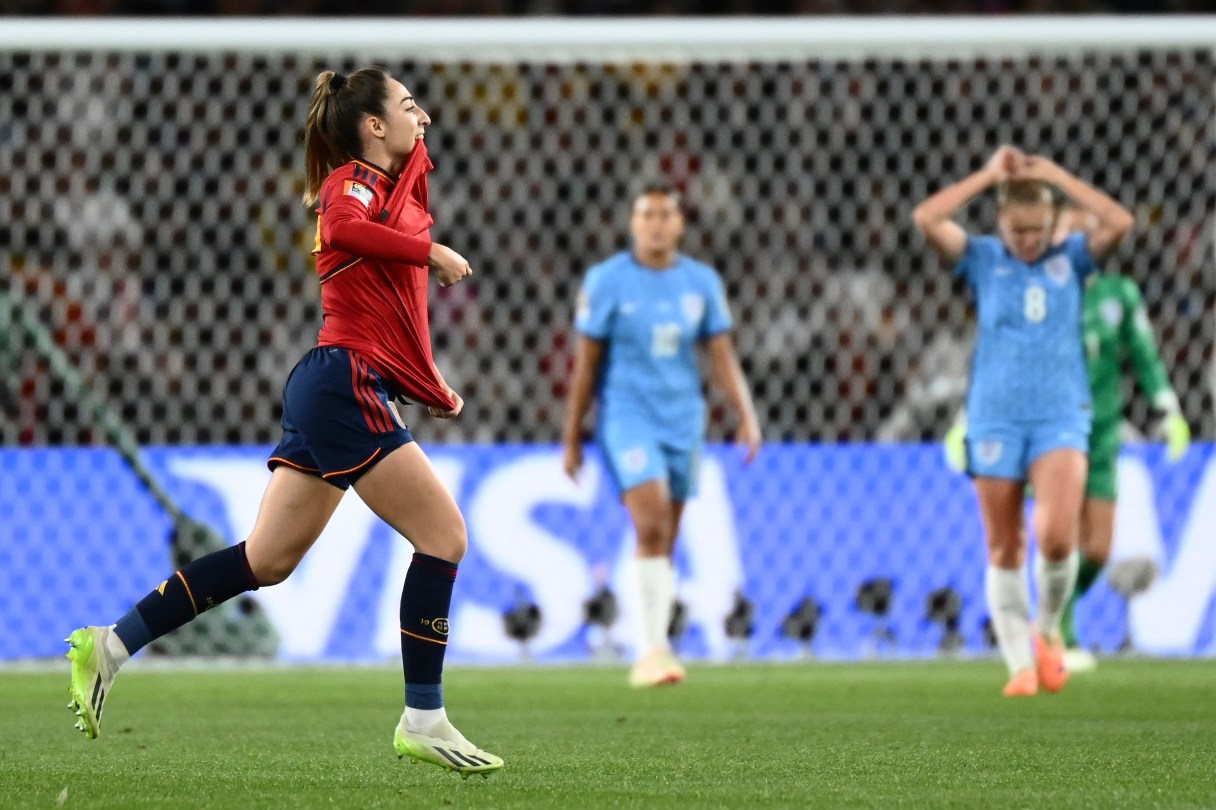
SYDNEY — Spain celebrated its first Women’s World Cup championship Sunday after an impressive display proved too much for England in a 1-0 victory by La Roja.
Olga Carmona scored in the first half, and Spain held on to cap the month-long tournament co-hosted by Australia — the site of the final as well as Sweden’s 2-0 win against Australia in Saturday’s third-place game — and New Zealand.
Overcoming the turmoil that had surrounded the team, Spain won to become the first nation to hold the global under-17, under-20 and senior titles in women’s soccer at the same time. Spain is the fifth winner in nine editions of the Women’s World Cup and joined Germany as the only two nations to win both the men’s and women’s titles.
Spain’s men were champions in 2010 in South Africa. Germany has won the men’s quadrennial tournament four times and the women’s event twice.
At the final whistle, the Spanish players piled on each other in front of their goal. They were still dancing on the field until the trophy presentations, where they kissed the trophy and raised their arms triumphantly as golden glitter fell from above.
“We’ve suffered a lot throughout the past 12 months, but I think everything has a reason to be. This has made us a stronger team,” Carmona said after the game. “And it’s really incredible. I don’t know just why Spain is the world champions, but I think that we deserved it.”
After the final, Carmona learned of her father’s death, the Spanish soccer federation said. It did not say when Carmona’s father died or give a cause of death.
“We love you, Olga,” the federation wrote on social media. “You are part of the history of Spanish soccer.”
The Lionesses, meanwhile, were trying to bring a World Cup trophy back to England for the first time since the men won the country’s lone such title in 1966. The wait will go on.
“At first you feel like you failed with not winning,” England captain Millie Bright said. “I think in a couple of weeks and it settles, we’ll be really, really proud.”
There were 75,784 fans at the final at Stadium Australia, including tennis great Billie Jean King, increasing the record attendance for the tournament to more than 1.975 million.
In an open game featuring multiple chances for both teams, Carmona’s left-foot strike in the 29th minute — finishing off a fast-breaking counterattack after England’s Lucy Bronze lost possession — remained the only goal.
Carmona also scored the winner in the 89th minute of Spain’s 2-1 semifinal victory against Sweden on Tuesday, becoming the first player since the United States’ Carli Lloyd in 2015 to score in a Women’s World Cup semifinal and final.
Spain had a chance to double its lead in the 68th minute of the final after a video review awarded a penalty for Keira Walsh’s handball, but Jenni Hermoso’s ensuing kick was saved by Mary Earps.
One of England’s best chances was in the 16th minute, when Lauren Hemp’s blast caromed off the crossbar. A minute later, Salma Paralluelo raced toward goal but couldn’t get a clean shot, and Earps stopped Alba Redondo’s attempt in the scramble in front of the net.
England was coming off a 3-1 victory over Australia in the semifinal.
Spain’s title came despite a near mutiny by the team last year, when 15 players said they were stepping away from the national squad for their mental health while also calling for a more professional environment. Three of those players —Ona Batlle, Aitana Bonmatí and Mariona Caldentey — reconciled with the federation and were at the Women’s World Cup.
The victory was also a bit of redemption for La Roja, which fell to England 2-1 in the quarterfinals of the European Championship last year. England went on to win the tournament title on home soil.
“I think all of us, we felt that this team had something special,” Carmona said. “I believe that we’ve shown this on the field, we’ve shown this in the group stage, in the knockout stage. We’ve been fighting until the end. We never stopped.
“Last year was different, but football gives you second chances What better chance than in a World Cup final and to be able to call ourselves world champion.”
On Sunday, Spain coach Jorge Vilda started 19-year-old Paralluelo, who scored the breakthrough goal against Sweden and the winner in extra time over the Netherlands in their quarterfinal. Those performances helped her win the young player of the tournament award. Earps won the Golden Glove for best goalkeeper and Bonmati won the Golden Ball for best player.
Spain grew over the course of the tournament. After a 4-0 loss to Japan in the group stage, La Roja replaced Misa Rodriguez with Cata Coll in goal. The team rebounded quickly by trouncing Switzerland 5-1 to kick off the knockout round and built from there.
“When we found out that we had England in the final, we analyzed them and saw how they played,” Bonmati said. “We prepared it well, we came out confident of what we were doing, of our game, of our fight, of our dedication.”
England had momentum going into the tournament after winning the Euro title, but three of the team’s best players — captain Leah Williamson, Fran Kirby and Beth Mead — all had knee injuries that kept them off the squad for this tourney.
Sarina Wiegman became the first coach to take teams to back-to-back World Cup finals, but she is now 0-2 overall in the championship match. A native of the Netherlands, she coached the Dutch to the final four years ago in France, but they lost 2-0 as the United States repeated as champion and won its record-extending fourth Women’s World Cup title overall.
Lauren James, who was the team’s top scorer with three goals and three assists, was forced to sit out two matches after being suspended for stomping on Nigeria’s Michelle Alozie to open the knockout stage. While James was available for the final, Wiegman started Ella Toone and used James as a second-half substitute in a double change to spark the attack.