
(Editor’s note: Fifth in a series)
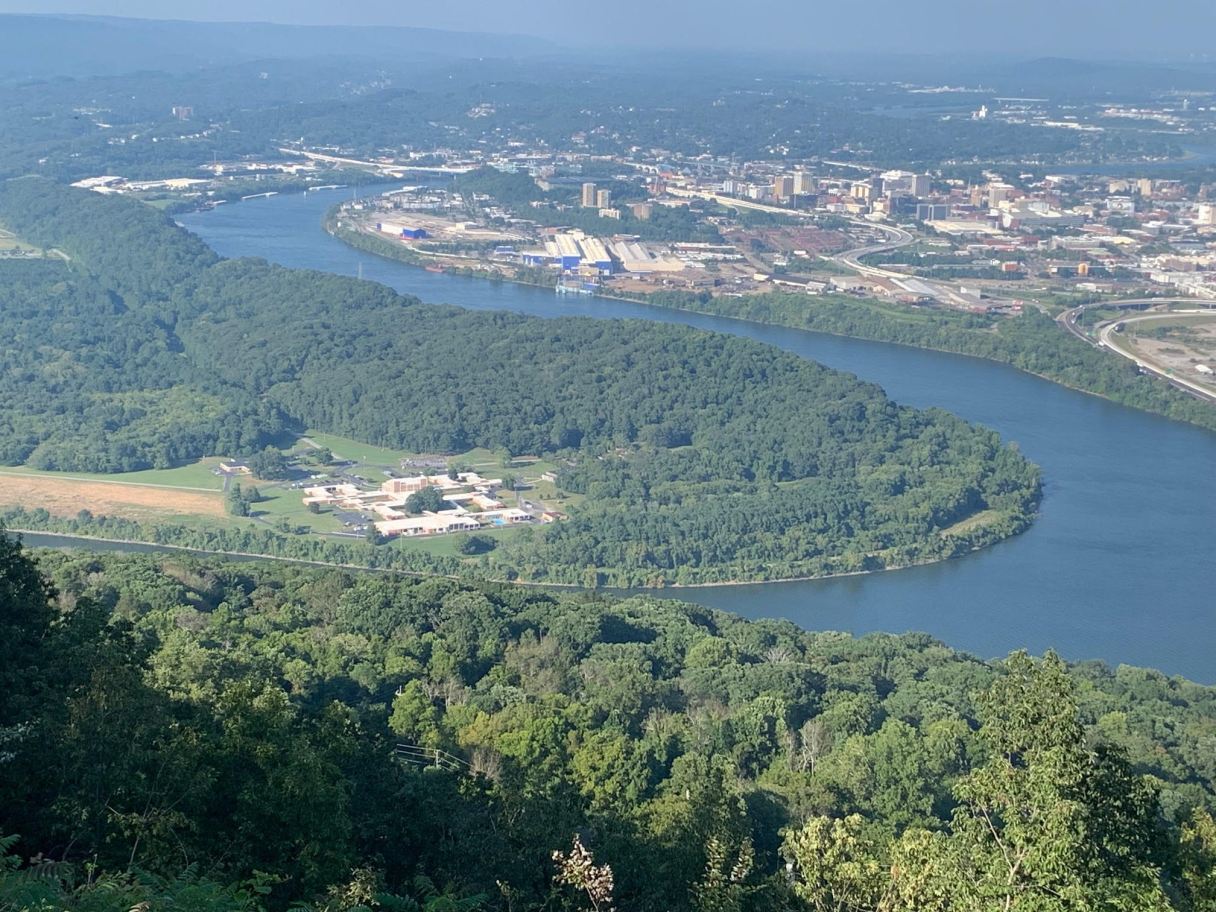
In 1898, business interests promoted a canal across Moccasin Bend, shortening the river trip by six miles, and industrializing neighboring acreage, but costs were too high. A spirited debate between developers and preservationists ensued for decades. A Chattanooga Times editorial in 1944 opined that a park on Moccasin Bend could be as great an asset for Chattanooga as Central Park for New York City, “Hyde Park for London, the Champs Elysees for Paris, the Prater for Vienna, the Cascine for Florence, the Corso for Rome, or the Prado for Madrid.” Legislation for a Moccasin Bend National Park passed in 1950, but a lack of state funds in 1953 halted the effort.
In 1982 the city and county formed the Moccasin Bend Task Force. The group developed a blueprint for the Tennessee Aquarium and other public-private projects, plus it started an effort to designate the Bend a National Historic Landmark. One of the National Park Services’ main conclusions in the Landmark nomination read: “This is the best preserved and most important, compact, diverse sample of archaeological remains known in the Tennessee River Valley; moreover it is ideally situated to be easily and rigorously protected for the long term future, and has the highest potential for rich and varied high-volume public interpretation and display … of any known archaeological resource in the United States.” It added, “Despite a litany of uninformed destructive alterations to the vicinity in the last few years, the basic integrity of content and setting of all of the constituent resources remains remarkably intact.”
The Park Service asked: “Why is such an unbelievable historic panorama concentrated and preserved on a small, 1000-acre tract?” It answered: “Chattanooga is and has been through much of American prehistory and history, one of the great strategic central places of North America. Its position on the Tennessee River relative to the Ridge and Valley Province, the Cumberland plateau, the Piedmont and the Southern Coastal plains maps made it a focus of human economic interest since the earliest times. At times it was probably the primary center of economic and political influence in the Interior Southeast. This may have occurred in the Late Archaic, Middle Woodland and Late Woodland periods in prehistory as well as at the dawn of European contact in the 16th century and the ferocious battle of the Civil War. As a result of this favored natural location and prominence, Chattanooga has, or had as its 20th century patrimony, many of the most striking and important archaeological properties in the Southeastern US.
“The Moccasin Bend resources offer a potential of national demonstration quality for coordinated scientific research, historic preservation, public education and deep appreciation of America’s prehistory and early history.” The report focused on the Hampton Place site as “one of the several most important contact sites in the nation, offering unparalleled potential to study and understand the rapid evolution of a culture from numerous avenues of research and a most rare window on aboriginal society at the very moment of initial European contact. And there is an added benefit in the fact that this site does not exist in isolation. It is surrounded closely by well-preserved sites containing important samples of the region’s earlier and later cultural periods, from the depths of prehistory through the American Civil War. Any and all of the remains, including those of Hampton Place, can be studied within the framework of a long and dynamic continuum of cultural development in a great American central place.”
The report recognized Civil War importance: “The perfectly preserved monumental remains of the Battle of Chattanooga (cannon emplacements, rifle pits, bivouac pads and areas, and tortuous access roads) are the best preserved of all physical remains of the important battles of Chattanooga and Chickamauga and the only recognized unit of Union Army facilities from the costly campaign. Their interpretive potential, given their location within the confines of the city of Chattanooga and overlooking the downtown center, and as the temporal capstone of the great surrounding comprehensive archaeological sample of Moccasin Bend, is tremendous.” In 2003 Congressman Zach Wamp won designation of the National Archeological District.
Recent news of the Tennessee Department of Mental Health’s plan to rebuild the mental hospital on the Bend brings into focus the potential of a complete national park — without the nonconforming hospital and police firing range. The range of attractions of a full park (educational, recreational, cultural, economic, etc.) is unlimited. Our governor, Mental Health commissioner and Hamilton County legislative delegation have important voices in this critical decision. You should feel free to communicate your thoughts on how Moccasin Bend can after decades now realize its full potential.
Frank “Mickey” Robbins, a past chair of Moccasin Bend Mental Health Institute, is a board member of the National Park Partners.