
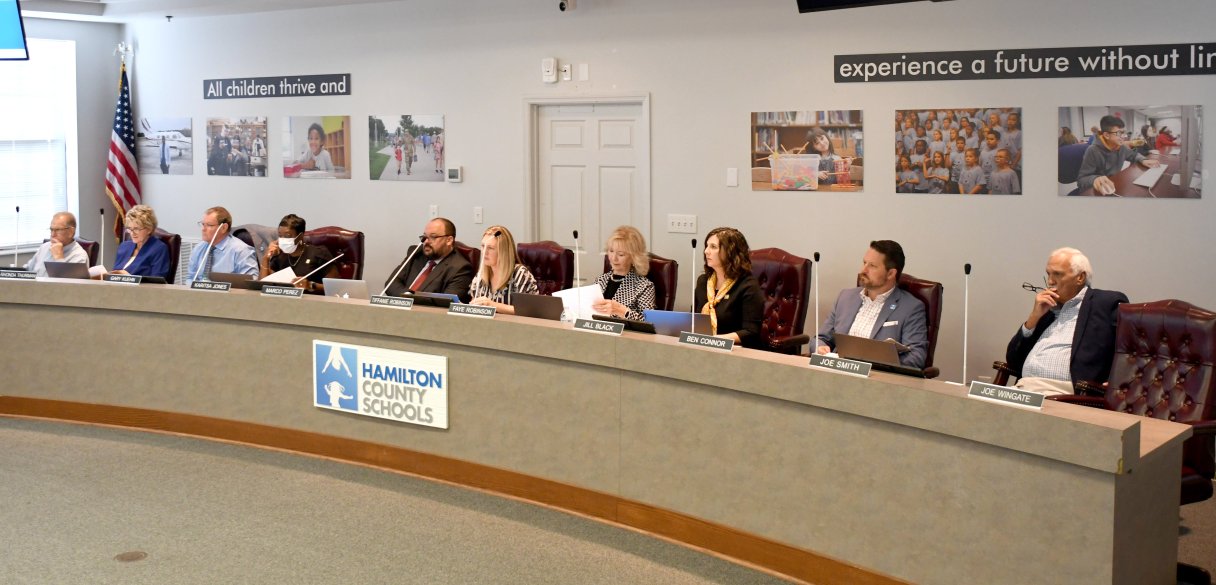
Some Hamilton County school board members expressed support Monday night for keeping the income and public school attendance requirements in Tennessee’s existing private school voucher program in place if it expands statewide.
“The guardrails cannot be lost to this at all,” School Board Member Ben Connor, D-Chattanooga, said at a meeting of the board’s legislative committee. “Every dollar pulled from a public school doesn’t just follow that one child and help them, it hurts us being able to build new schools and put roofs on those schools and playgrounds and teachers and food in the cafeteria. The individual good pulls from the whole.”
Late last month, Gov. Bill Lee announced a plan for legislation expanding Tennessee’s education savings account program beyond Davidson, Shelby and Hamilton counties to all 95 of the state’s counties. His proposal would provide more than $7,000 to each participant to use to attend a private school and would eventually eliminate income limits to access the program.
Members of the school board met Monday to discuss their legislative recommendations for the Tennessee General Assembly next year. Board Chair Joe Smith, R-Hixson, said parents who already send their children to private school shouldn’t take state funds, but there should be a compromise for those who want to enter the private school system for the first time.
“It’s that person’s tax dollars, and they ought to have some say,” he said. “That’s what choice is about.”
(READ MORE: How Gov. Lee’s expanded school voucher program could affect Southeast Tennessee)
School Board Member Jill Black, D-Lookout Mountain, emphasized that Lee’s proposal is very different from the current pilot program and that the changes in income limit could drastically affect the number of students who participate in the program.
“We have to look at the common good,” she said. “I can’t see how providing basically a funnel from the public education funding to private schools with no accountability on achievement could be good for the majority of students in the state of Tennessee.”
Board members also said lawmakers should apply the accountability requirements for public schools — including proficiency standards, letter grades and growth scores — to private schools accepting vouchers, as well as publicize those results.
Letter grades
Superintendent Justin Robertson drew a connection between the school letter grades expected to be released next week and Lee’s proposed expanded school voucher program. He said the conversation around private school vouchers may be the biggest moment in public education in Tennessee dating back to school integration.
“I don’t think it’s a coincidence that the year we finally decide to publish letter grades for public schools is the same year that we’re going to push through a school voucher program statewide when we have zero evidence to support its effectiveness,” he said.
Robertson added that the letter grades will likely arouse a lot of emotions for families that might have expected their school to get a better score, which may then be used to try to say public schools are not serving students well even though there’s no evidence suggesting private schools will serve students better.
The newly released letter grade model considers academic proficiency and student growth. It also weighs the growth of the lowest-performing quartile of students, who are identified based on the previous year’s Tennessee Comprehensive Assessment Program. For high schools, the model also considers college and career readiness.
(READ MORE: Tennessee outlines new school letter grading system, district officials respond)
Board members said it made more sense to give schools a 1-5 score instead of an A-F letter grade.
“That 4.1 shows me something more than an A or a B,” School Board Member Gary Kuehn, R-Ooltewah, said.
Some members also expressed support for using the previous model’s formula, which offered two ways for schools to demonstrate achievement. The first, called “pure achievement,” focused on the percent of students who demonstrate proficiency, while the other looked at whether schools met their annual measurable objectives, a yearly target for improving performance based on prior year results.
It also separated the data to account for subgroups such as race, socioeconomic status and students with disabilities.
“We don’t know what we don’t measure,” Black said. “It’s really scary to think that we would create a system where it would be easier for kids who are at risk to fall through the cracks.”
Federal funding
Board members also said the General Assembly should continue to accept federal education funding. A special Tennessee legislative working group met last month to explore the feasibility and implications if the state were to reject federal education funding — thereby freeing the state from federal mandates that come along with the funds.
“Why don’t we continue to accept the federal money and turn around and use that $1.8 billion for other things, such as building new schools or providing a higher salary for our teachers?” Kuehn asked. “There’s a wide range of things that that money can be used for if it’s just sitting there.”
Members also discussed the board’s stance on policies related to teacher licensure and educator pipelines, improving and expanding school safety measures and support strategies proven to affect K-12 student success.
The school board will vote whether to adopt the recommendations Thursday.
Contact Shannon Coan at scoan@timesfreepress.com or 423-757-6396.