
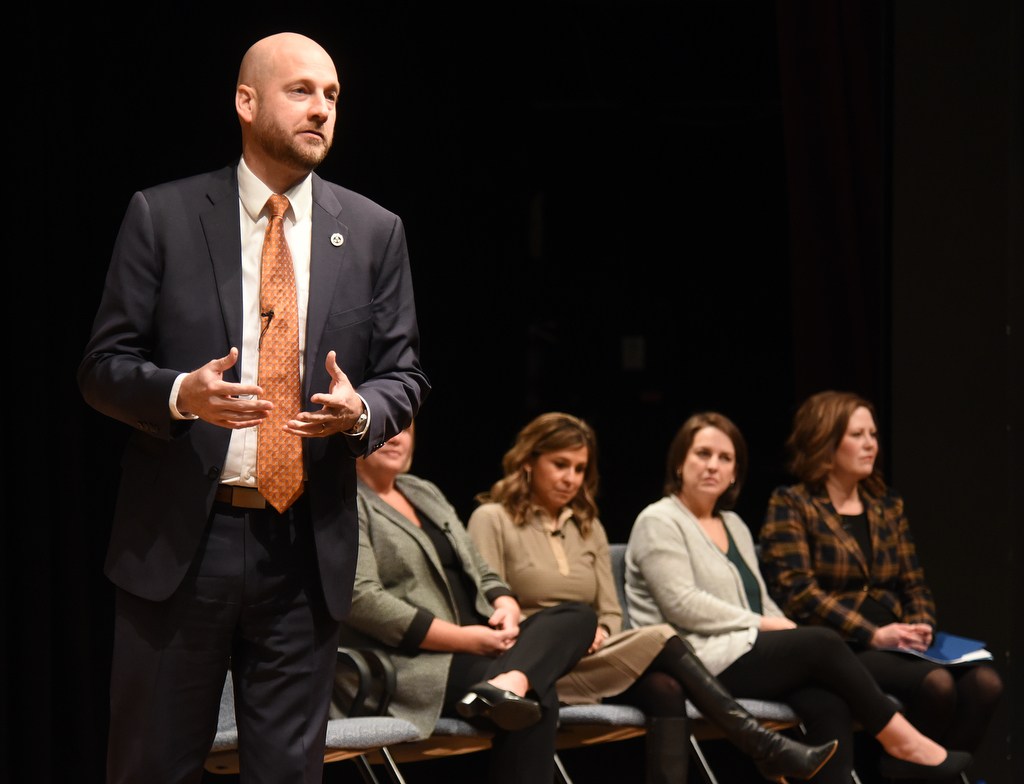
Serving people with disabilities starts by ending assumptions about what they can and can’t do, Tennessee Department of Intellectual and Developmental Disabilities Commissioner Brad Turner said Wednesday to a small audience at Chattanooga State Community College.
Turner is leading state efforts to expand career and educational opportunities for disabled young adults by partnering with universities. He visited Chattanooga State on Tuesday to speak with local educators and organizations.
“I’m very proud of the fact that we’ve had the opportunity to advocate at the highest level directly to the government to serve Tennesseans with disabilities,” Turner said.
In 2022, state legislators appropriated $500,000 in a recurring grant, called Tennessee Believes, to the Department of Intellectual and Developmental Disabilities to increase the number of inclusive higher education programs. There are four colleges and universities participating in the program, including Tennessee State, which became the first historically Black college in the nation to have a program dedicated toward individuals and students with disabilities, Turner said.
(READ MORE: People with disabilities left out of climate planning)
Though the next round of grants have not yet been distributed, Chattanooga State hopes to develop a program for its campus.
“Our purpose is to support and empower everyone in our community to learn without limits,” Rebecca Aslinger, assistant professor in early childhood education at Chattanooga State, said in a news release. “This rings true as we start developing a new college program for students with intellectual and developmental disabilities with the full support of the administration and community.”
Turner said one of the biggest barriers for those with disabilities is stereotypes, especially when it comes to their education and careers.
 Staff Photo by Matt Hamilton / Brad Turner with the Tennessee Department of Intellectual and Developmental Disabilities speaks Wednesday at Chattanooga State Community College.
“The thing that happens that is really challenging for us is that businesses already have in their mind what jobs individuals with disabilities can do, but more importantly, what they can’t do,” Turner said. “We’re trying to go to a lot of these companies and change the narrative around the conversation and stop putting (disabled people) in boxes.”
(READ MORE: Better disaster support sought for people with disabilities)
Another barrier is transportation, and the state is looking at ways to partner with local services to help those with disabilities get to work and school.
“Speaking frankly, it’s an excuse for employers to say, ‘Well, they can’t get to work, so I can’t hire them,'” Turner said.
He added Chattanooga is one of the most disability-friendly cities in the state for transportation.
“That’s something to be proud of, ” Turner said.
From institutionalizing the disabled to serving them at the government level, Tennessee has come a long way in the past 40 years, Turner said.
“We have had parents tell us a lot of these stories that they share,” Turner said. “They were told, ‘The best your child’s ever going to be is in an institution.’ They would drop them off at the door or leave them for 40 years and never come back and see them. Those are true stories.”
Jim Frierson, whose daughter, Anna Frierson, has Down syndrome, said the state’s efforts are “radical.”
“It says that in our diversity, equity and inclusion conversation, we’ve left out a class of people, a demographic slice, which is a huge thing,” Frierson said in an interview following Turner’s discussion.
Anna is enrolled in Chattanooga State’s vocational culinary training program aimed at students living with disabilities. Though she was too shy to offer a comment, Frierson said it’s an inviting and welcoming program that she loves.
Contact Carmen Nesbitt at cnesbitt@timesfreepress.com or 423-757-6327.