
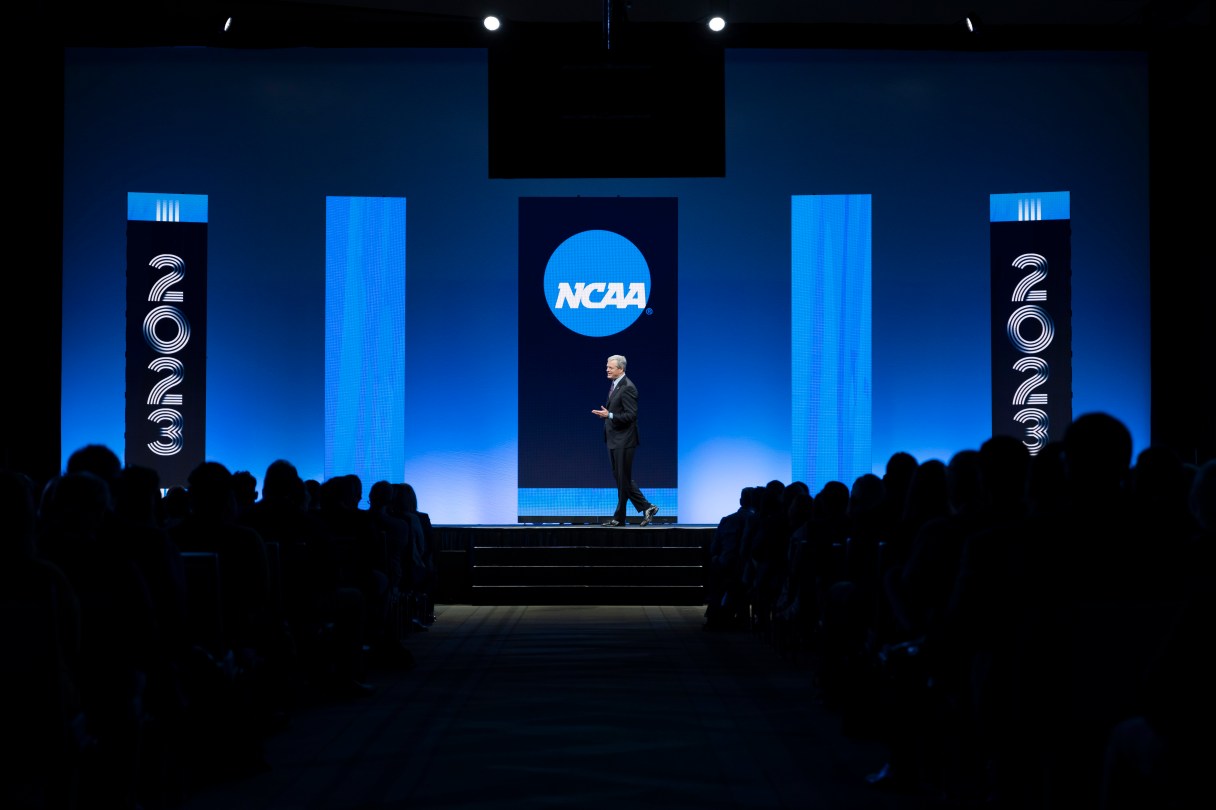
SAN ANTONIO — At the NCAA convention Thursday, outgoing president Mark Emmert said goodbye, incoming president Charlie Baker introduced himself, and the state of college sports was declared perilous.
“As a collective enterprise, we are both thriving and threatened,” said Linda Livingstone, who is president of Baylor University and also chairs the NCAA’s Board of Governors.
Livingstone handled most of the annual state of college sports address with the NCAA in a period of both transition and transformation.
Earlier in the day, the Division I Board of Directors approved a host of recommendations intended to reform the top tier of college sports, from membership standards to the size of championship brackets. During her time on stage, though, Livingstone reiterated what has become a familiar refrain from college sports leaders, saying federal intervention is needed.
“We need a safe harbor to a certain degree from antitrust complaints,” Livingstone said. “We’re not looking for, nor do we need, a broad antitrust exemption. But we do need the ability to make common sense rules without limitless threats of litigation.”
Amid a patchwork of state laws, the NCAA is struggling to regulate the way athletes can now be compensated for the use of their names, images and likenesses. The association lifted its ban on athletes being paid by sponsors and making endorsements in July 2021, and many within college sports worry NIL deals have quickly become a way to induce recruits or pay for play.
There are also multiple movements to grant college athletes employee status. Livingstone said while it is essential college athletes not become employees of the schools they attend, that doesn’t mean they couldn’t eventually be compensated.
“That’s one of the questions that we’re working on, trying to answer that question,” she said during a news conference after her address to membership. “It’s why protection of the status of our student-athletes is so important, that they be viewed as sort of a unique status on our campus, that they would not be employees.”
Baker, the former Republican governor of Massachusetts, was brought in to lead the NCAA because of his reputation as a consensus builder in a mostly Democratic state. He conceded getting federal legislation passed is challenging, but not having it might not be an option.
“I do believe that there are serious issues with just letting this train run without doing something to deal with the consequences that are currently facing college sports,” he said in the news conference after he briefly addressed membership.
Baker doesn’t start until March 1. He attended the convention as part of his listening tour. He said his notes over the past few days of meeting with NCAA staff, school administrators, conference commissioners and athletes filled an entire notebook.
Emmert thanked the membership for allowing him to serve at the top of the NCAA for 12 years and congratulated them on making massive changes in college sports that have benefited athletes. And he said he was “absolutely delighted” with the choice of his successor.
“It’s got to be a challenging role,” Emmert said. “You know that, Charlie — you know that this is not a cakewalk. Anything but.”
Livingstone has been an active participant in the NCAA’s recent efforts to reform from within as part of a transformation committee. The made its final report public last week, and the D-I Board of Directors’ approval came Thursday at the convention.
“Keep in mind these are concepts at this point,” said Jere Morehead, the University of Georgia president and the board’s chair. “So there’s still a lot of work to be done on the details, but tremendous progress was made today. The board was very adamant its support of student-athletes and most of the transformation committee recommendations focused on how to enhance the experience for student-athletes.”
The report called for more sport-by-sport governance in Division I, more involvement by athletes in governance, and enhanced expectations for schools with a goal of creating a more uniform experience for athletes.
Transformation committee co-chairs Greg Sankey, commissioner of the Southeastern Conference, and Julie Cromer, Ohio University’s athletic director, reiterated in a joint statement the work of transforming Division I will continue beyond the committee’s work.
“We’re confident these important changes will meet the needs of student-athletes because they were rooted in the perspective of student-athletes,” they said. “In fact, we’re confident that student-athletes’ voices have never featured more prominently in shaping how college sports is run.”
The committee recommended allowing 25% of teams in sports sponsored by at least 200 schools to compete in annual championship events. That opens the door to possible expansion of the popular March Madness basketball tournaments from 68 to as many as 90 teams each.
The board also approved the creation of a second 32-team postseason tournament in D-I women’s basketball. The event would be similar to the National Invitation Tournament, which is owned and operated by the NCAA. The Women’s NIT already exists but is not run by the NCAA.
The tourney recommendation stemmed from an independent gender equity review and is intended to provide an equal number of NCAA-funded postseason opportunities in men’s and women’s basketball.