
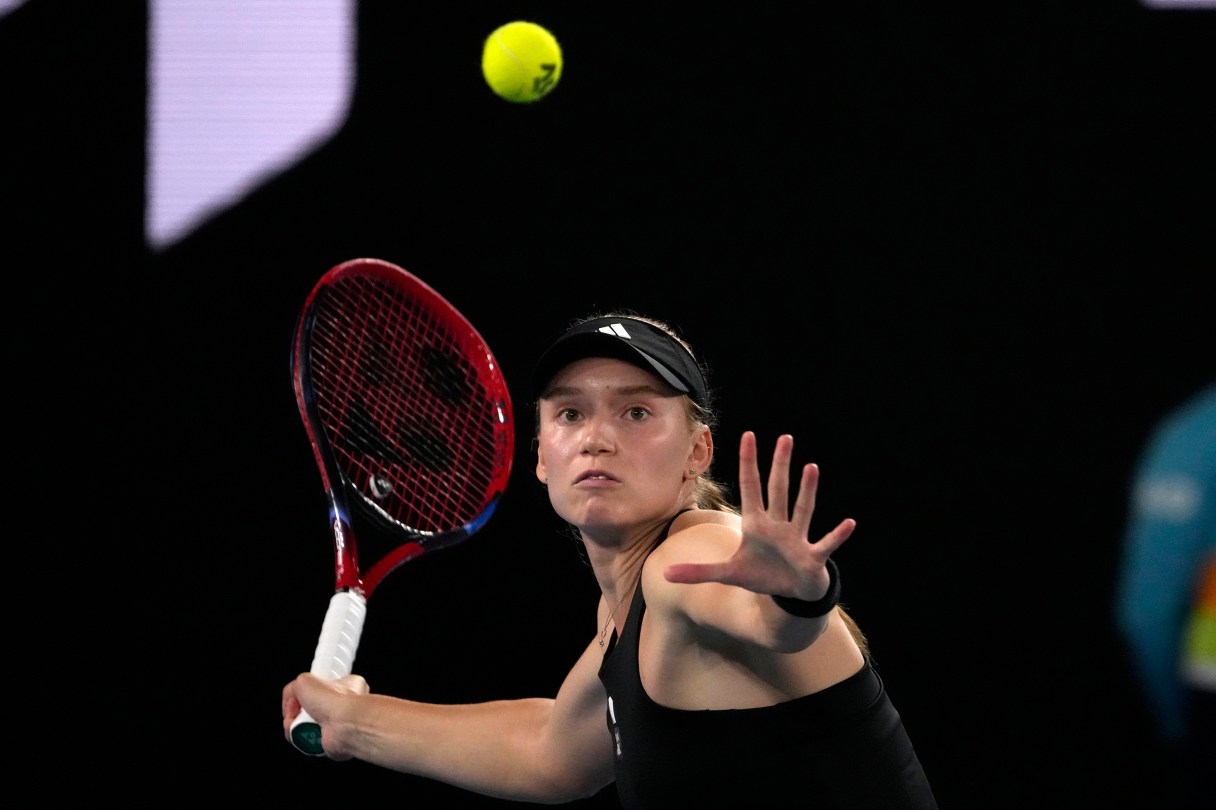
MELBOURNE, Australia — What all seemed so different — so daunting, even — to Elena Rybakina about trying to win a Grand Slam title a little more than six months ago is now coming rather naturally.
And if she can win one more match at this Australian Open, she will add a second major championship to the one she secured last summer at Wimbledon.
Rybakina, a 23-year-old who represents Kazakhstan, reached her second final in a span of three major tournaments by beating Victoria Azarenka 7-6 (4), 6-3 at Melbourne Park on Thursday, signaling a rapid rise toward the top of tennis.
“Everything was new at Wimbledon,” Rybakina said after hitting nine aces in the semifinal victory to raise her tournament-leading total to 44. “Now I more or less understand what to expect.”
That could come in handy Saturday, when she will face No. 5 seed Aryna Sabalenka of Belarus. Sabalenka reached her first Grand Slam title match at age 24 with a 7-6 (1), 6-2 win against unseeded Magda Linette of Poland in Thursday’s second semifinal.
Sabalenka improved to 10-0 in 2023, winning all 20 sets she has contested this season. More importantly, the victory over Linette gave Sabalenka her first taste of success in a Slam singles semi after going 0-3 at that stage until now, losing each previous attempt by a 6-4 score in the third set.
Rybakina and Sabalenka employ a somewhat similar brand of tennis, relying on big serves and big hitting at the baseline. Sabalenka is far less cautious, though, and her penchant for high-risk, high-reward play was evident against the 30-year-old Linette, who had never before been past the third round of a singles bracket in 29 appearances at majors.
Sabalenka finished with a whopping 33-9 edge in winners, but she also compiled more unforced errors — including a trio that led to a break at love by Linette in the opening game.
The key to both semifinals turned out to be a first-set tiebreaker. Azarenka lost the mark on her strokes, for the most part, making things smoother for Rybakina, while Sabalenka raced to a 6-0 lead in hers. It wasn’t the case that each and every shot Sabalenka hit landed right on a line, but it must have seemed that way to Linette.
“In the tiebreaker, I really found my rhythm,” said Sabalenka, who owns major doubles championships with Elise Mertens from the 2019 U.S. Open and the 2021 Australian Open. “Started trusting myself. Started going for my shots.”
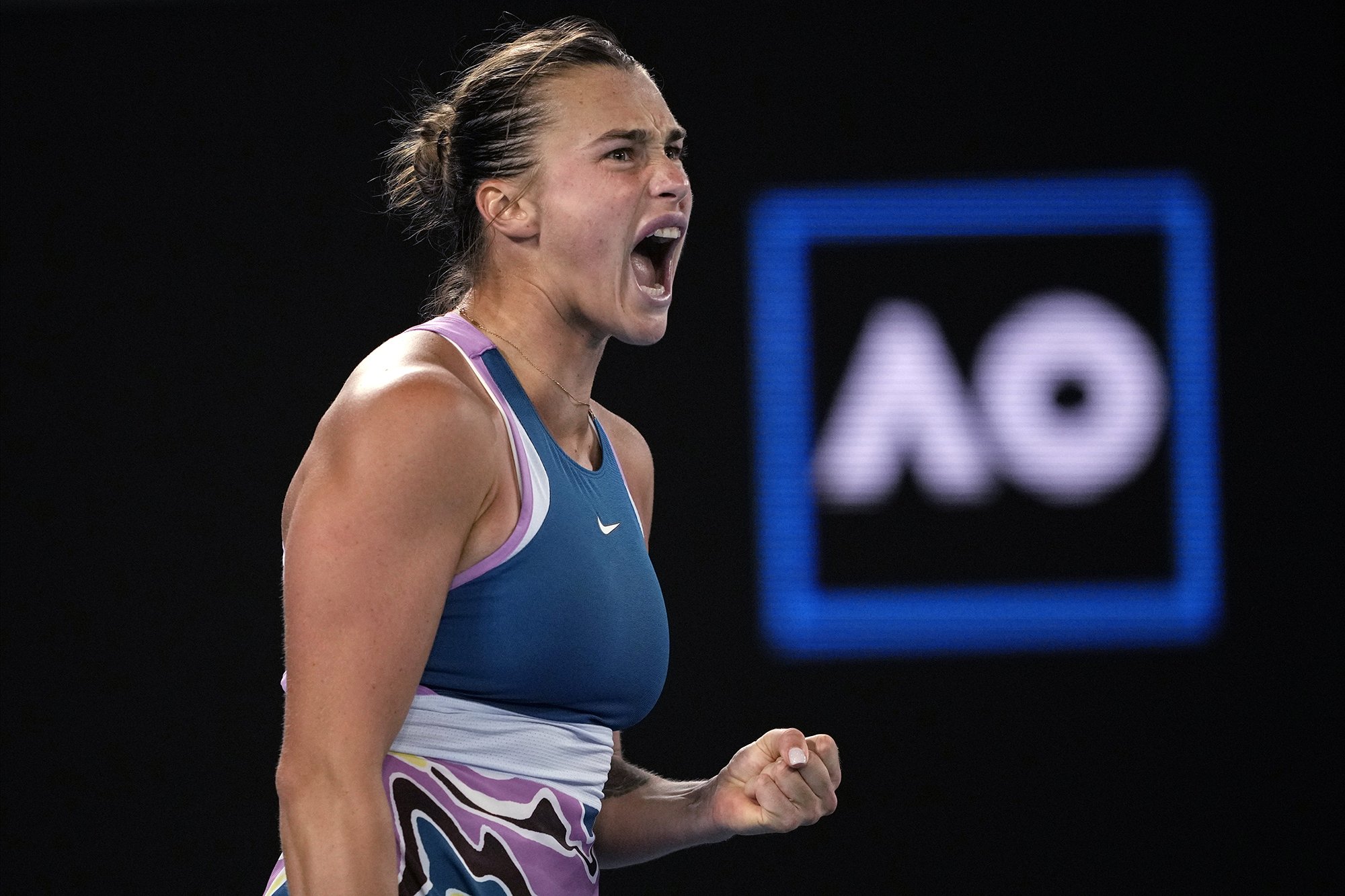 AP photo by Aaron Favila / Aryna Sabalenka celebrates winning a point against Magda Linette during their semifinal Thursday at the Australian Open. Sabalenka won 7-6 (1), 6-2 to reach a Grand Slam singles final for the first time.
Rybakina’s win over Azarenka, the champion at Melbourne Park in 2012 and 2013, added to what already was an impressive run through a string of top opponents. She also beat No. 1 Iga Swiatek and No. 17 Jelena Ostapenko — both owners of major titles — and 2022 Australian Open runner-up Danielle Collins.
“For sure, they’re very experienced players,” said Rybakina, whose parents and sister have been in town throughout the Australian Open. “I knew that I have to focus on every point.”
She delivered serves at up to 117 mph and stinging groundstrokes she used to close points seemingly at will on Thursday. Her performance was particularly noteworthy against a returner and defender as established on hard courts as Azarenka, a former No. 1 in the WTA rankings and a three-time runner-up at the U.S. Open.
“Kind of hard to digest,” Azarenka said. “Obviously, I had quite a few chances that I gave myself.”
Rybakina is 10 years younger than Azarenka, and the future sure looks bright at the moment.
Rybakina might be seeded just 22nd in Melbourne and ranked just 25th, but those numbers are rather misleading and not indicative at all of her talent and form. She did not get the usual bump from her title last July at Wimbledon, where zero rankings points were awarded after the All England Club banned players from Russia and Belarus because of the invasion of Ukraine.
Rybakina was born in Moscow; she switched to Kazakhstan in 2018, when that country offered to fund her tennis career.
It was breezy and chilly at Rod Laver Arena from the start of the first semifinal, with the temperature dipping below 70 degrees Fahrenheit. That had a role in the way the first set was as much of a seesaw as can be, with each player seeming to gain the upper hand — and then ceding it just as quickly. Both found the conditions slowed down the tennis balls.
“Kind of misjudged a lot of balls,” Azarenka said.
Rybakina encountered similar challenges, and her occasional inconsistency was encapsulated by the very first game. She began, inauspiciously enough, with a double fault before holding with the help of three aces.
Azarenka nosed ahead by breaking for a 3-2 lead on a leaping, full-extension volley winner with both women at the net. Rybakina, though, broke right back, and then once more to go up 5-3. Azarenka saved a set point at 5-3 with a terrific forehand passing shot down the line, then wound up taking the game with a backhand she accented with a shout of “Let’s go!”
A mistake-filled tiebreaker ended with Azarenka pushing a forehand wide to cap an 11-shot exchange, and the set belonged to Rybakina. She broke at love for a 2-1 lead in the second, and while they competed for another 25 minutes, the outcome was never really much in doubt.
Sure, Rybakina again faltered for a bit while trying to serve out the victory at 5-2; no one expected Azarenka to go quietly. But one last break, aided by a double fault from Azarenka, allowed Rybakina to take another step toward another trophy.
“Ready,” she said, “to give everything I have left.”