
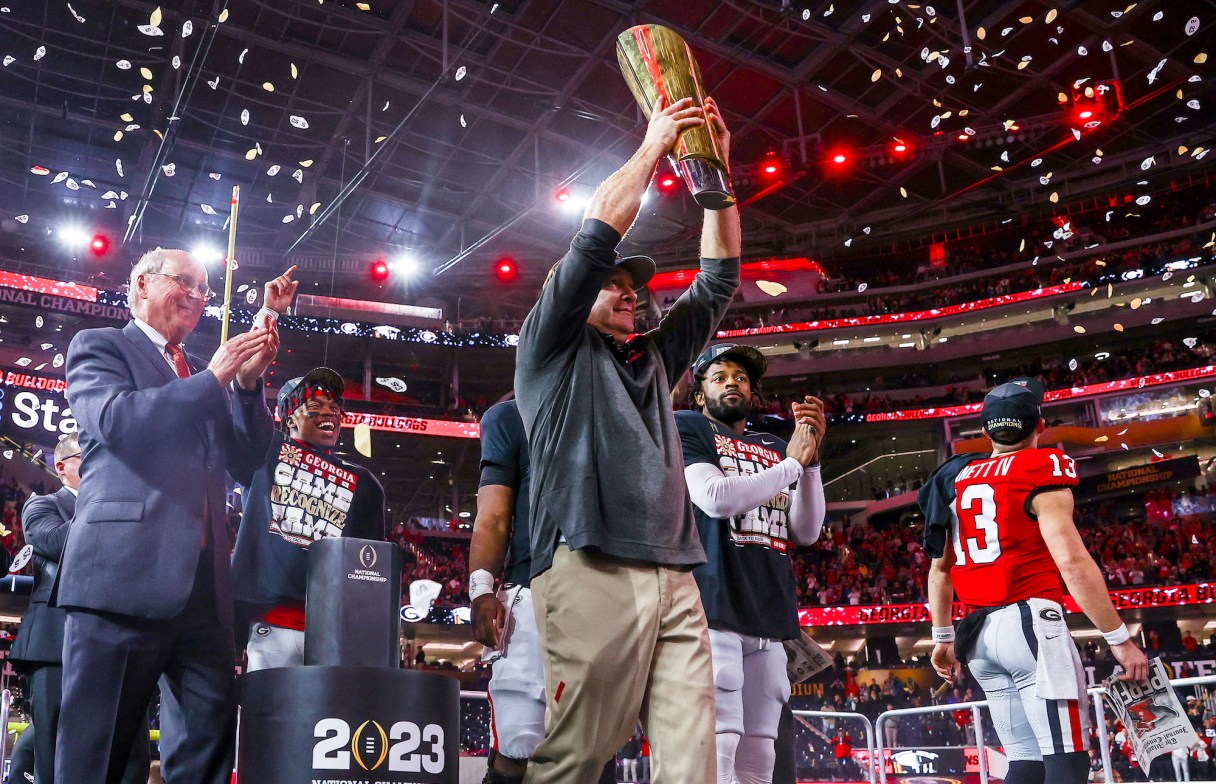

There is no debating that the landscape of college football is rapidly changing.
The big question is whether it is changing for the better.
One of my favorite faces to see at Southeastern Conference Media Days is Bill Hancock, the executive director of the College Football Playoff. Hancock has overseen the method for determining the national champion expand from two teams vying in the Bowl Championship Series title matchup to a four-team playoff to what will become a 12-team field beginning next season.
A 12-team playoff is as appealing to me as a rash I can’t reach, so my conversations with Hancock are always entertaining given that we are complete opposites on the subject. They usually begin with us agreeing that the BCS was both productive and a blast during its run from 1998 to 2013.
“We would not have the College Football Playoff if we hadn’t had the BCS beforehand,” Hancock said in Nashville. “The BCS, frankly, was the biggest change in the history of college football in terms of administration. We took the bowls together to give us the chance to have No. 1 and No. 2 meet in the championship game, which we only had before if we got lucky.
“The BCS was great for college football, but it eventually became time to move on.”
No system is perfect, including the BCS, but it sure worked out way more often than it didn’t, and this is from an Auburn graduate. In 2004, Auburn became the only undefeated Power Five team ever to get left out of a BCS title pairing.
Still, the inevitable decision was made to expand to four teams, beginning with the 2014 season.
“It was all about participation,” Hancock said. “When people ask why we’ve gone to 12, it’s about more participation and more schools getting a chance to compete in the tournament. People make fun of me when I call it a tournament, but it is a tournament.
“It’s a 12-team tournament with more opportunities for more players and more schools.”
Of course, if I wanted a 12-team tournament with some 8-4 and 9-3 teams, I would watch the NFL’s 14-team tournament that had three 9-8 teams and one 8-9 team this past season, but I kept that thought to myself. I do view and enjoy the NFL playoffs, just not to the same level of Alabama-LSU, Michigan-Ohio State and Florida-Florida State pairings, let alone the Egg Bowl or Iron Bowl.
When Hancock brought up more participation, I replied that many folks believe more money would be the more accurate reason.
“I was there for every step, and people won’t believe this, but the money never came up in all of the conversations about it,” Hancock said. “I’m sure everybody had it in the backs of their minds, ‘Oh, there is going to be more money,’ but it never came up. It was about how we could make this happen and how we could make college football more relevant in more parts of the country.
“I will be really disappointed if this doesn’t bring more fans into college football. We can do better in the Northeast. The research shows we can do better with Hispanics. We need to roll up our sleeves and make that happen.”
There is nothing wrong with trying to increase the visibility of your sport, but what about wearing down those who have been there all along? Remember what NASCAR has been through?
Hancock admitted that scheduling the 12-team field will be the biggest challenge moving forward given that it will require four stages — first round, quarterfinals, semifinals and the championship game — and that it must take place around the behemoth known as the NFL.
That will result in significant midweek travel and significant cash spent for the fan bases whose teams keep advancing.
“We do have to work around the NFL schedule, because they have the weekends,” Hancock said. “Our semifinal games will be on Thursday and Friday in that January 8-10 range, and those are games people are going to have to think about and say, ‘I’ve got to be there. I’ve got to figure it out.’
“We are looking at that cost. There were people who, for that reason, thought we should play more games on campus, but we decided to keep them in bowl games. We’ll see how it works, and I think we’ll be fine. People are going to want to watch their teams play.”
My biggest concern with college football’s future is this ongoing realignment that has resulted in the Big Ten and SEC becoming 16-team super conferences — until they expand again — and how the SEC is seriously considering remaining at eight league games. That would eliminate showdowns such as Alabama-Tennessee, Auburn-Georgia and LSU-Ole Miss from taking place on an annual basis.
You know, the rivalries that truly helped make the SEC what it is today.
When the SEC announced it would remain at eight league games for the 2024 season once Oklahoma and Texas joined, conference commissioner Greg Sankey cited one of the reasons as “providing additional time to understand the impact of an expanded College Football Playoff.”
That college football is now being dictated to a decent degree by the College Football Playoff makes me sad, and the fact there could be two Bears-Lions games per NFL season and not one Alabama-Tennessee showdown or one Georgia-Tennessee contest in certain years makes me downright nauseous.
Of course, the best rivalry of my childhood, Nebraska-Oklahoma, has taken place a whopping twice in the past dozen years.
“I don’t necessarily disagree with you,” Hancock said, “but conference realignment has been happening forever, and we should not be surprised that it continues to happen. I guess we could be surprised about USC and UCLA going to the Big Ten, because geographically that feels so unusual, but it’s been going on for forever.
“If it’s happened forever, that probably means it’s going to continue to happen. In some of these cases, it was the conference expanding, but in most of them, it was a school looking for a little greener pasture.”
Naturally, I’ve already got my first question ready for Hancock next year.
Who gets the Pac-12’s automatic bid in a 12-team playoff if there is no Pac-12?
Contact David Paschall at dpaschall@timesfreepress.com.