
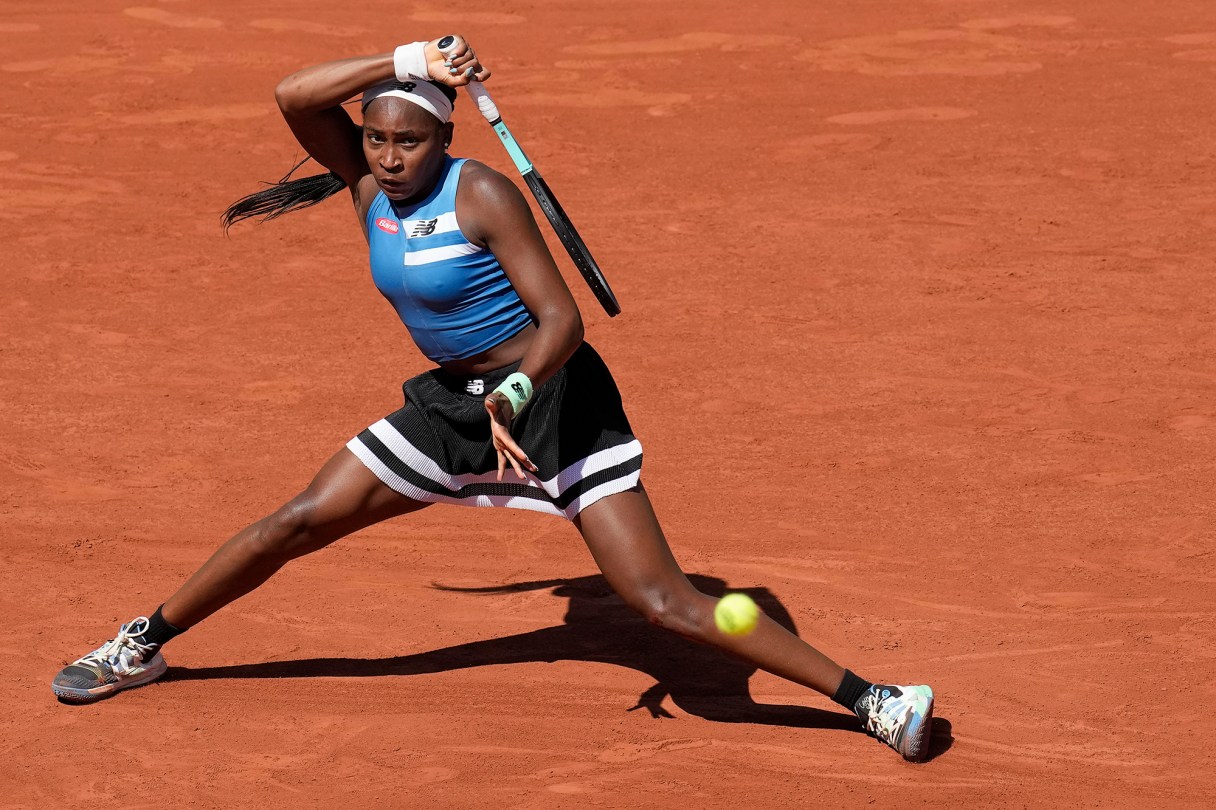
PARIS — Not all that long ago, Coco Gauff was always the kid on the tennis court, the unknown underdog, younger and less experienced than every opponent she faced on a big stage.
Now, still just 19, Gauff is well-versed in the ins and outs of the WTA Tour, already a Grand Slam runner-up in singles and doubles, and seeded No. 6 at this French Open.
On Saturday at Roland Garros, the young American was the veteran in Court Suzanne Lenglen under the cloudless sky, the one with the steady hand and steady head, in an all-teen showdown against Mirra Andreeva, a 16-year-old qualifier from Russia who is ranked 143rd, the French Open her debut at a major tournament.
After a first set that was as tight as can be, with Gauff two points from winning it before eventually ceding, she grew her game and proved to be the better player. She pulled away to reach the fourth round in Paris with a 6-7 (5), 6-1, 6-1 victory over Andreeva, who was warned by the chair umpire for unsportsmanlike conduct after smacking a ball into the stands.
Gauff, who lost to Iga Swiatek in last year’s French Open final, might see a bit of herself in Andreeva.
She knows what it’s like to be the newcomer no one has scouting reports on. What it’s like to hear plenty of discussion about her youth. To feel the freedom of performing without the burden of expectations. Gauff was just 14, after all, when she became the youngest qualifier in Wimbledon history, then beat multiple-major winner Venus Williams along the way to the fourth round at the All England Club in 2019.
So by now, Gauff is a bit tired of that whole subject — which she explained in a good-natured manner Saturday.
“People love to say, ‘You’re only this, you’re only that.’ When I’m on the court, we’re not thinking about our age. I don’t think she was thinking, ‘Oh, I’m only 16 and she’s 19, she’s older.’ If she was thinking that, she wouldn’t win a match, because she beat people older than me. And at my age, I wasn’t thinking about that,” Gauff said. “I was just thinking about playing the ball.
“Age is important to mention sometimes, but as a player and going through it, yes, it gets a little bit annoying. … I don’t need to be praised because of my age or anything. I prefer just to be praised because of my game.”
Her talent is undeniable, especially when it comes to her serve and backhand, as is her maturity. Against Andreeva, she never let the rough way the first set ended carry over. Indeed, it was Andreeva who sent a ball into the crowd late in the tiebreaker — she was contrite afterward, acknowledging it was a “stupid move” and “really bad” — then bounced her racket off the court early in the second set.
Most of all, Gauff remained patient. After 19 unforced errors in the first set, she made just seven the rest of the way.
“I didn’t feel like she was lacking experience,” Gauff said about Andreeva. “She plays beyond her years.”
They practiced together in Paris and could have many more encounters that count down the road.
Some day, perhaps soon, Andreeva will earn kudos because of her game, not just her age, but forgive one more mention related to that subject: She is the youngest player since 2005 to win a match in the women’s main draw at the French Open.
Asked what might be to come, Andreeva replied: “I’m just Mirra, who loves to play. … I hope I will stay the same person in the future. But the future is the future, so I cannot know what will happen.”
Gauff is one of three women from the United States remaining in singles, along with Bernarda Pera and Sloane Stephens. And while there were 16 Americans in men’s singles when the tourney opened last Sunday, none remain after unseeded Marcos Giron, No. 9 Taylor Fritz and No. 12 Frances Tiafoe all lost Saturday.
For Gauff, a possible quarterfinal looms next week against No. 1 Swiatek, who beat Wang Xinyu 6-0, 6-0 in 51 minutes on Saturday. Swiatek has won all six sets she has played so far in Paris, four of them 6-0.
“I always try to kind of be careful, because you don’t want to get lazy after winning these matches,” said Swiatek, bidding for a third French Open title and fourth major championship overall. “But on the other hand, sometimes all your head can remember is the score, and I always want to kind of be ready for every situation.”
She now faces Lesia Tsurenko, who overwhelmed 2019 U.S. Open champion Bianca Andreescu 6-1, 6-1. Gauff gets Anna Karolina Schmiedlova, a 6-1, 6-3 winner against American qualifier Kayla Day. Other fourth-rounders: No. 14 Beatriz Haddad Maria against Sara Sorribes Tormo, who moved on when Wimbledon champion Elena Rybakina withdrew because of illness; and Pera against No. 7 Ons Jabeur.
In men’s action, No. 22 Alexander Zverev eliminated Tiafoe 3-6, 7-6 (3), 6-1, 7-6 (5) and next meets No. 28 Grigor Dimitrov. Other men’s fourth-rounders: No. 4 Casper Ruud — last year’s runner-up to Rafael Nadal, who’s not playing this year due to injury — against Nicolas Jarry, No. 6 Holger Rune against No. 23 Francisco Cerundolo, and No. 27 Yoshihito Nishioka against Tomas Martin Etcheverry.
“Last year, I could sort of just do my work in the shadow,” said Ruud, who had never made it to a Grand Slam quarterfinal until his run at the 2022 French Open, which was followed by a run to the U.S. Open final, too. “This year, it’s a little more eyes on me. … I feel the pressure a bit different.”