
Tuesday, November 17, 2026Nov 17

Supreme Court rules in favor of Black voters in Alabama redistricting case

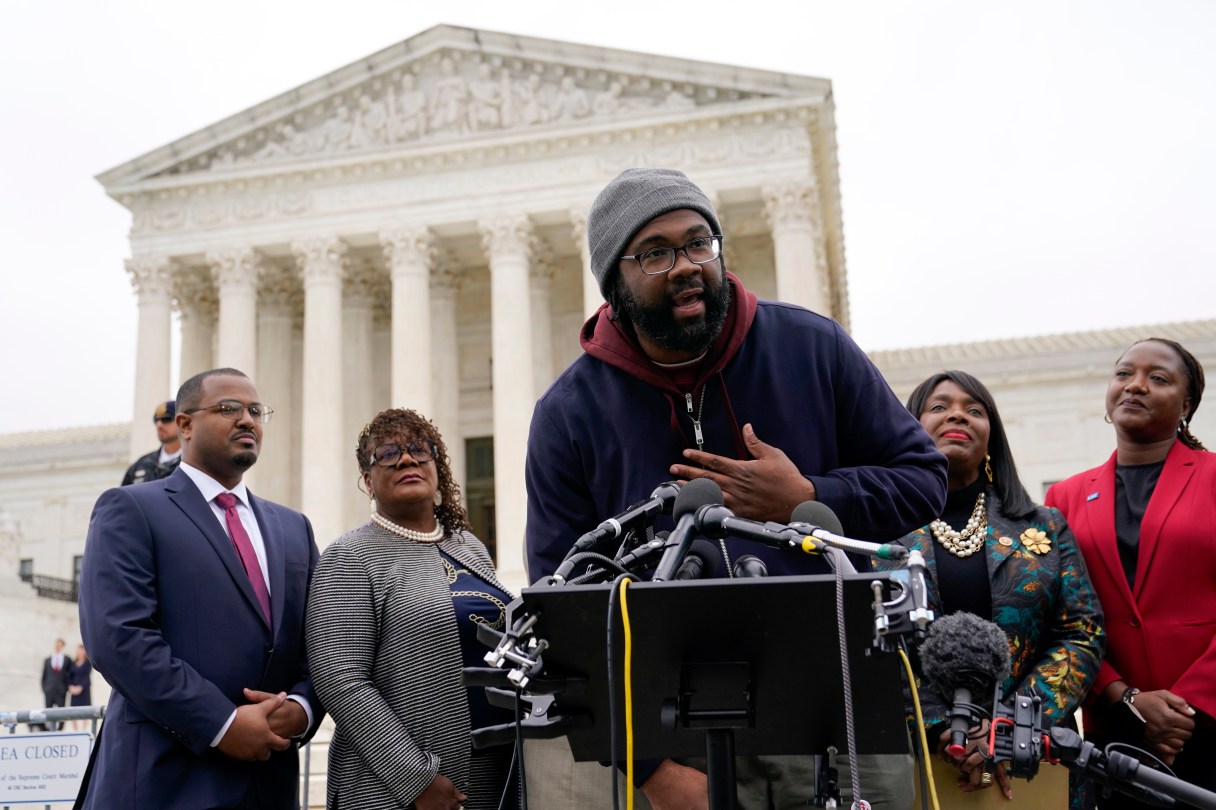
FILE - Evan Milligan, center, plaintiff in Merrill v. Milligan, an Alabama redistricting case, speaks with members of the press following oral arguments outside the Supreme Court on Capitol Hill in Washington, Oct. 4, 2022. Standing behind Milligan are Milligan's counsel Deuel Ross, from left, Letetia Jackson, Rep. Terri Sewell, D-Ala., and Janai Nelson, President and Director-Counsel of the NAACP Legal Defense Fund. The Supreme Court on Thursday, June 8, 2023, issued a surprising ruling in favor of Black voters in a congressional redistricting case, ordering the creation of a second district with a large Black population. (AP Photo/Patrick Semansky, File)


WASHINGTON (AP) — The Supreme Court on Thursday issued a surprising 5-4 ruling in favor of Black voters in a congressional redistricting case, ordering the creation of a second district with a large Black population.

Chief Justice John Roberts and Justice Brett Kavanaugh joined with the court’s liberals in affirming a lower-court ruling that found a likely violation of the Voting Rights Act in an Alabama congressional map with one majority Black seat out of seven congressional districts in a state where more than one in four residents is Black.

The case had been closely watched for its potential to weaken the landmark voting rights law.

The court had allowed the challenged map to be used for the 2022 elections and at arguments in October, the justices appeared willing to make it harder to use the voting rights law to challenge redistricting plans as racially discriminatory.