
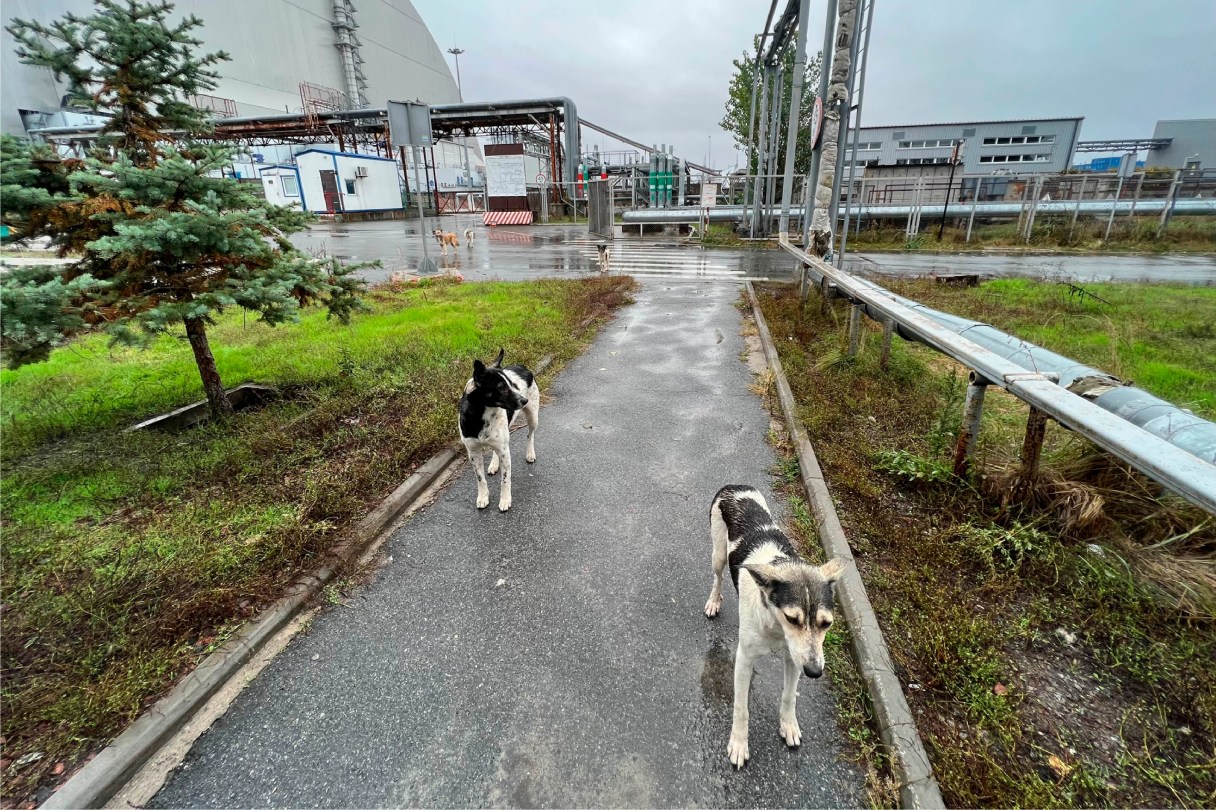
More than 35 years after the world’s worst nuclear accident, the dogs of Chernobyl roam among decaying, abandoned buildings in and around the closed plant – somehow still able to find food, breed and survive.
Scientists hope that studying these dogs can teach humans new tricks about how to live in the harshest, most degraded environments, too.
They published the first of what they hope will be many genetics studies on Friday in the journal Science Advances, focusing on 302 free-roaming dogs living in an officially designated “exclusion zone” around the disaster site. They identified populations whose differing levels of radiation exposure may have made them genetically distinct from one another and other dogs worldwide.
“We’ve had this golden opportunity” to lay the groundwork for answering a crucial question: “How do you survive in a hostile environment like this for 15 generations?” said geneticist Elaine Ostrander of the National Human Genome Research Institute, one of the study’s many authors.
Fellow author Tim Mousseau, professor of biological sciences at the University of South Carolina, said the dogs “provide an incredible tool to look at the impacts of this kind of a setting” on mammals overall.