
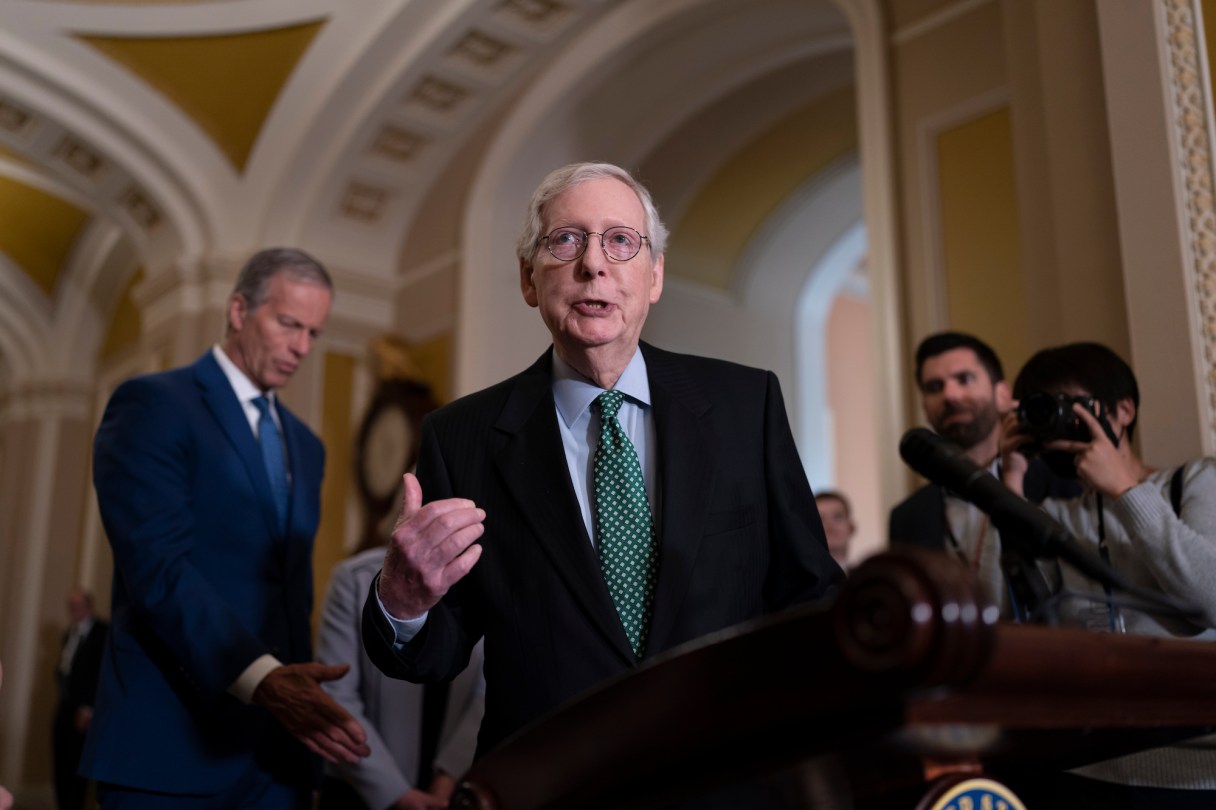
America is hurtling toward a historic and potentially cataclysmic default — and its best hope for avoiding it may be one of the least popular men in Washington: Senate Minority Leader Mitch McConnell.
Don’t mistake passage of a plan to raise the debt ceiling for progress. The bill, passed by the Republican-controlled House of Representatives on a party-line vote, is dead on arrival in the Democratic-controlled Senate, and as of this writing there are no serious negotiations among any of the relevant players. Among the Senate staffers I’ve spoken to, the prevailing view is that nobody is going to move unless Wall Street starts panicking. Financial markets, meanwhile, have seen this story before, and seem confident it will get resolved one way or another so there’s no need to panic.
Enter Mitch McConnell. But first, it’s necessary to understand how House Speaker Kevin McCarthy got the country to this impasse.
The House bill was mainly a way for the speaker to solve a problem in his caucus. He’s spent months calling on the White House to negotiate with him on a package of spending cuts paired with a debt limit increase. President Joe Biden’s position, understandably, has been that he deserves the kind of “clean” debt ceiling increases that his predecessor got on multiple occasions. And from a practical standpoint, it just wasn’t possible to negotiate with House Republicans — especially since McCarthy had no stated bargaining position and hadn’t shown the ability to muster the votes for any deal he did assemble.
Thus began his quest to assemble a package that could pass the House.
Failure to pass the bill would have been humiliating for McCarthy. But it also would have left him no choice but to allow a vote on something that would win the support of most Democrats and a handful of Republicans. That would have been either a debt ceiling increase paired with modest discretionary spending cuts, or a suspension of the debt ceiling for long enough to get through the annual appropriations cycle. Allowing a vote on a bill opposed by most Republicans would have left McCarthy vulnerable to an intraparty coup. But it would have left the country in a far better position.
This leads to the big important question: Is McCarthy prepared to jeopardize his speakership and split his caucus by advancing a realistic bill?
Let me answer the question this way: The idea that the U.S. is going to embark on a huge rightward shift in policy with a Democratic White House, a Democratic Senate and a five-seat Republican House majority is fantasy, both politically and mathematically. Republicans took the House in the midterms, so they’re entitled to claim a pound of flesh. But McCarthy is asking to devour the entire body politic.
The man to broker a deal is the Senate minority leader. Because of the filibuster, the Senate is already more amenable to negotiating than the House; the existing discretionary appropriations bills all had to pass with some bipartisan support. These bills tilted toward Democratic priorities because Democrats control the Senate, but Republicans did have some input. With the GOP running the House, Republican dealmakers in the Senate can claw back some of what they’ve given away in the past two years and put forward bills that trim discretionary spending without fundamentally transforming anything. A bipartisan Senate deal — a deal that, like earlier Biden-era spending deals, is passed mostly with Democratic votes — would then set the stage for the House to pass a bill with a similar configuration of votes.
So far, McConnell is demurring and saying that Biden and McCarthy need to work this out themselves. A speaker who’s hostage to the furthest-right members of his caucus isn’t going to be able to get a deal done. The Senate minority leader has a more reasonable conference, and he has the experience and savvy to negotiate with the president. Mitch McConnell, a nation turns its debt-laden eyes to you.
Bloomberg