
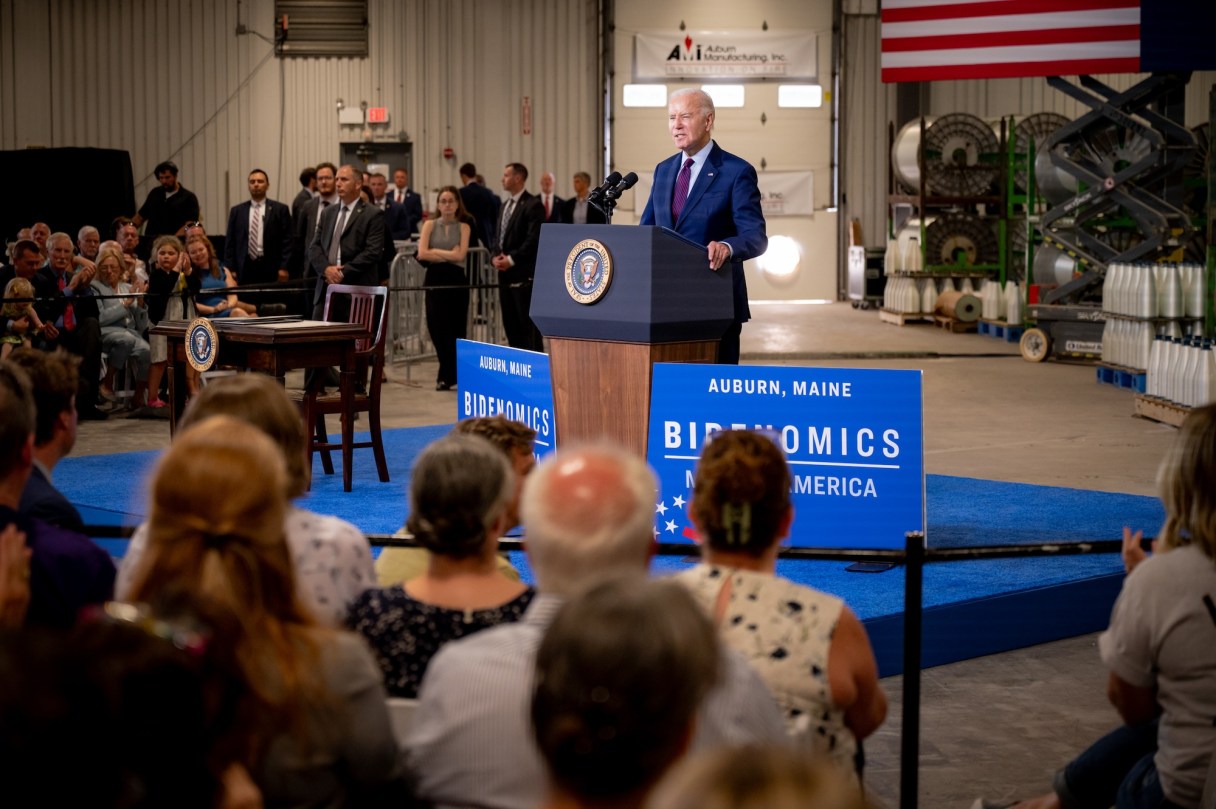
President Joe Biden has been traveling the U.S. touting a manufacturing revival that he no doubt hopes will help his chances for re-election. Unfortunately, there is much less substance to this “Biden Boom” than the White House would have Americans believe. Even under the rosiest of projections, the administration’s signature programs will do little to increase manufacturing employment — and even less to uplift the overall economy.
Construction spending on manufacturing facilities more than doubled from an annualized rate of $81 billion this time last year to an all-time high of nearly $200 billion in August. Some of that increase can be attributed to the incentives provided by the Inflation Reduction Act and the CHIPS Act, both championed by the president.
But there are more relevant factors. Shortages caused by COVID, backlogs at major ports in 2021 and a three-year-long (and continuing) surge in retail sales created a compelling case for reshoring production even without those incentives. Spending on consumer goods is 30% higher now than when the pandemic started, and global supply chains have yet to fully recover. So a near-term expansion in domestic manufacturing was all but inevitable.
Another reason the recent run-up in manufacturing investment is not as impressive as it might seem: When adjusted for inflation, the figures are overshadowed by a decline in investment in the rest of the economy.
The U.S. Bureau of Economic Analysis estimates that inflation-adjusted investment in manufacturing facilities was a more modest $125 billion (annualized) in the second quarter. Outside of manufacturing, investment in non-residential structures was $480 billion last quarter, down $90 billion from its peak in the third quarter of 2019 (again, figures are annualized).