
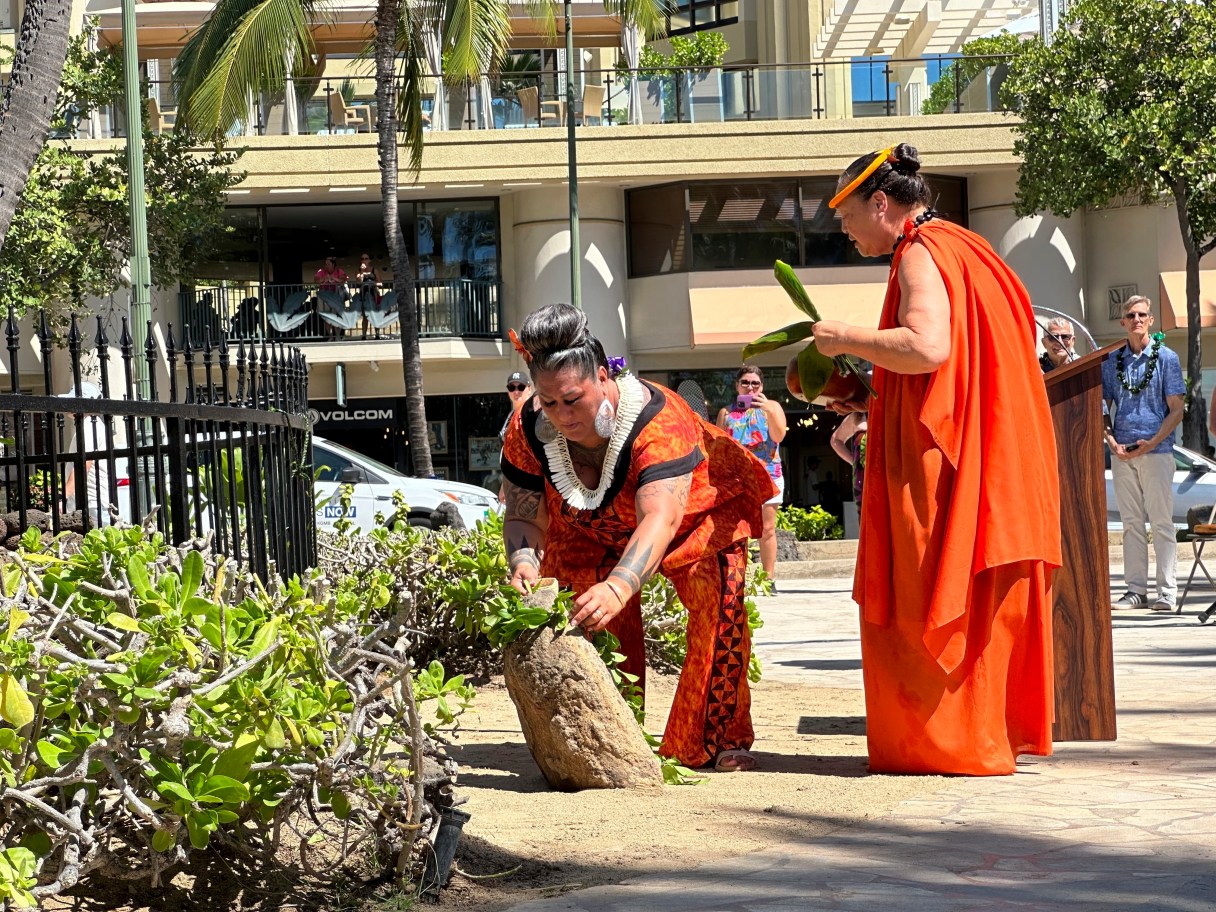
HONOLULU (AP) — Honolulu officials on Tuesday introduced a new interpretive plaque for four large boulders in the center of Waikiki that honor Tahitian healers of dual male and female spirit who visited Oahu some 500 years ago.
The centuries-old boulders — one for each of the four visiting healers — are protected by an iron fence in a beachside park surrounded by hotels and shops in the heart of the world-renowned tourist district. The monument is known as the stones of Kapaemahu, after the group’s leader.
According to stories handed down orally, the boulders were placed on Waikiki’s shore at the time of the healers’ visit. But the stones became neglected more recently. In 1941, a bowling alley was even built over them and remained there for two decades.
The earlier plaque dates to 1997. It doesn’t acknowledge the healers were “mahu,” which in Hawaiian language and culture refers to someone with dual male and female spirit and a mixture of gender traits.
Scholars blame that omission on the homophobia and transphobia pervasive in Hawaii after the introduction of Christianity. Missionaries pushed aside gender fluidity’s deep roots in Hawaiian culture and taught believers to suppress anything that deviated from clearly defined male and female gender roles and presentations.