
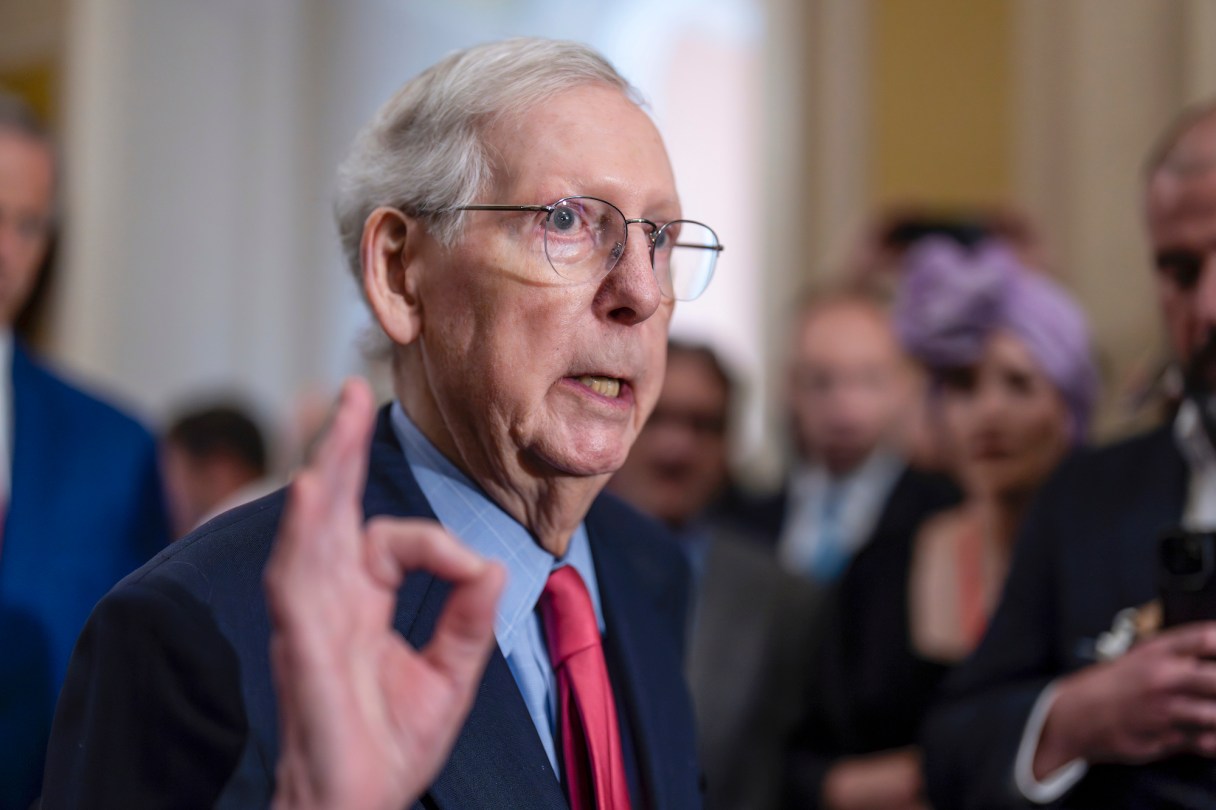
The concerning episode of the U.S. Senate Minority Leader Mitch McConnell freezing up while addressing the media on Aug. 30 has put the spotlight yet again on age in American politics.
This is the second time that the 81-year-old senator from Kentucky had frozen in public, raising questions about his health.
After the incident, the Capitol’s attending physician, Brian Monahan, said in a letter that there is no evidence McConnell had a seizure disorder — or that he experienced a stroke or a movement disorder such as Parkinson’s disease.
Unfortunately, McConnell is not the only U.S. official to have their performance called into question because of their age.
President Joe Biden, 81, had a fall scare back in June. Now his age has people concerned about whether he can complete his duties as president.
The health of 90-year-old U.S. Sen. Dianne Feinstein, D-Calif., also is under scrutiny.
Biden, Feinstein and McConnell’s age and health have raised — again — the question of term limits or even age limits.
While all signs would point to yes to term or age limits, let’s remember where the people’s power lies.
Young adults must step up
Millennials and Gen Zers seem to be having their fun with making light of McConnell’s incident, using it to point out an electoral system that allows past-their-prime politicians to hold onto power. If you ask these younger voters, they’re ready for a change by way of younger candidates.
According to a Pew Research survey published this year, about 48% of adults under the age of 30 say it is ideal for a president to be in their 30s or 40s. Only 6% of adults over the age of 50 share this view. Around half of Americans say they prefer someone in their 50s, the survey said.
With Tennessee state representatives such as Justin Jones and Justin Pearson, both 28, we would think younger voters are who elected them to the statehouse. Statistics say otherwise. In the 2022 election cycle, Tennessee had the lowest voter turnout in the country among young adults at 13%, according to the Center for Information & Research on Civic Learning and Engagement. So even when young adults get their candidates, they still don’t quite show up. That has to change fast for Democrats to compete successfully with the right.
This might be an over-simplification, but voters support candidates with whom they align, both in values and in some cases, age.
For instance, more Pew statistics from the 2022 midterms show 35% of Americans over the age of 69 voted for Republicans. Seven out 10 young adults voted Democrat.
Trends show that younger people are leaning more blue, but that’s when they actually show up to vote.
Consistency is key when you want to change the makeup of Tennessee’s and nation’s political map.
Voting is how change begins
Term and age limits are not a bad idea, but it’s not going to fix everything we despise about political greed. We need people engaged.
The outrage about how old a politician is, on top of a push for age and term limits originates from a desire to want change in our elected leaders and the direction of our state and country. It might be a tough pill to swallow but age restrictions won’t help progressives win elections. Winning will take more young people having the courage to run and then persuading voters to actually make it to the polls.
This conversation about age and capability is a distraction from what matters most: results.
The truth of the matter is it’s not about how old you are, but what you can get done. America needs leaders, across the age spectrum, to help communities thrive. Did young progressives forget when they supported then-75-year-old Bernie Sanders in the 2016 election cycle and then again in 2020?
For the progressive movement to survive, specifically, voter turnout has to be better. Age and term limits could go into effect today but that wouldn’t mean anything if people are not willing to go to the polls and vote for younger candidates.
McConnell, Biden and Feinstein will ultimately make their own decisions to step aside or not seek re-election. Whatever the outcome, the power still lies with the people.
Age and term limits aside, we still have to vote.