
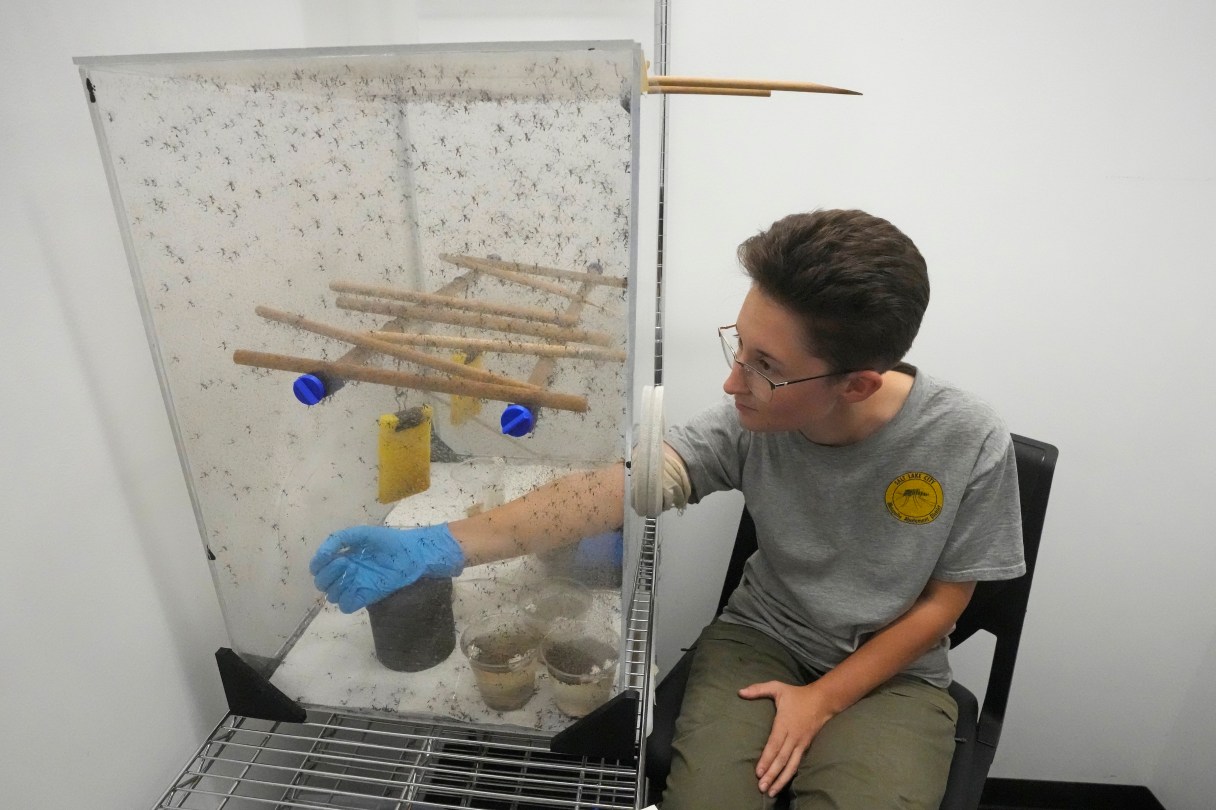
SALT LAKE CITY (AP) — It’s lunchtime at the Salt Lake City Mosquito Abatement District and a colony of sabethes cyaneus — also known as the paddle-legged beauty for its feathery appendages and iridescent coloring — find their way to Ella Branham.
“They’re not very aggressive and they’re kind of picky eaters,” said Branham, a technician, as she exhaled into a glass tank to attract the insects to the carbon dioxide in her breath. “So I’ll be feeding them with my arm.”
Branham had volunteered to let the South American mosquitoes feed on her blood so they can produce eggs and maintain the colony for education and research at the lab in the Salt Lake City district. It’s one of the many mosquito control districts around the United States that seek to hold in check one of the world’s deadliest animals — one well-positioned to thrive as climate change fosters a warmer and wetter environment.
Mosquitoes can carry viruses including dengue, yellow fever, chikungunya and Zika. They are especially threatening to public health in Asia and Africa but are also closely monitored in the United States. Local agencies reported more than 1,100 cases of West Nile virus in 2022, according to the U.S. Centers for Disease Control.
Most humans who contract West Nile show no symptoms. But for some, it can cause vomiting, fever and in rare cases seizures or meningitis. Over roughly the last 25 years, nearly 3,000 deaths and more than 25,000 hospitalizations linked to West Nile were reported throughout the United States — most of them in August.