
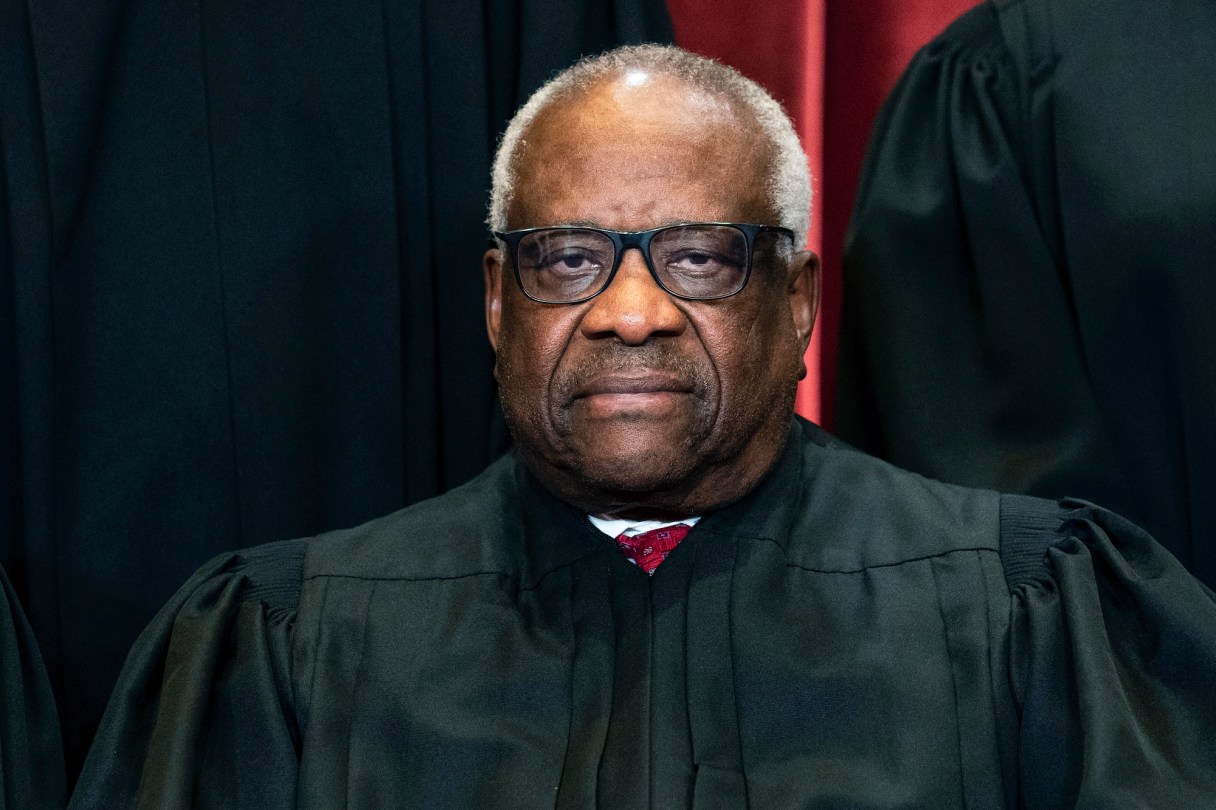
It is hard to think of a comparison point for the corrupt behavior of Justice Clarence Thomas.
We have had partisan justices; we have had ideological justices; we have had justices who favored, for venal reasons, one interest over another. But it is difficult to think of another justice, in the history of the Supreme Court, who has been as partisan and as ideological and as venal as Thomas, to say nothing of the fact that significant parts of his life have been subsidized by the largesse of some of the wealthiest men in the country.
Most recently, for example, Thomas was found to have attended a 2018 gathering of conservative donors convened by Stand Together, a political organization founded by billionaires Charles and David Koch, part of what has come to be known as the Koch network. Thomas arrived at the event by private jet — paid for by an unknown benefactor — in an appearance that was arranged with the help of Leonard Leo, then the vice president of the Federalist Society. “The justice was brought in to speak,” ProPublica reports, “in the hopes that such access would encourage donors to continue giving.”
A spokesperson for the Koch network denied to ProPublica that Thomas was “present for fundraising conversations.” But by any imaginable standard a just society would set for an ostensibly impartial judge, Thomas’ presence was unacceptable.
The question, as always with these revelations, is “So what?” The justices of the Supreme Court are not bound by an ethics code other than the one they say they have voluntarily adopted, and there is no legal sanction for misconduct. And Thomas has also made it clear, over the course of his career on the court, that there is essentially nothing his opponents could do that would pressure him off the bench.
The only official recourse is impeachment, which would be a nonstarter even if there weren’t a Republican-led House of Representatives. There has not been an impeachment of a Supreme Court justice since a failed attempt by the Jeffersonian Republican-controlled Congress to remove Samuel Chase in 1804 (incidentally, on a charge of excessive partisanship). And as Thomas Jefferson — who was involved in the case against Chase — observed in multiple letters reflecting on the problem of the court’s power, impeachment was “an impracticable thing, a mere scarecrow” and a “bugbear” that the justices “fear not at all.” They consider themselves “secure for life,” Jefferson wrote, and they “skulk from responsibility to public opinion.”
Jefferson was right about the nullity of impeachment as it relates to the Supreme Court. At the same time, the process can still serve an important political role. There might still be something to gain, in other words, from calling for and pursuing impeachment even if it fails.
The Chase example is instructive here. While Jefferson’s Republican Party failed to remove Chase, a Federalist, from the bench, it limited judicial participation in partisan politics.
In the absence of a Democratic majority in the House, there’s little chance that congressional critics of Thomas could initiate the impeachment process. Still, a steady demand that he either resign or be impeached might pressure him to respond — forcing him to do the minimum and explain his actions to the public. And if stories of misconduct continue to mount, then a call for impeachment could even begin to shift his conduct. If nothing else, a regular focus on his corrupt behavior through the lens of congressional action would remind the public that Congress does, in fact, have the power to sanction individual justices.
It is important to note, here, that impeachment is not a legal remedy. It is political — a way to address serious wrongdoing that nonetheless falls outside the scope of the law.
There are, admittedly, complications in this account. Impeachment cannot be so political as to become little more than a tool for partisan revenge. (See the House Republican effort to impeach President Joe Biden over a whole host of nothing.) This means that impeachable conduct must meet some standard that lies between illegality and ordinary partisan disagreement. That this line is difficult to discern in practice is perhaps one reason the impeachment power, as it relates to the Supreme Court, is essentially vestigial.
Even in light of this conceptual problem, however, Thomas’ behavior is, to my mind, clearly impeachable under the standard the Constitution sets. His opponents, which is to say Democrats and their supporters, should say so, loud and clear.
As it stands, though, most congressional Democrats have restricted themselves to making calls for an ethics code. Thomas and Justice Samuel Alito “have made it clear that they’re oblivious to the embarrassment they’ve visited on the highest court in the land,” Sen. Dick Durbin of Illinois, chair of the Senate Judiciary Committee, said this year. He added that it’s up to Chief Justice John Roberts “and the other justices to act on ethics reform to save their own reputations and the court’s integrity.”
This is all well and good. But if Democrats truly want to establish the severity of Thomas’ misconduct, if they want to raise the issue in the minds of Democratic voters, if not the public as a whole, then they should not be afraid to put impeachment on the table.