
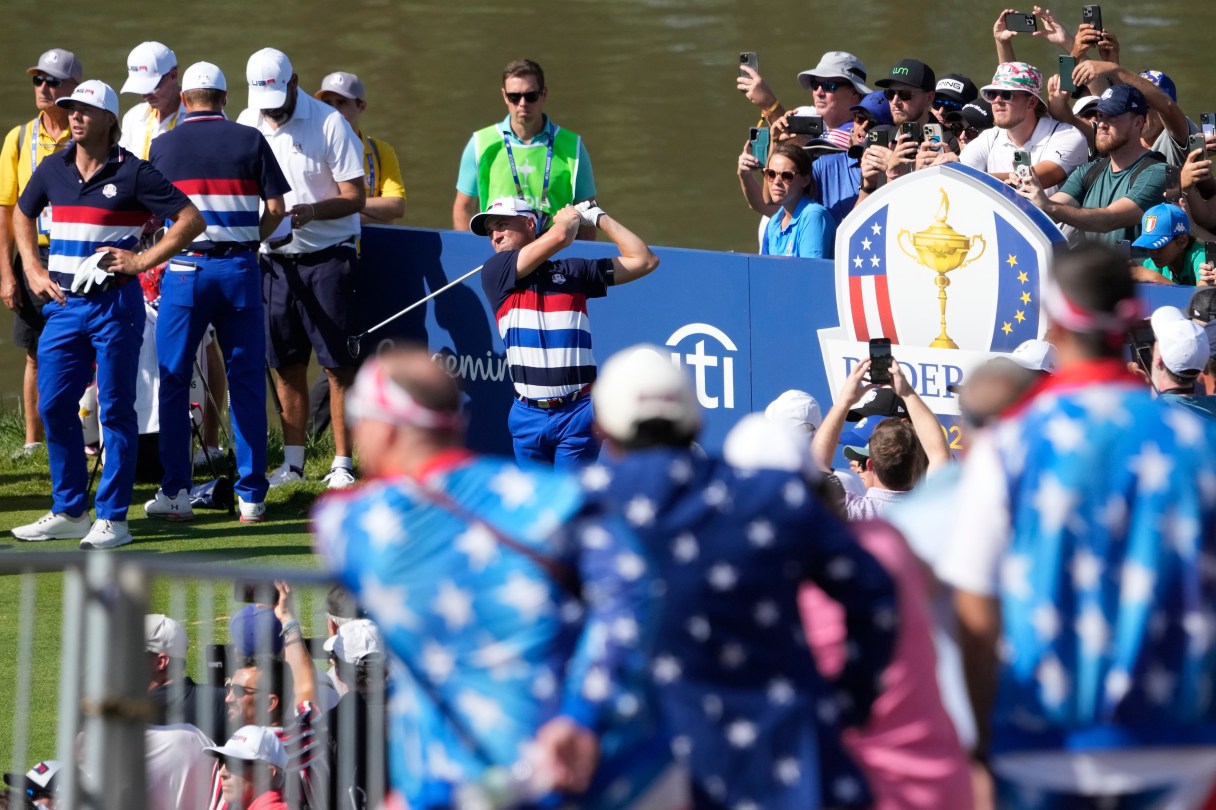
The Americans never felt more confident. The Europeans rarely felt so annoyed.
A two-year wait can seem even longer when it comes to the pride and passion only the Ryder Cup can deliver in golf, and shortly after the completion of the most recent edition of the biennial matches pitting Europe against the United States, both sides were eager for the next opportunity — but for different reasons.
It was late September 2021, and the U.S. was fresh off its most lopsided victory over Europe, 19-9 at Whistling Straits along the shore of Lake Michigan. The Americans had reason not only to celebrate regaining the Ryder Cup trophy itself but reason to believe they would turn the series back in their favor with such a young, powerful squad. Jordan Spieth already was looking ahead as he celebrated that autumn evening in Wisconsin.
“If we play like we did this week, the score will look the same over there,” he said, “over there” being in Italy in 2023.
England’s Tommy Fleetwood recalled how much it burned to see the Americans celebrate, speaking as if he could still smell the smoke from Xander Schauffele’s victory cigar mixed with the spray of champagne.
“All of us stood there and thought, ‘We want to get our chance back,'” Fleetwood said. “The flight on the way home, we were all a little tender and hungover, but we were already planning what we can do better at the next Ryder Cup to bring it back.”
The 44th Ryder Cup matches start Friday morning just outside of Rome at Marco Simone Golf & Country Club, and the latest battle in golf’s ongoing transatlantic war will be waged between two teams that don’t look the same from two years ago.
Some of that is a product of age; Europe had four players in their 40s at Whistling Straits. A lot of it is a product of eight players from the most recent Ryder Cup defecting to the Saudi-funded LIV Golf League; Europe kept those players off its teams, while the bar was set extremely high for any Americans on the rival tour to return and represent the U.S.
Brooks Koepka was the only LIV player to make it back, and it took a PGA Championship victory and a runner-up finish in the Masters for that to happen.
What hasn’t changed is the history against the Americans.
Five players on the U.S. team — including Scottie Scheffler, who is No. 1 in the Official World Golf Ranking — were not even born the last time the Americans won a Ryder Cup on European soil. That was in 1993 in England, where Ryder Cup rookie Davis Love III made the cup-clinching putt at the Belfry. Love is now a 59-year-old assistant captain.
“It’s really wild,” Scheffler said of the six straight road losses with teams that were stacked with World Golf Hall of Fame players such as Phil Mickelson and Tiger Woods and fellow major champions such as Love, Spieth and Dustin Johnson. “Such great players. Just proves how difficult it is. But we’ve got a lot of fresh blood on the team this year. Only a handful of guys have played over there. I like our chances. Ignorance is bliss.”
Even so, it’s tough to ignore 30 years of history, which suggests this is more than a coincidence or one team making a few more putts.
Europe prefers to set up the golf course to its strengths: thick rough to put a premium on accuracy, slightly slower greens to allow for more aggressive putts.
And then there’s the small matter of fans. The gallery was one-sided at Whistling Straits not only because it was held in the U.S. but because of travel restrictions still in place from the COVID-19 pandemic. The volume at the Ryder Cup is unlike anything in golf, from the first tee to the 18th green, from the opening match on Friday morning to the final singles match on Sunday afternoon.
It never ends.
“Just the mere fact that when you come to a hostile, foreign environment, it’s hard,” said U.S. captain Zach Johnson, who admitted he didn’t know exactly why the Americans haven’t won in Europe for so long, before adding, “What I do know is that 2023 will be an opportunity of a lifetime, and that will be my message.”
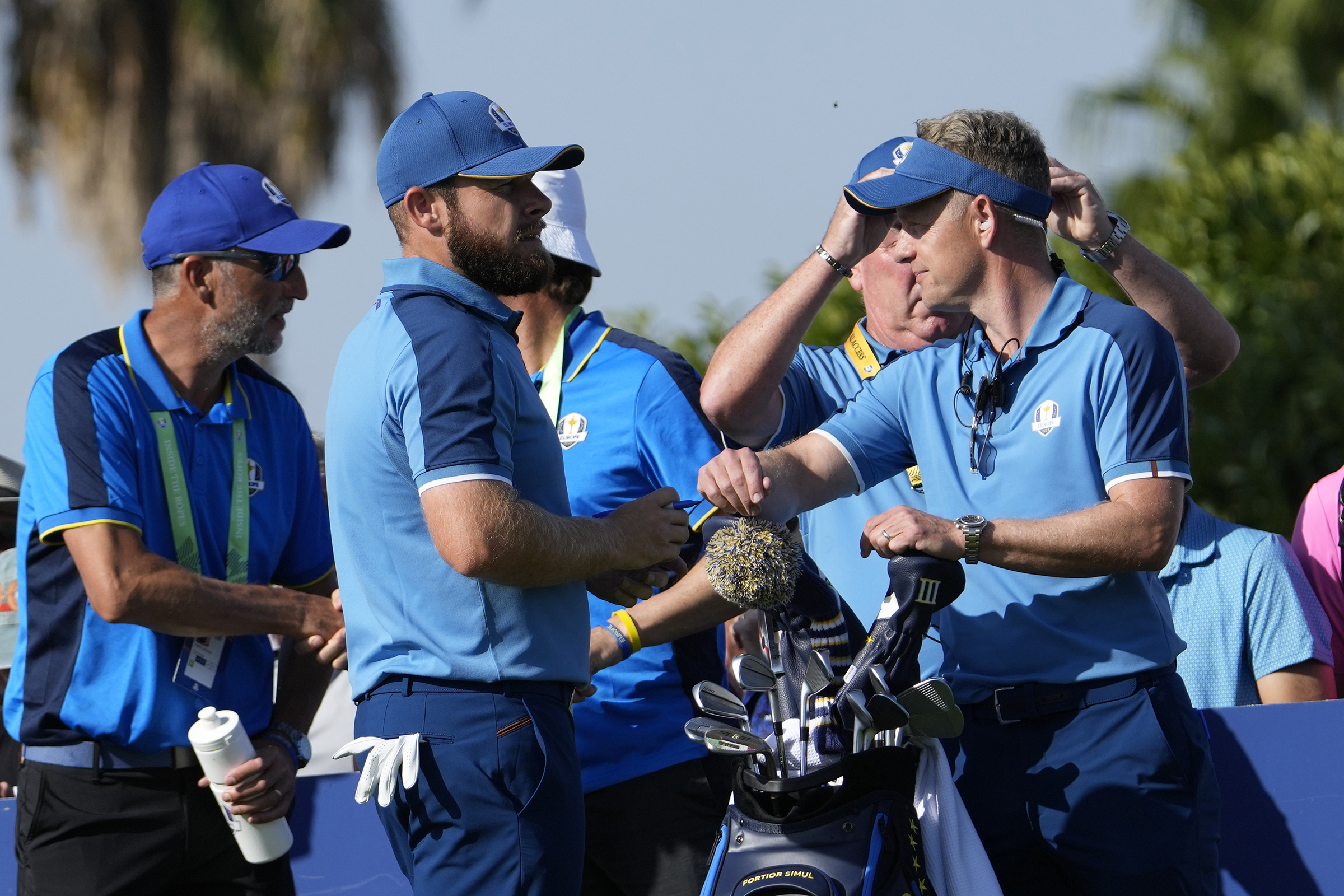 AP photo by Alessandra Tarantino / England’s Tyrrell Hatton, left, speaks to Team Europe captain Luke Donald on the 10th tee at Marco Simone Golf & Country Club during a practice round Wednesday ahead of the Ryder Cup. The 44th edition of the biennial matches starts Friday morning.
FanDuel listed the Americans as slight favorites, which is nothing new. The U.S. team typically looks great on paper, suspect on European grass. All 12 of the Americans are ranked among the top 25 in the world. Three of them won majors this year.
Then again, the U.S. had all 12 players on its roster among the top 25 and three major champions in 2018 in France and lost at Le Golf National. They had 10 players in the top 25 and three major champions in 1997 in Spain and lost at Real Club Valderrama.
“I think one of the great accomplishments in our game now is to win an away Ryder Cup,” Northern Ireland’s Rory McIlroy said. “I think with just how partisan it’s become in terms of having a home-field advantage, being able to set the golf course up in a way that benefits your team, I think the next team that wins a Ryder Cup on foreign soil, I think it’s a huge accomplishment.”
McIlroy was still a teenager the last time Europe truly owned the Ryder Cup in the mid-2000s. Starting with 2008, the home team has won every Ryder Cup except for the “Miracle at Medinah” in 2012, when Europe staged an improbable comeback at the Chicago-area course.
“We weren’t supposed to win in ’12,” McIlroy said. “Since then, the home team has won, each time pretty convincingly.”
The Americans return seven players, including Koepka, from that record-setting win over Europe two years ago.
The PGA Tour has suspended players who joined the rival LIV circuit. The PGA of America runs the Ryder Cup — not the PGA Tour — though the only access to Ryder Cup points for Americans was the majors. That’s where Koepka thrives. He finished just outside the top six automatic qualifiers, and no one was surprised when Johnson used one of his six captain’s picks on him.
“He’s built for the biggest of stages,” Johnson said of the five-time major champion. “And there’s no bigger stage than the Ryder Cup.”
For Europe, the effect was stronger. Sweden’s Henrik Stenson was stripped of his captaincy when he joined LIV, and England’s Luke Donald took over only last August. Missing from the European team for the first time since 1997 is Sergio Garcia, the leading scorer in Ryder Cup history.
Masters champion Jon Rahm wanted his fellow Spaniard on the team. Garcia made a last-minute effort, telling the Europe-based DP World Tour he would pay all his sanctions for joining LIV and play as many tournaments as needed. The tour told him he could not be reinstated until next year.
It was always going to be a transition year for Europe, though, and Donald used two of his picks on the future. One was 22-year-old Nicolai Hojgaard of Denmark. The other was Sweden’s Ludvig Aberg, the top college player in the U.S. this year. In four months as a pro, Aberg already has a win on the DP World Tour and a footnote in history as the first player who will appear in a Ryder Cup before he plays in a major.
McIlroy played a practice round with Aberg at Marco Simone and was impressed.
“I was on the bandwagon before,” McIlroy said. “Certainly at the front row of it now.”