
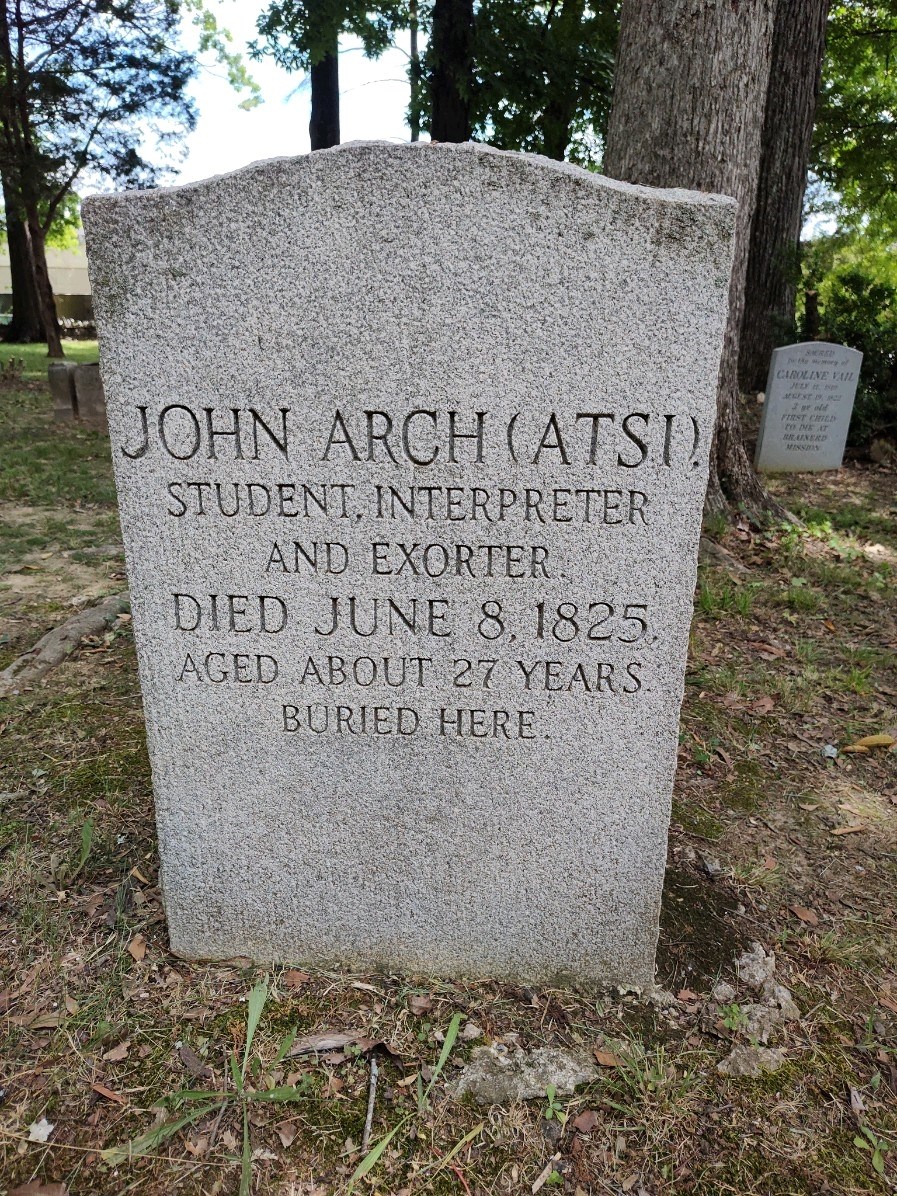
One cold day in January 1819, a young Cherokee man presented himself at the door of the Brainerd Mission. He had traveled seven days from his home in the Nantahala Mountains in North Carolina to seek admission to the school. The missionaries were appalled by his dirty appearance and reached the uncharitable conclusion that he was a “savage.” They accepted his application only after learning that he spoke English fluently and that he had attended school, where he learned the English alphabet. Admitted on a trial basis, this young man soon proved to be an outstanding student who contributed significantly to the success of Brained and its satellite missions.
Atsi, better known as John Arch, did not know his age when he arrived at Brainerd. He thought he might be about 25, but the missionaries believed he was closer to 21. His mother died when he was very young, so he was raised by his father who taught him to be an excellent hunter. John agreed to trade his gun for new clothes to gain admission to the school.
While John’s primary reason for travelling to Brainerd was to further his education, the missionaries wrote in their journals that he soon converted to Christianity and lived a pious life. He was baptized at Brainerd in February 1820, only two months after the missionaries wrote letters recommending John and fellow Cherokee student David Brown for admission to the Foreign Mission School in Cornwall, Connecticut. The school was operated by the American Board of Commissioners for Foreign Missions (ABCFM), the governing board of Brainerd and its sister missions. While David chose to attend the Cornwall school, John preferred to remain near his family in North Carolina and his new friends at Brainerd.
Over the next six years of his short life, John remained close to his family. His father visited Brainerd in November 1819, with the hope of persuading his son to return home. While John chose to stay, he visited his family and friends in the Cherokee Mountains when his mission work allowed. He took a leave in the fall of 1820 to visit his father. On two trips to the Valley Towns and the Baptist mission in North Carolina in 1823, John and the Rev. Daniel S. Butrick visited John’s friends, aunt, and niece in Tsiyahi, Otter Town, near present-day Robbinsville.
In late 1819, both John and David Brown helped Butrick develop the Brainerd Speller, a small dictionary which Butrick hoped to use in his school and missionary work. The Brainerd Speller used an English-based orthography invented by the trio, which was later abandoned in favor of using Sequoyah’s syllabary to produce books in the Cherokee language.