
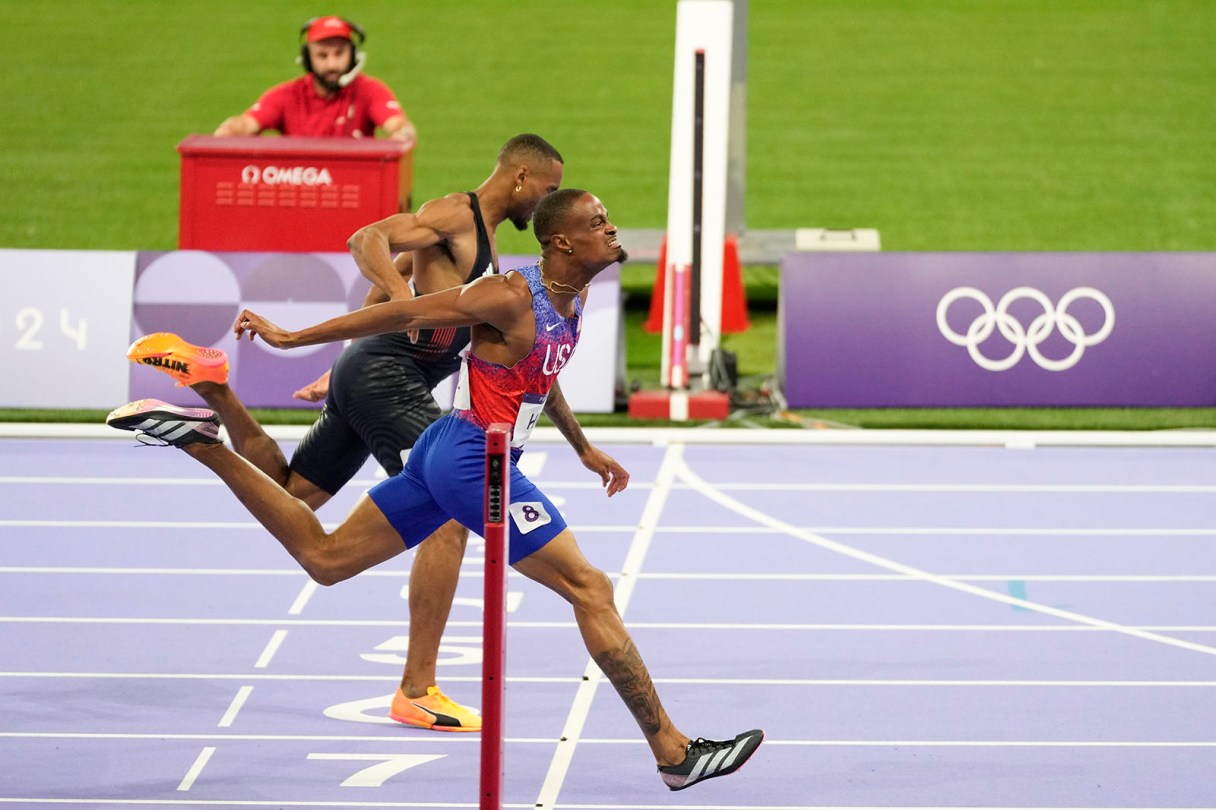
SAINT-DENIS, France — As the flash of red, white and blue streaked past one sprinter — then the next, then the next — the American runner delivering the latest out-of-nowhere comeback on the track said he had one thing going through his mind: “Get home, son! Get home, son!”
Quincy Hall got home in first, then fell to the ground and did snow angels — sans snow. Just another routine day in another comeback for the U.S. track and field team at the Paris Olympics.
Hall reeled in three runners down the stretch of the men’s 400-meter final Wednesday to deliver another heart-stopping win for his country at the Stade de France. He finished in 43.40 seconds, beating Britain’s Matthew Hudson-Smith by .04 second; they are now the fourth- and fifth-fastest men in history at the distance.
Hall’s late push came the evening after American runner Cole Hocker rocked his sport by coming from way back to beat the favorites in a memorable men’s 1500. Add in Noah Lyles, whose only lead in his 100-meter thriller Sunday came at the exact point he crossed the finish line, and it’s easy to see a pattern.
“I’ve got determination,” said the 26-year-old Hall. “That’s what got me to that line. A lot of hurt, a lot of pain.”
The win came about an hour after Lyles advanced to the 200 final despite finishing second to Letsile Tebogo in his semifinal. Lyles will race for the gold medal Thursday.
With 100 meters to go in the the 400 final, things did not look good for Hall, who was some five meters behind Hudson-Smith and 2012 champion Kirani James, both to his left. As eight sprinters approached the final curve, Hall was making up ground on Jareem Richards to his outside in what looked to be a good battle for bronze.
With his arms pumping low and wide and his head bobbing, Hall passed them all, then thrust his chest out to beat his British opponent at the finish.
Hall fell to the ground and scissored his arms and legs back and forth, making snow angels in 80-degree weather on the bright purple track.
“I just wanted to keep doing what my coach told me to do, just keep driving and keep driving and get home,” Hall said.
Lost in that chaos was Samukonga, the Zambian runner who also came from nowhere to take third.
Hall is the first American since LaShawn Merritt in 2008 to capture gold in the one-lap race that the country dominated for decades before that. He joins the likes of Michael Johnson, Jeremy Wariner and Lee Evans among the champions the United States has produced in the most tactical sprint on the track program.
“I knew these guys would get out, try to see who they could throw off their race,” he said.
Turns out, not him.
The new champ’s reaction when he crossed the line: “I just won. It’s over. Next four years, I can say I’m Olympic champion.”