
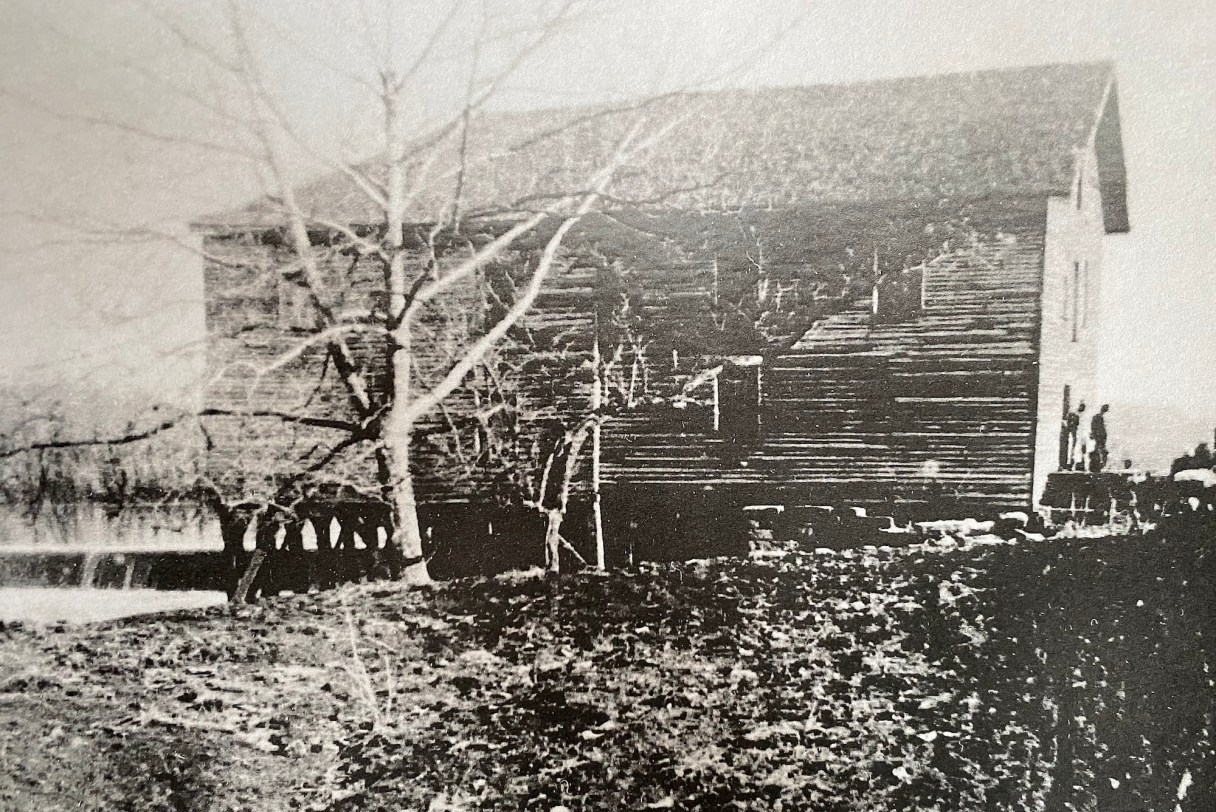
If you explore Chattanooga today, you will discover a short section of the climb up Missionary Ridge denoted as Bird’s Mill Road. Few know anything about its history, the mill or the person for whom it was named — Philemon Bird. Each of their stories creates an interesting tale of early Chattanooga history.
Few records remain on Philemon Bird, but the historical marker located near the site of his mill refers to Bird as “a member of a prominent and wealthy Georgia family” and lists among his accomplishments the construction on West Chickamauga Creek of the mill that bears his name, the ownership of Glass’s Mill in Walker County, Georgia, and his holding of more than 1,000 acres east of Missionary Ridge, including the site of the former Brainerd Mission farm.
Bird’s Mill Road was originally called Mission Road since it crossed Missionary Ridge and included the Brainerd Mission. After Thomas Crutchfield sold the Mission property to Bird in 1852, the road became known by the new owner’s name and eventually extended through today’s East Brainerd, ending at Jenkins Road.
The historical record about property ownership and inheritance is obscured by the fact that Philemon Bird never married but “lived in concubinage” with first Shelia Wicker, a free woman of mixed race, and after her death with Mary Gardenhire, a former mulatto slave. There were several children born to the two relationships. Deeds seem to state that the majority of his personal and real estate property was bequeathed at his death in 1871 to the two sons by his concubines, Samuel and George. His estate was appraised before the Civil War at a value exceeding $90,000. The two half-brothers took over the running of the mill.
In July 1882, the Hamilton County Court minutes record that “on the motion of Allen Parker, Esquire R.C. McRee, A.H. Rogers, Eli Crabtree, William Rogers and S.H Conner were appointed to build the bridge at Bird’s Mill.” Five months later, the Chattanooga Daily Times reported that work had not yet begun on the “superstructure” of the bridge, although the masonry had been completed and the contractors were “waiting on the Canton Bridge Company.” The bridge was completed within the next year.
Court minutes in July 1887 include a Workhouse Committee report that second quarter road expenses were $4,514.27. An average of 70 prisoners were assigned each day to complete “the grading of Bird’s Mill Road from the top of Missionary Road to Bird’s Mill … having put in good open stone water ways from the foot of the ridge on the eastern side.” The committee report indicated that there had been only “five escapes” during the period and that the “cost of feeding has been 15 ½ cents per day.” Members of the court accepted the report and applauded the careful operation of the workhouse force. In an interesting footnote, the 1888 court minutes indicate that “about forty actual working days would be required to extend the work through to the [original] James County line.”
By 1888, the Mission Ridge Incline Railroad had added from Chattanooga to the “Bird’s Mill Resort” a “hack line,” or horse and buggy service, which charged a fare of 20 cents. The Times reported on July 27, 1888, that the resort offered fishing, hunting and boating facilities and hosted picnic parties on weekends for Chattanooga families. The story suggested that the Bird’s Mill Resort was destined to become “one of the best known in the state.” However, it appeared that neither Samuel nor George Bird possessed the business acumen of their father. The mill property was sold in a 1901 “chancery” auction to Hugh D. Huffaker and Willard Springfield for $14,000.
But, the story continues.
On May 30, 1920, the Chattanooga Daily Times headline, “Anniversary at Bird’s Mill,” explained that Pilgrim Congregational Church would honor the pioneer missionaries with a special service on site, which would include the “decoration of the graves of the dead.” After recounting a brief history of the site, the writer invited the public to join in commemorating the “one hundred and third anniversary of the founding of the first mission among the Cherokee Indians at Brainerd, now Bird’s Mill.” The church planned to recreate Cyrus Kingsbury’s first sermon in 1817 and attract an audience of more than 100 people in recalling the Cherokee Nation’s legacy and the missionaries who accompanied the Native Americans westward.
That story resonates today.
Linda Moss Mines is the official Chattanooga and Hamilton County historian. For more on local history, visit Chattahistoricalassoc.org.