

We often look at successful business people and assume they were destined for greatness from the start.
But the truth is, everyone begins somewhere. More often than not, their journeys include humble beginnings that shaped their path to success.
This month, we spoke with six Chattanooga-area entrepreneurs, asking them to share stories about their first jobs — the experiences that shaped them, setting them on the course to becoming the people we know today.
The responses were both insightful and entertaining. Among them, we found a hip-hop artist, a golf ball diver and a corn dog salesman. And we’ll let you turn through the pages to discover who got their start paying off damage done during an unauthorized joy ride in their mother’s vehicle.
Beyond the humor, these stories offer a deeper takeaway: Life and work are full of learning opportunities if we’re willing to look at them the right way.
Stephen Culp — CEO, S Ventures; co-founder, Delegator and Prodiligence
Beyond his work as a serial entrepreneur, Stephen Culp has an impressive resume that includes a law degree from Stanford University, as well as service in the Peace Corps, the U.S. Navy and the Federal Bureau of Investigation.
He recalls being a young FBI intelligence research specialist in 1996, when he was assigned to the Bureau’s security detail for the Atlanta Olympics. He writes in an e-mail that the experience was “fascinating and exhilarating,” but punctuated by tragedy.
“I ran the torch through Thomasville, Georgia,” Culp writes, “But watching the (American) flag being lowered to half-mast the morning after the Centennial Park bombing was heartbreaking.”
Since 2008, Culp has founded or co-founded at least 10 different businesses. The most familiar to Chattanoogans might be Smart Furniture, which he opened in 1998. Culp writes in an e-mail that the business “wound down” in 2023 due to the global pandemic “and its associated supply chain constraints.”
“Very proud of the Smart Furniture team over the years,” Culp writes. “A great group of people who absolutely changed the industry for the better.”
So how does one find the time — never mind the energy — to do all that work?
“The answer,” he says, “is an initial lack of common sense paired with curiosity, later scaffolded by organization.
“People think I’m very organized. I am now, because getting organized was the only way to manage doing too many things. Plenty of mistakes ensued. Thankfully, I got the biggest decisions right: my wife, kids and Chattanooga.”
Tell us about your first job and the lessons you learned.
I salvaged golf balls from Florida lakes and sold them back to the dudes who hit them in those lakes. It sounds relatively white collar until you add in the alligators (not joking), flipped canoes, toxic muck, broken nets, snapping turtles and late-night security.
It also taught me plenty about starting a business — customer service, retail, margins, working shifts, overhead, management, maintenance, security, and last but not least, the threat of emerging competition, who included both patrician golfing authorities and other teenagers.
My first career-track position was with The Peace Corps. It was perhaps the most entrepreneurial job I’ve ever had, where often you truly have to conjure something from nothing.
The biggest lesson is that the best way to start something like a company is to actually start. Do something.
You can plan all you want, but you learn so much in the first minutes, hours, days that it’s often better to just get moving. Learn, adjust and keep moving. This way you actually make progress, versus miring yourself in incessant planning and procrastinating.
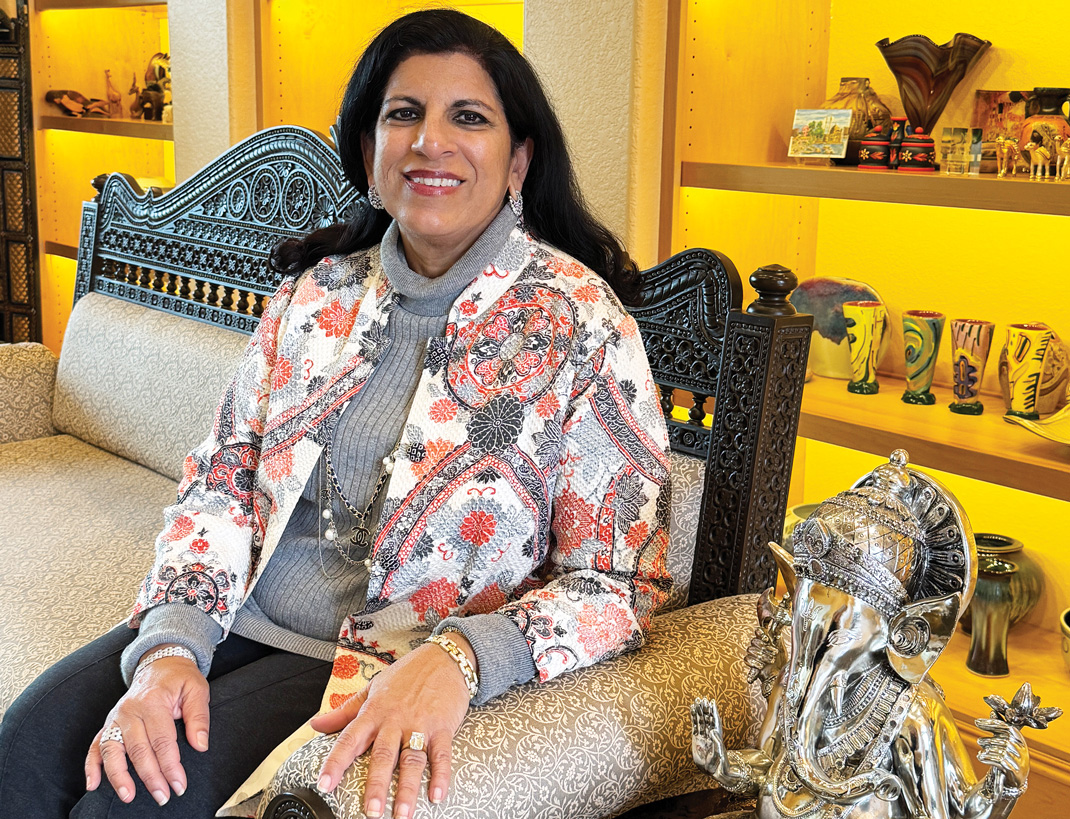 Photo by Jennifer McNally / Thinking Media CEO Sheila Boyington
Sheila Boyington — CEO, Thinking Media
Sheila Boyington’s father offered her valuable advice during her college years: Start a business early, while you’ve got a lifetime ahead of you to grow it.
He felt so strongly about it that he offered to support Sheila and her husband, Dane — who were just beginning their marriage at the time — for five years while they got started. After career positions in engineering, the couple took him up on his offer.
They soon discovered computer-based training, which is widely known today as “e-learning.” Dane taught himself how to become a developer, while Sheila spent hours and days working her way through the Chattanooga Chamber of Commerce membership directory, making cold calls and pitching the concept to local companies.
Years later, the Boyingtons learned that American College Testing (ACT) was in search of a training curriculum for WorkKeys, a tool that measures hard and soft skills across various industries and job levels. Sheila and Dane developed the first online curriculum for WorkKeys, eventually securing statewide contracts in 28 states.
In 2011, ACT acquired the Boyingtons’ program, which she remembers as being one of Chattanooga’s biggest acquisitions at the time, under the umbrella of their parent company, Thinking Media.
“We were vice presidents with ACT, but as engineers by training, we knew there was more innovative work we could do,” Boyington recalls. “Our youngest child had gone to college, and how much do you need to lie on the beach?”
So, they got to work on their next project: Learning Blade, a STEM and computer science career awareness curriculum designed for middle school students to encourage careers in math and science.
The couple ran Learning Blade for about 10 years, securing 13 statewide contracts. About a year and a half ago, a private equity firm approached them with an offer to combine Learning Blade with their other resources including their newly launched Ready for Industry (a career-preparedness system for the five highest-demand industries). They sold both programs to eDynamic Learning.
Along the way, they developed a health care product called Picture RX, a health adherence solution, which they later merged with a company out of Atlanta.
“Essentially, Dane and I had three major products, and all three have been acquired by other organizations,” Boyington says. “So I think we’ve done the entrepreneurial thing really well.”
Tell us about your first job and the lessons you learned.
I babysat a lot while growing up, back when it paid about 50 cents an hour. I also worked at Burger King a couple of summers while in college, which taught me about how to treat the customer.
We once had a secret shopper, and he loved everything I did. But I forgot to tell him “thank you” when he left, and he dinged me for that — and it was posted in the store. So, guess what I do now? I thank everybody for everything.
That has stuck with me since, and I was 19 years old at the time. People want to know that you appreciate them. Relationships are key in a business.
Back in the early 1980s, Dane and I were living in California, and I ended up at a very large engineering company called Black & Veatch. I absolutely loved it — I learned a lot about myself, about business, about dealing with others.
Another memory was an interview with American Micro Devices. They gave me a problem to solve, and I did. But part of my solution included giving my boss something to do, delegating tasks to different people.
But that was the wrong answer. They wanted me to say that I didn’t know how to do the task and ask for help. So I didn’t get the job, but I learned that I’m a very good problem solver. To this day, most people that know me, know that if they have a problem, they can come to me, and I’ll help them solve it.
All the lessons I’ve learned along the way have not only contributed to our company’s success, but have also benefited other organizations like Erlanger Health, where I serve on the board. The lessons and relationships I’ve made have enabled me to expand our reach to many other parts of the country and world.
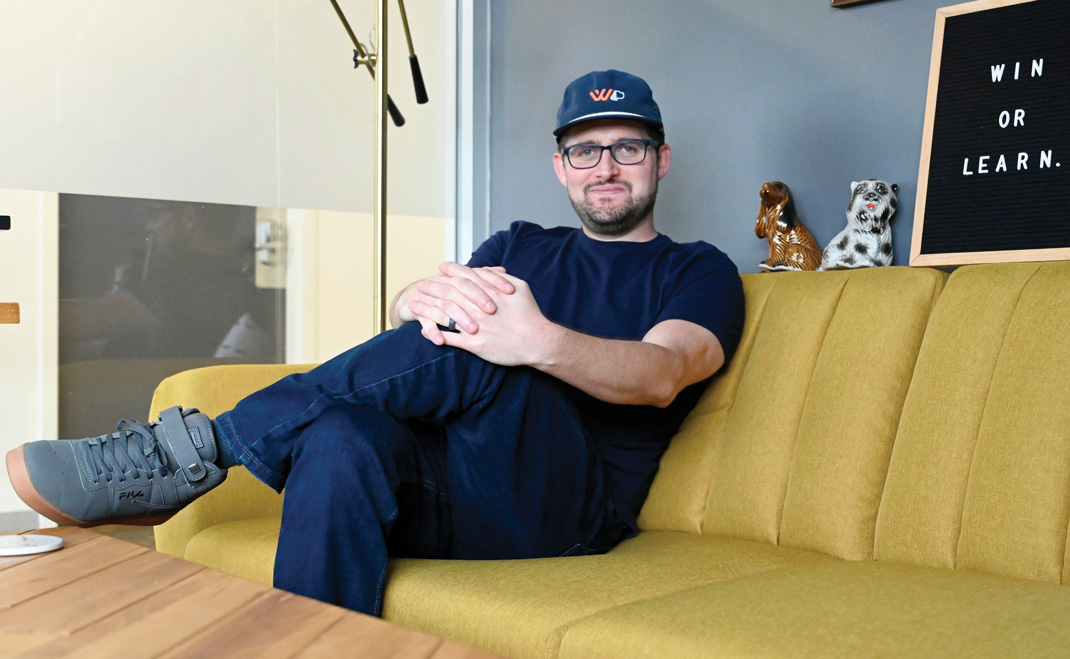 Photo by Abby White / WorkHound CEO Max Farrell
Max Farrell — CEO, WorkHound
While working for a tech startup, Max Farrell noticed something unsettling: Most people he met seemed miserable in their jobs.
As for himself, he loved his work, disrupting industries and pushing boundaries. And that got him thinking: How could he take that excitement and create “intrapreneurs” within big companies to spark more of an entrepreneurial spirit?
Farrell soon left that job and launched his own consulting firm, running workshops to help companies foster innovation. But, while it made some money, he started to realize that he was “selling a vitamin,” when what he really wanted to was “provide a painkiller solution.”
He started to take a serious look at which industries seemed to be hurting. One of his mentors suggested he study the trucking industry. With a 95% annual turnover rate, a 50,000-driver shortage, and an average driver age rising to 45, Farrell recognized that there were major problems to be solved.
So he decided to go all in.
Farrell spent his days talking to dispatchers and executives, and even rode along as a passenger on a trip from Iowa to Los Angeles. He slept and ate in the truck, and showered at truck stops, doing all he could to understand the struggles of the industry.
That research led to the Chattanooga-based business now knows as WorkHound — a software company that provides a feedback loop between organizations and workers, with a focus mainly on industries like trucking, warehousing, manufacturing that are somehow connected to the supply chain.
“WorkHound unlocked two layers of value for businesses,” Farrell says. “First, it helps address individual issues to retain workers. And second, it analyzes trends within the feedback to improve overall business operations.”
Tell us about your first job and the lessons you learned.
I feel like I have had three first jobs, the first being a soccer referee when I was in middle and high school. I think that really strengthened my decision-making skills because you literally have to make the call and deal with people that don’t like your decision.
My second is from my Hip-Hop career. Before I started WorkHound, I was big into music, and was a rapper. During high school, I started throwing events and concerts. And so I really believe Hip-Hop is the most entrepreneurial genre.
I would go to the studio to record the music. I would go arrange a concert at the venue. I would promote events through press and social media, and by word of mouth on the streets, to get hundreds of people to come out to these events.
It was a huge way to learn. How do you build something from nothing, arranging all the different components, getting people to commit their most valuable asset, which is their time, to experience something you built? Honestly, I feel Hip-Hop is the thing that launched me into really being curious about entrepreneurship.
The third was working at a tech company based in Des Moines. That was where I really got punched in the face by life.
I joke to people that I’m hesitant to hire people fresh out of college because they haven’t been punched in the face by life yet. … You have to earn your value and and find ways to contribute on a team.
I thought I knew how to make big decisions, but I didn’t know what I didn’t know. It taught me that I have to approach the world with extreme curiosity and have a hunger to learn.
That became one of the values that we have at WorkHound today — “win or learn.” Every day, if we don’t win, then we’ll learn from it. We don’t point fingers if there’s failure. We learn from the mistakes and keep going forward.
 Contributed photo / The Professional Cleaning Solution Founder Sharon Green
Sharon Green — Founder, The Professional Cleaning Solution
Sharon Green remembers when, back in her teen years, she and her best friend, Latasha Sharp, did everything together. For years, they “worked together and quit together,” moving from job to job in their hometown of Columbus, Georgia.
Their first job as teens was at Lieutenant’s Diner, a retro-style spot inside Hollywood Connections.
“It was a Dave & Buster’s kind of place,” Green says. “Lieutenant’s Diner was very old-school — pedal-pushers, poodle skirts and a jukebox.”
But eventually, life led the two friends in different directions. Sharp chose to join the Army, and Green went to college.
Green evidently liked college a lot.
Today, she holds two four-year degrees — one in accounting from Troy University and another in management, with a minor in finance, from Athens (Alabama) State University. And she’s currently working on a master’s degree in leadership from Belhaven University, while working online toward another, in public administration, from the same school.
The story Green tells of her work history has a similar ring.
She moved to Chattanooga in 2003 to take a new job with a finance company and stayed there until 2014, when she joined CBL & Associates. At one point in 2020, she was working as the administrator at Olivet Baptist Church in addition to her job at CBL — and running The Professional Cleaning Solution, which she had launched in 2018.
Green says The Professional Cleaning Solution grossed $130,000 in 2019, its first full year of operation. In 2023, that figured reached more than $350,000. In between, Green says, the business managed to survive the global pandemic.
“The pandemic made me nervous,” she says. “But even if we have lower profits in some years, making sure our employees (19 at present, with 10 contractors) are taken care of is where I get my joy. We like to give opportunities to people who might have some blemishes in their backgrounds.”
Tell us about your first job and the lessons you learned.
My very first job was at my grandmother’s beauty shop, Jackson Hair Designs. I was an appointment setter and I kept the books. That experience made me want to be an accountant and started the gears turning toward owning my own business.
After college, I was hired by Covington Credit, a finance company in Columbus, Georgia, as an assistant manager in 2002. The next year, I was promoted and moved to Chattanooga. I became branch manager of the Brainerd Road store and stayed with (that company) until 2014.
From my grandmother, I learned to always be up front. Always say what you mean, mean what you say and be a person of your word. She once told me that she never had a problem having a difficult conversation, because she just said exactly what she meant and was a person of her word.
 Photo by Abby White / SockWell CEOs Thomas Lee, left, and Jim Markley
Thomas Lee and Jim Markley — CEOs, SockWell
When Thomas Lee and Jim Markley met in the 1990s while working in Chattanooga’s hosiery manufacturing industry, they had no idea they’d become lifelong friends — much less business partners.
But in 2007, they took a financial leap and founded Goodhew, a brand of high-quality, American-made socks. One year later, the company shipped its first product. And since that time, some 17 years ago now, that venture has evolved and unified under the widely-recognized brand name of SockWell.
“We’ve built a very nice business,” says Lee. “Over the past decade, we’ve developed a specialty in health-focused products, like compression socks, diabetic-friendly, plantar fasciitis-relief socks, and a full range of athletic and lifestyle socks for every need.”
Tell us about your first job and the lessons learned.
LEE — My very first job was the result of making an unauthorized use of my mother’s car. I was 15, had a learner’s permit, and decided it might not be a bad idea to, without asking,
borrow my mother’s car to deliver some of my friends home. Turned out the car was out of gas, and I got about a half a mile from my parents’ house. In my panic, I side-swiped a Fiat and did about $125 worth of damage to that car.
As a consequence, I ended up spending my spring break working for my father to earn enough money to have the car repaired. He was at the industrial valve business, and I spent an entire week sorting thousands of forged steel pipe fittings that were in buckets. … I got paid $3.25 an hour, and worked for 40 hours and made just enough money to pay for the car.
I took away the lesson that it’s always best to stop and think about the consequences rather than the immediate joy of our actions.
My first job after college was as a commercial banker for First Union National Bank out of North Carolina. I spent about nine or 10 months in their training program, then moved to Nashville, where I called on companies in the Southeast Tennessee region. Obviously, Chattanooga is sort of the the hub of Southeast Tennessee, so I got to know all sorts of things about the the manufacturing and business environment.
At 19 years old, I was able to learn about business arenas I didn’t even know existed. It was also an opportunity to meet an incredible range of entrepreneurs. And for someone who was young and didn’t really know their interests, it was a wonderful place to get a panoramic view of all the aspects of what a business could potentially be.
MARKLEY — When I was about 13, we lived in Grand Haven, Michigan, which is right on Lake Michigan. We were a small beach town and had a state park. The community was always looking for ways to enhance summer tourism. One year, they decided to do a musical fountain, and built these beautiful stands where people could sit in the evenings. They decided to do musical performances honoring each of the U.S. states.
There were maybe 250 people on weekend evenings; and there was a guy three blocks down the street, Pronto Pup corn dogs — and he is still there today. I asked if I could take his corn dogs and sell them to the crowds by the fountain. I would walk through the stands and sell corn dogs. By the end of the night, I was the richest kid in the whole world.
What it taught me was how to engage with and service people. It was a blast.
Out of college, I worked for Chautauqua Hardware Corporation out of Jamestown, New York, a company that built brass hardware for furniture companies. We were the very high end of the market, and so my first job was to call on furniture designers and companies. We they would want a certain look, and we’d make samples to show them. You had to engage with creative people on the design side, and also work with the people on the on the purchase side to make sure the pricing was right.
No matter what you’re doing — you’re not selling them anything. You’re trying to make them money, not sell them something. That’s one of the things I learned early in life: If you engage with people the right way, you’re going to be successful.
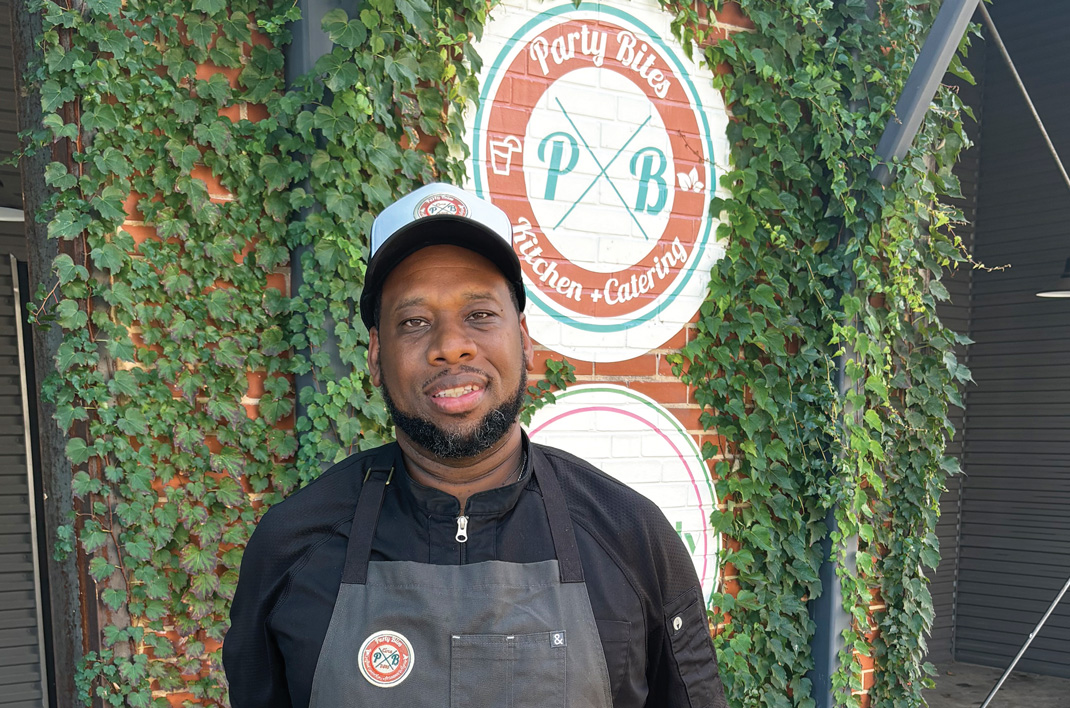 Contributed photo / Party Bites Kitchen + Catering & Events Founder Antonio Tate
Antonio Tate — Founder, Party Bites Kitchen + Catering & Events
Antonio Tate remembers the day his father threw him in the deep end — not in a pool, but in the kitchen of their family’s gumbo restaurant in Michigan.
“He wanted to see where I was,” says Tate, who was 13 then. Now 44, he’s the owner and operator of Party Bites Kitchen + Catering & Event Space, which he says has grown from 45 events in its first year, 2020, to more than 700 in 2023.
“He really locked down on me (one day) preparing roux for gumbo,” Tate says. “He sat me down and taught me the proper way to make roux, the depth of flavor.”
And how’d it go?
“Burned it,” Tate says. “Burned the roux. It took me a while to learn to make that gumbo.”
Tell us more about the gumbo restaurant.
It was my very first job. The restaurant was Gumbo 2 Go, in Grand Rapids. I shopped every day, prepped the gumbo, red beans and rice, etouffee, pecans.
And how did Michiganders take to a gumbo restaurant?
They tore it up.
What was the first career- track job you had?
When I was 15, I started working at Burger King. Because of my experience with my dad, I became a manager at 16. Later on, in college, I was a food service manager at Eastern Michigan (University) and got my room and board paid for.
Is there a lesson from an early job that has stayed with you?
I learned huge lessons in customer service.
Customer service was really big for my dad. Working at his restaurant, dealing at a young age with adults, learning at a young age how to serve; then, in college, dealing with students in fast-food and sit-down (situations). I can deal with the stress of the food-service business because I learned at every level.
Customer service is the great separator — it separates a great business from an average business. It involves anticipating the guest’s need, being proactive and creating an experience for that guest. Customer service is why people looking for fast food will drive past places to get in line at a Chick-fil-A drive-through — they know how much better the customer service will be.
NOTE: This story was corrected on Dec. 3 to say that Stephen Culp had worked as an FBI intelligence research specialist.
* Living and learning together: Rollins scholars boost UTC business college
* A unique new demographic at UTC: People who want to be their own boss