
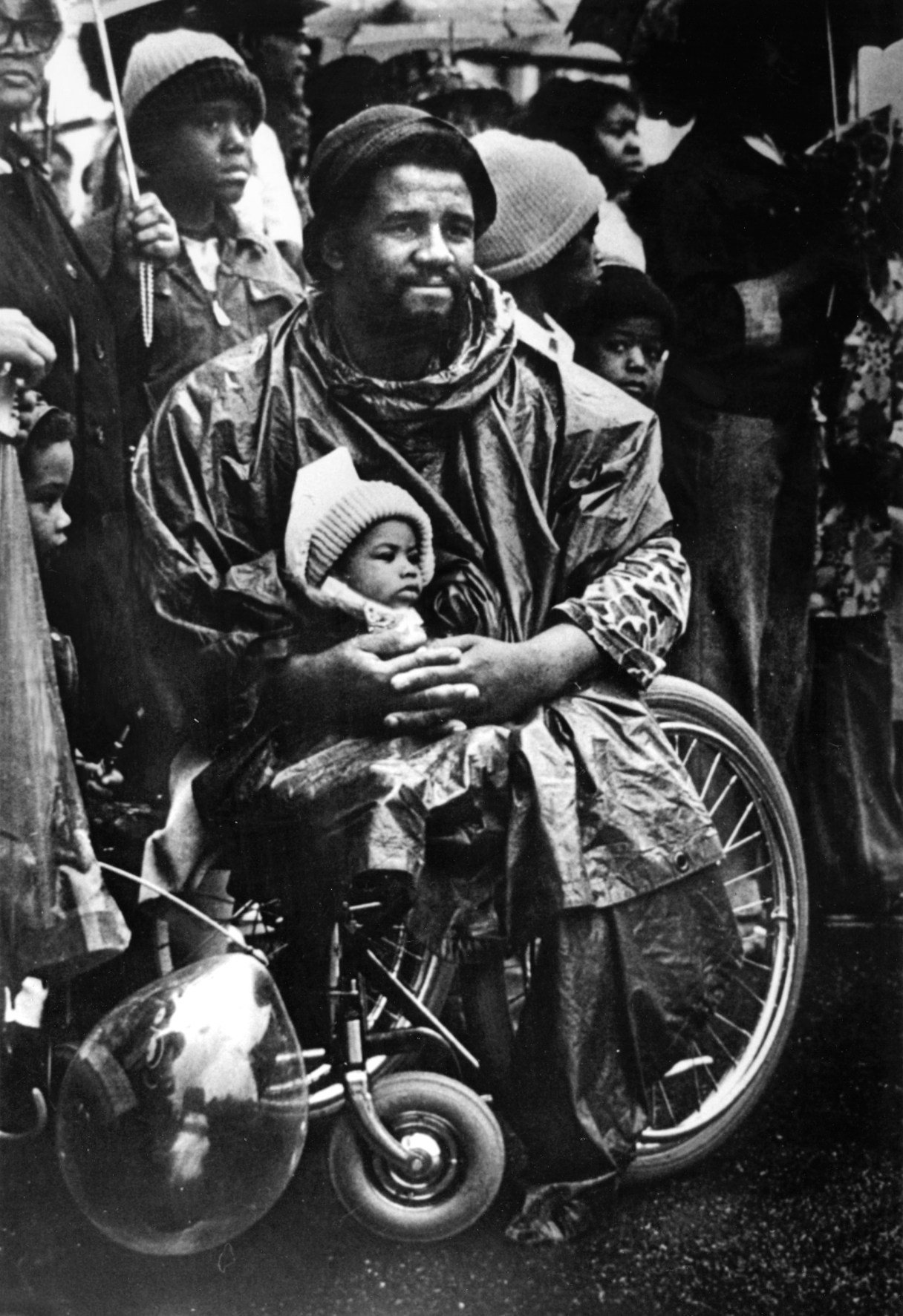

Q. Why did an image from the 1976 Chattanooga Armed Forces Day parade gain national attention?
A. Robin Hood had experienced a somewhat painful day on Monday, April 18, 1977. The Chattanooga News-Free Press photographer had injured his wrist while photographing spring dogwood trees on Suck Creek Road on the side of Signal Mountain. After seeking treatment, he returned to the paper to drop off his film, not knowing his life was about to change forever.
Upon spotting him, several reporters and photographers rushed to share some breaking news. Hood had won a Pulitzer Prize for a photo he had taken during the previous year’s Armed Forces Day parade. The winning image featured Eddie Robinson, a double-amputee Vietnam War veteran seated in a wheelchair holding his 1-year-old son, watching the parade on a rainy Chattanooga afternoon.
“To be honest, I had no idea the impact it would have,” Hood said of his award win in an interview with the Chattanooga Times Free Press. “I wasn’t jumping around and celebrating. I took it in stride. I thought, ‘Hey, that’s really nice.'”
Ironically, the photo almost didn’t make it into the paper.
Hood had recommended two of his parade photos for the May 15, 1976, edition of the News-Free Press — the photo of Robinson and a photo of children from a Vietnamese refugee family waving American flags, believing the stories behind the photos tied together. However, when Hood returned to the office on the morning of May 15, he said, he found out City Editor Julius Parker had decided to use only the photo of the children that afternoon. (The Chattanooga Times was the city’s morning paper in that era, while the News-Free Press was released in the afternoon.)
Hood lobbied for the photo of Robinson, and Parker relented but told him there was only spot left in the paper that was being put together — a black and white space on page 5. Problem was, the photo had been shot on color film, meaning Hood had to rush to convert it to black and white using a process he had never tried before.
Hood made it work. The photo ran — on page 5 in most editions, although it was added to the bottom front of page 1 for the final edition — and the whole incident led to a humorous moment the next year after the Pulitzers were announced.
“When I came in the next morning,” Hood said, “Julius Parker, the person I forced the black and white photo on, he put his arm around me and said, ‘Robin, I knew that was a great photo the minute I saw it.'”
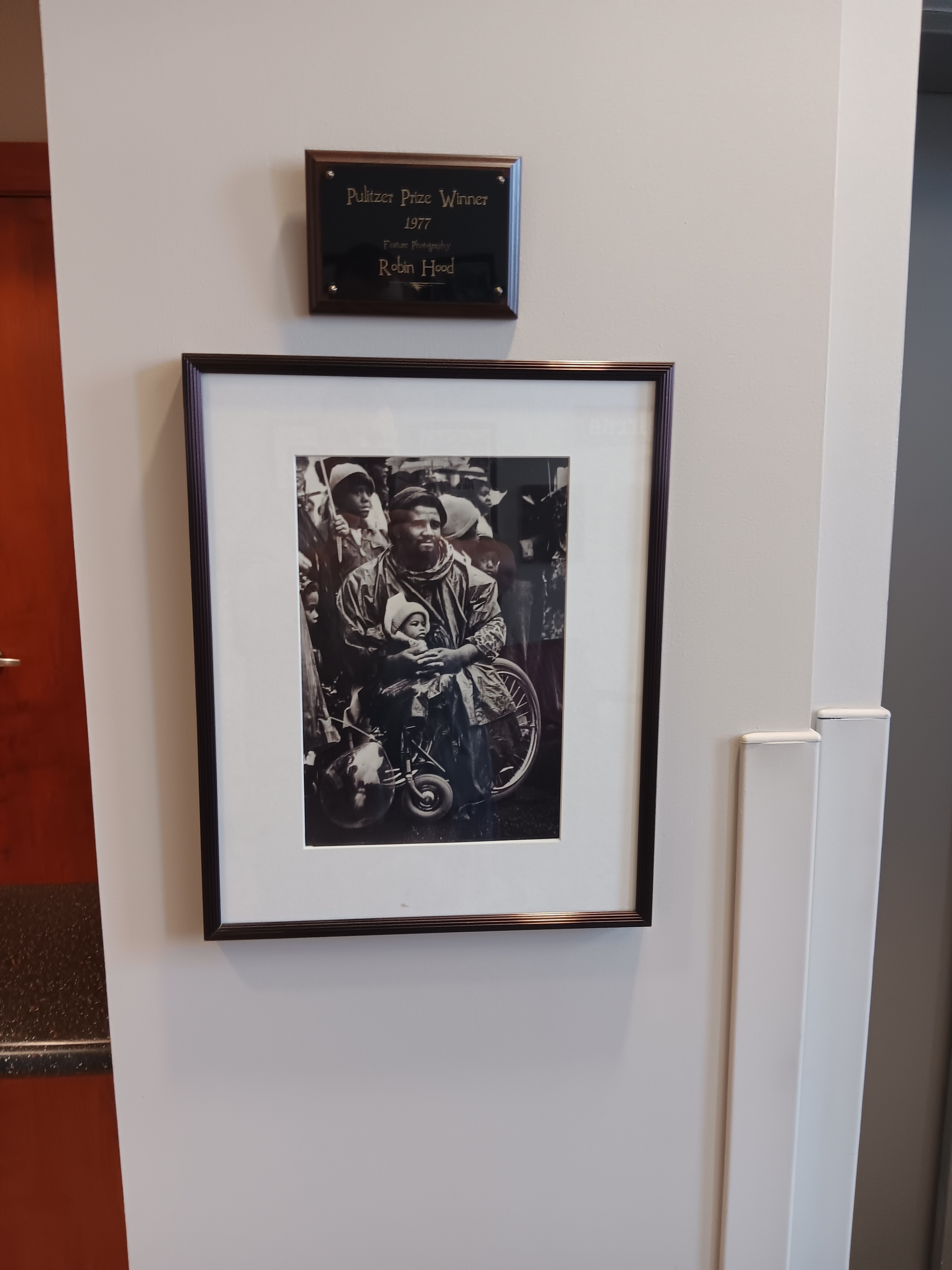 Staff Photo by Lew Gilliland / A display recognizing Robin Hood’s 1977 Pulitzer Prize winning photo hangs Nov. 13, 2024, in the lobby of the Chattanooga Times Free Press newsroom
THE PARADE
Hood, a native Chattanoogan who graduated from City High School and studied at the University of Chattanooga, joined the Army in October 1967. He served as a first lieutenant in Vietnam, where he was awarded a Bronze Star and Combat Air Medal. He joined the News-Free Press after leaving the service in 1971, getting hired as a reporter on the condition he attend night classes at Kirkman Tech to learn how to type, according to the April 19, 1977, News-Free Press.
Hood said in the 1977 article it didn’t take long to figure out reporting probably wasn’t the role for him.
“They didn’t have the heart to fire me, so they let me stay as a photographer, which is what I wanted to do in the first place,” he told the paper.
For the 1976 parade, he was one of two photographers assigned to take pictures of the crowd. He first spotted the family from Vietnam. At that time, the United States was just a few years removed from the Vietnam War, and close to 120,000 Vietnamese refugees and asylum-seekers had been relocated to America following the war, according to National Geographic.
“I spent a few minutes trying to get different photos from different angles of those kids, trying to get pictures of them watching the parade instead of me,” Hood told the Times Free Press.
About 50 yards down the parade route, Hood spotted Robinson, a Vietnam veteran who Hood learned later had stepped on a land mine, losing both legs. On the day of the parade, he wore a boonie-style hat and a green poncho that Hood said was probably Marine-issued. In his arms, he held his 1-year-old son. Hood, trying not to attract attention, began shooting pictures.
“I was watching his face, what he was looking at as I was snapping his pictures,” Hood said. “As the music was playing and the floats were going by, I realized he was biting his lip and starting to cry.”
Hood said Robinson had been a football standout at The Howard School, and the Howard band had been marching by, playing patriotic tunes, at the time Hood snapped his photo.
Asked when he knew the photo of Robinson was special, Hood said, “Before I snapped the shutter. Just like the Vietnamese kids, I knew that was a strong image … Both of these subjects had an immediate impact on me before I took the photograph. I was going to be sure that I delivered that impact to the newspaper.”
Hood said he felt a “kinship” to Robinson.
“When I was in Vietnam, I was a combat infantry platoon leader,” he said. “I obviously came out more fortunate than he. I knew a lot of people personally that did not come back. There was kind of an instant bond with him as a subject matter and what he represented.”
(READ MORE: Chattanooga Knows: What candidate won Hamilton County in the 1968 presidential election)
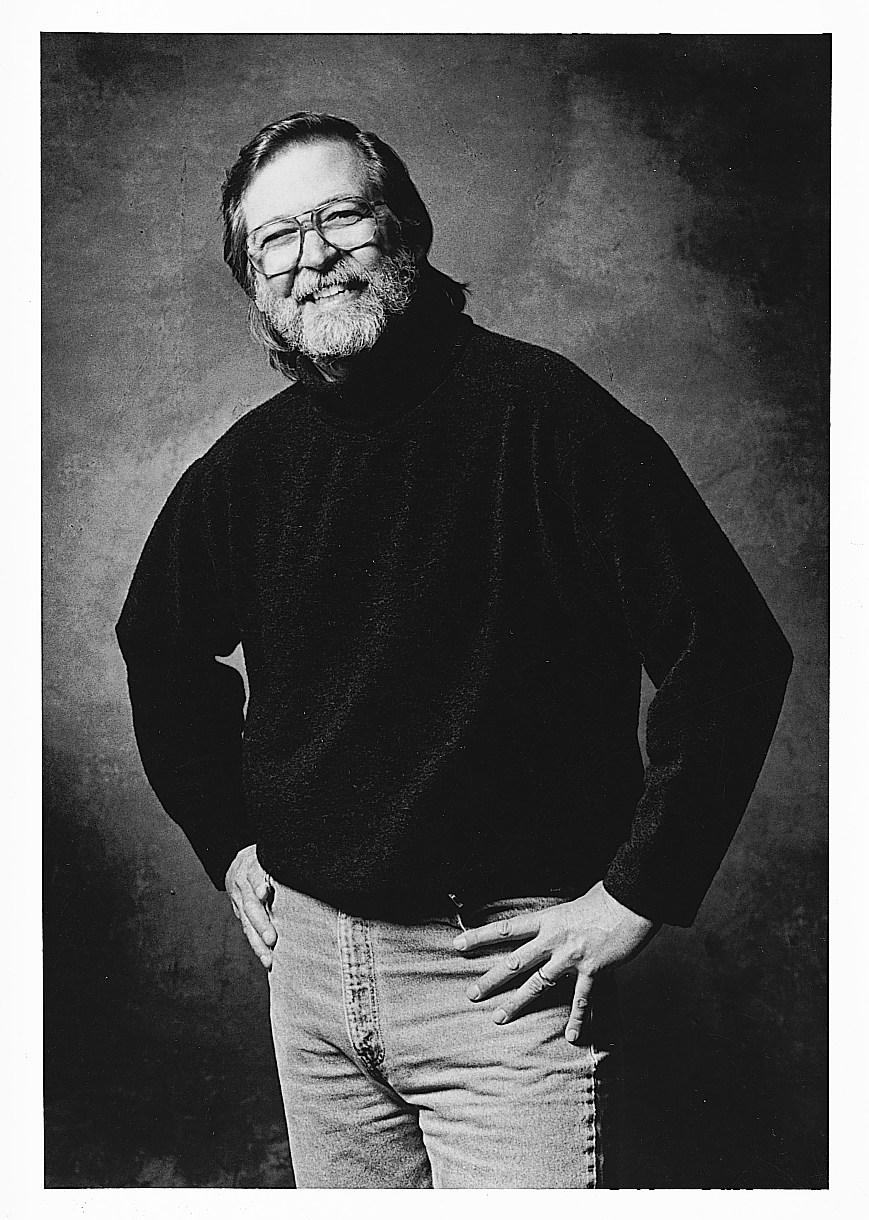 Contributed Photo / Pulizer Prizer winner and former Chattanooga News Free Press photographer Robin Hood.
PULITZER NOMINATION
In the months following the Armed Forces Day parade, the News-Free Press held an open house. For the event, each staff photographer was asked to make a 16-inch-by-20-inch print of their favorite photo from their time at the paper. The photos were mounted on heavy boards and made into a gallery for the open house. Hood chose the photo of Robinson.
Several days after the event, Associated Press correspondent Eric Newhouse, who had an office at the News-Free Press, spotted the photo. Newhouse hadn’t seen the photo before.
“He said, ‘Do you mind if I nominate that for a Pulitzer,'” Hood, looking back, told the Times Free Press. “I just kind of laughed and said, ‘Sure, Eric, do whatever you want.’ He asked me to give him a copy of the print, and I did and told him the story behind it.”
The Pulitzer would mark the first time Hood won a first-place award for one of his photos. He had earned second- and third-place honors in other contests but never taken the top prize. Now, he was the winner of the top prize in journalism.
“I’ve probably done a lot of pictures just as catchy or pleasing to the eye, but I’m glad that picture won,” Hood told the News-Free Press in 1977. “It meant something to me when I shot it, and it still does.”
After winning, Hood’s photo ran in Life magazine and in newspapers all over the country, he said.
EPILOGUE
Hood was looking to take the next step in his career about the time of his Pulitzer win. He collaborated with then-Gov. Lamar Alexander on a book, “The Tennesseans: The People and Their Land,” and became his media director.
“Beginning in 1984, Hood was principal of Robin Hood Photography, creating national advertising campaign photography for Coca-Cola, General Motors, Jack Daniels, Alaska Tourism, Purina, Winchester, Arizona Tourism and other national brands over a 20-year span,” according to a Hood biography.
“In the early 1990s, Hood partnered with friend and fellow Tennessee Pulitzer Prize winner Alex Haley to create publications celebrating the spirit of American communities,” the biography continued. “Hood has served on the boards of several historic preservation foundations and holds membership in Society of Mayflower Descendants, Jamestown Descendants and Sons of the American Revolution.”
In 2004, Hood founded Grandin Hood Publishers in Franklin, Tennessee, where he had relocated after leaving the News-Free Press. Grandin Hood publishes “coffee-table photography books celebrating the stories of historic sites, foundations, cities and states,” according to Hood’s biography.
Eric Newhouse spent 18 years with The Associated Press and later became projects editor at the Great Falls Tribune in Helena, Montana. He won his own Pulitzer in 2000 for a yearlong series on alcoholism. He was invited to judge the Pulitzers in 2007-08.
“When I first saw Robin’s photo nearly half a century ago, I was engulfed by widespread emotion,” Newhouse told the Times Free Press by email. “Foremost was the expression on the vet’s face, a profound humility mixed with gratitude and sorrow. The gratitude became obvious when I saw the small child tenderly cradled in his arms, the sorrow when I saw the wheelchair and his missing legs. The rain gear underscored the depth of his emotion. Clearly, he knew he was going to get soaked, but he was determined to show his support. And finally, his race reminded me of the sacrifices that people of color have made for generations in America.”
Sadly, Eddie Robinson died just a year or two after Hood took his photo on that rainy day in 1976, the Pulitzer winner said.
Hood still has the negatives for that photo, which was published in black and white and has only been seen in color by two people — Hood and Julius Parker. Surprisingly, Hood said the Times Free Press interview for this story was the first time he had been asked for permission to print the photo in color. Hood gently turned his old paper down, saying he believes the photo is more effective in black and white, and that is the format in which it should be forever viewed.
Do you have Chattanooga related trivia to share or a question you’d like answered? Email news@timesfreepress.com with subject line Chattanooga Knows.
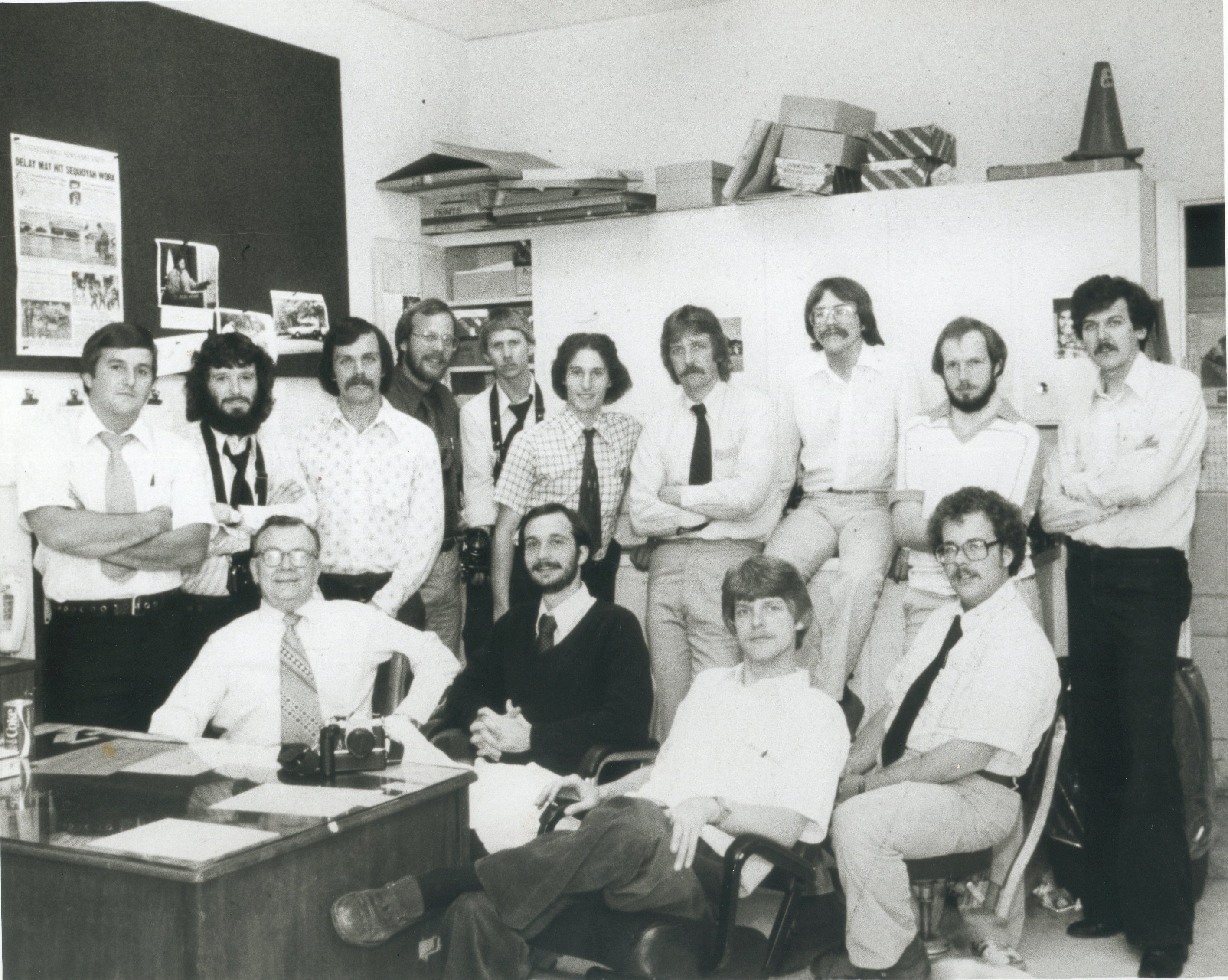 File photo / The Chattanooga News-Free Press photography staff circa 1978. Front row, from left, Delmont Wilson, Buddy Werner, Michael Crawford and Alan Vandergriff. Back row, from left, John Penalver, John Rawlston, Tim Barber, Bob Nichols, Steve Mayfield, Steve Grider, Robin Hood, Thom Coombes, Ronnie Krupp and Michael O’Neal.