
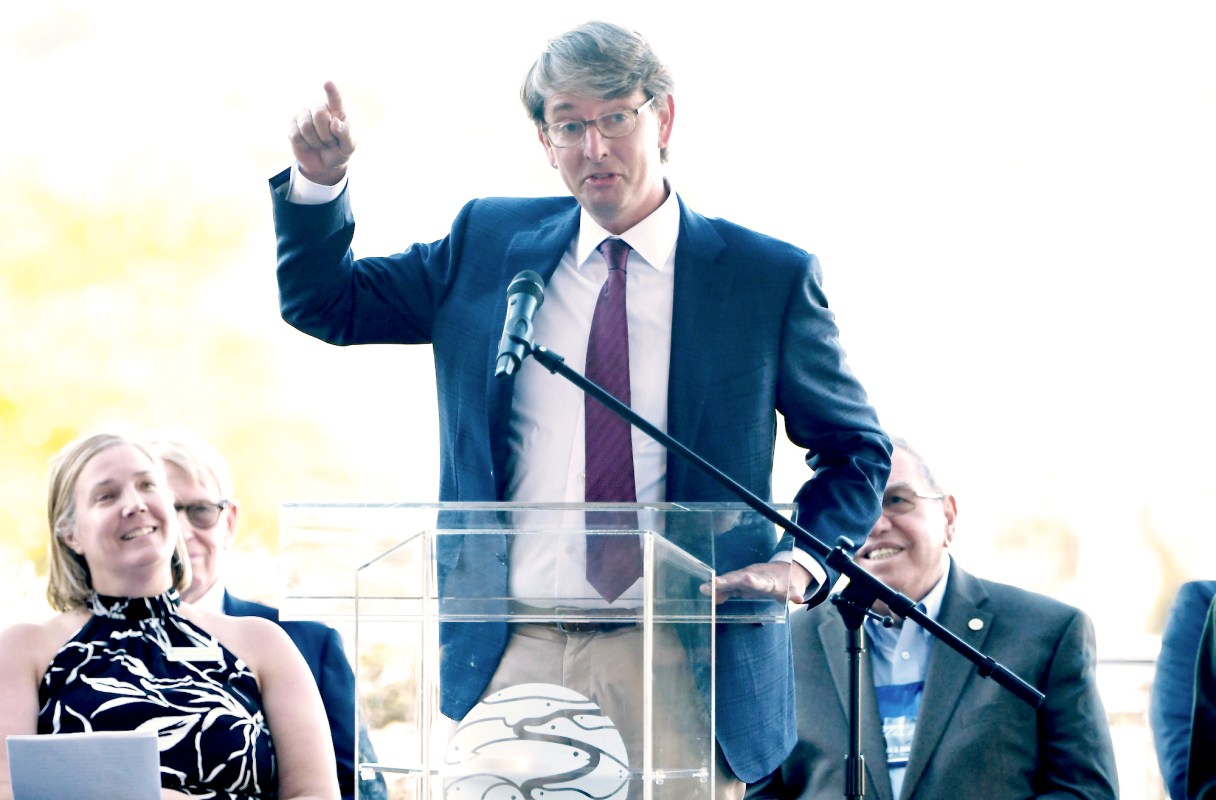
Chattanooga Parks and Outdoors Administrator Scott Martin is leaving the city to take the job of chief executive of the Fort Monroe Authority in Virginia.
In his time in Chattanooga, Martin led the opening of Lynnbrook Park, Lupton Mills Meadows and Shallowford Preserve, and he has championed projects like the reimagining of the riverfront, Chatt Town Skate Park and Montague Park, according to a news release from the city.
The Chattanooga City Council unanimously approved Martin’s appointment as parks administrator in January 2022. His last day on the job is Tuesday. Monica Kinsey, deputy administrator of parks and outdoors, will serve as interim administrator.
Prior to his departure, Martin sat down with the Chattanooga Times Free Press for an interview at the Philip Grymes Outdoor Chattanooga Center at Coolidge Park. The conversation has been edited for clarity and brevity.
Q: What do you think it is about parks and outdoor spaces that brings people together?
A: I think there’s a great – not to go full Ken Burns – but there’s just a great American tradition of parks are for everybody. And whether you just broke up with your significant other and you just want to get some quiet time, you’re going to propose to your significant other, you’ve got a family photo to get taken, you’re on T-ball (team), you’re catching your first bass – public lands and public spaces in America, I think, are so shared by everyone as the landscape on which their lives were written. I think they’re really special, almost hallowed places.
National Parks is where you see it go to the next level. Those are the vacation memories. But, it’s in these humble neighborhood parks where the “Dennis the Menace” moments or “The Sandlot” baseball moments happen. That, you see over and over again, is where it really comes together. You see it on Walnut Street Bridge here every day, with people just walking across that bridge and smiling. It’s those little moments.
Q: What’s been the most surprising thing you’ve encountered in your time with Parks and Outdoors?
A: I think when we put out the initial request for people to apply to be on the parks committee, my colleagues in other city departments were like “Oh, great. Another city board. You’re going to have to go find people.”
We had over 18o applications come in to be on a volunteer board. No one’s ever seen that level of interest for a volunteer board, to my knowledge, in Chattanooga before. And, that was great to see that the people really want to be involved and invested in their system and were really showing out to do that.
I think a lot of that credit goes to the original Moccasin Bend Task Force. I think when people look back at Chattanooga’s recent history – and they see what the folks who were engaged in that Moccasin Bend Task Force did that became the riverwalk and the museums – they remember that enough to know, “I want to be a part of that again.” And, I think that’s (why) they were signing on. So, seeing that response was really a surprise.
(READ MORE: Remember When, Chattanooga? The Tennessee Aquarium was considered a risky experiment)
Q: How does Chattanooga’s history inform its present in terms of outdoor spaces?
A: That’s like a long-form piece for The Atlantic, certainly. I mean, everything goes back to water here. It all comes back to the rivers and the waterways because they shape us. Our history … it doesn’t disconnect from the landscape.
There’s stories here that are bigger than us, like from 12,000 years ago. This landscape speaks to you, and I’m not talking in a spiritual way, although it does for some people. But, this landscape is going to tell you what it wants you to do, and it’s going to remind you that you may not be the biggest story. You’re part of a land that’s far bigger than you and older than you. And, get over yourself. It humbles you, and I think that’s good. I think landscape that does that is good. I think we find strength there, and we find story there. And, we find, “Hey, here’s the why,” there.
Q: So, what would you say is your part in the landscape?
A: I was just lucky to sit in this chair for a brief period of time. I’ve been very lucky to walk Moccasin Bend early in the morning. I’ve been very lucky to go out birding with my wife and see north of 200 species and 300 white pelicans out on the lake or see an osprey downtown. I’ve been able to see how nature in the city can really coexist happily here in a way that I haven’t been able to see anywhere else I’ve lived.
Q: What would you say are Chattanooga’s strengths and weaknesses when it comes to outdoor spaces?
A: The strengths are the nonprofits, the partners, all the history that comes before. There’s been great leaders here doing great work and have been many, many mayors over many years who have committed to making this city great from the government side. But, more importantly, the firsts here are pretty big. It’s the first national military park … and the first archaeological district that Zach Wamp did. You have the TVA and the river. And, you have behind me – that’s the John Nolen plan from (1911). That’s the first park plan done for Chattanooga. … So, there’s a great wellspring, there’s a great commitment to design quality. The foundations have been very keen to get good architects in here, so it’s not something cheesy. I think that’s the strength.
(READ MORE: Chattanooga and Hamilton County unveil plans to revamp Ross’s Landing)
I think the weakness, frankly, is going to be a hope or an expectation or mythology that a Jack Lupton is going to jump out of the Tennessee River and pay for things again. That’s not going to happen. There’s not going to be five rich billionaires who show up and do it. The city’s opportunity is now to figure out how do you build things in an era where you’re not going to have a few donors that come in and save the day. How do you find the capacity, how do you find the confidence in place, to make big investments in these green spaces?
And, the thing with green spaces is oftentimes they’re not going to pencil out in a short five-year return on investment calculation, because oak trees take 50 years, 100 years to grow. So how do you have a little bit longer term time frame in terms of the return? How do you look beyond an election cycle, but much further beyond? How do you look in a 5o-year increment and say, “What can I do today that’s the best thing I can do for tomorrow?”
Q: How does Chattanooga’s attitude toward outdoor spaces compare to other places you’ve worked?
A: I’ve worked in places that don’t have these assets, and Chattanooga is aware that it has the assets.
I’ve lived somewhere where the Monday morning question is: What did you consume? What did you buy? Or, who’d you see when you were out? I don’t find those places near as interesting as here where the money morning question is always: What did you do? What-did-you-do towns are just more fun.
Q: Is there a parting thought you’d leave Chattanooga with in terms of outdoor spaces?
A: Keep doing it. It’s your strength. Just keep doubling down. I have yet to see a park built where people 50 years down the road go, “Man, that was a mistake. I wish they’d never made that a park.” I have yet to have that experience. It always pays for itself.
Contact Sam Still at sstill@timesfreepress.com or 423-757-6579.
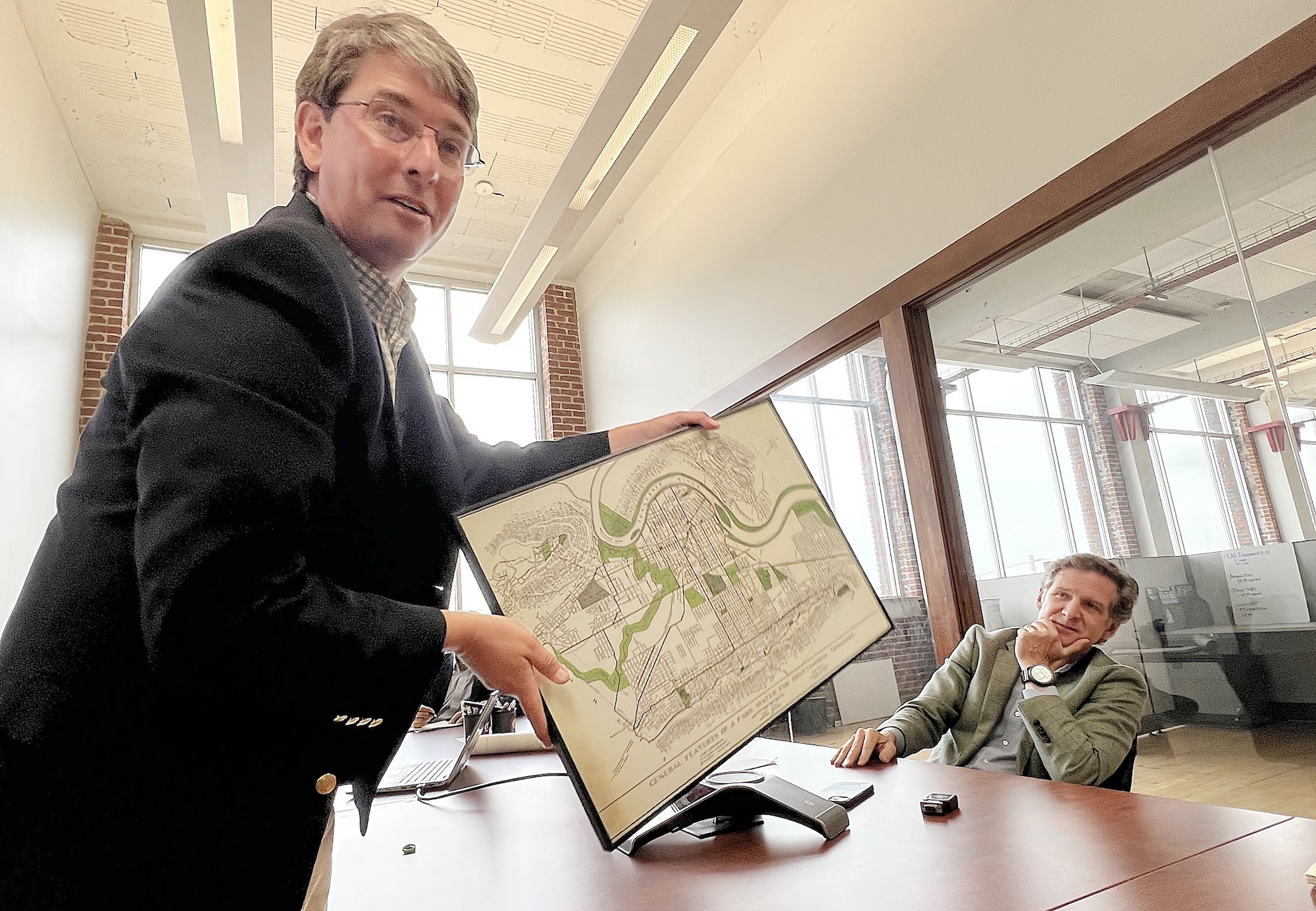 Staff photo by Alison Gerber / Scott Martin, left, administrator of Chattanooga Parks and Outdoors, shows a 1911 plan for a parks system while Chattanooga Mayor Tim Kelly, right, looks on at a meeting at the Chattanooga Times Free Press office in 2023.