
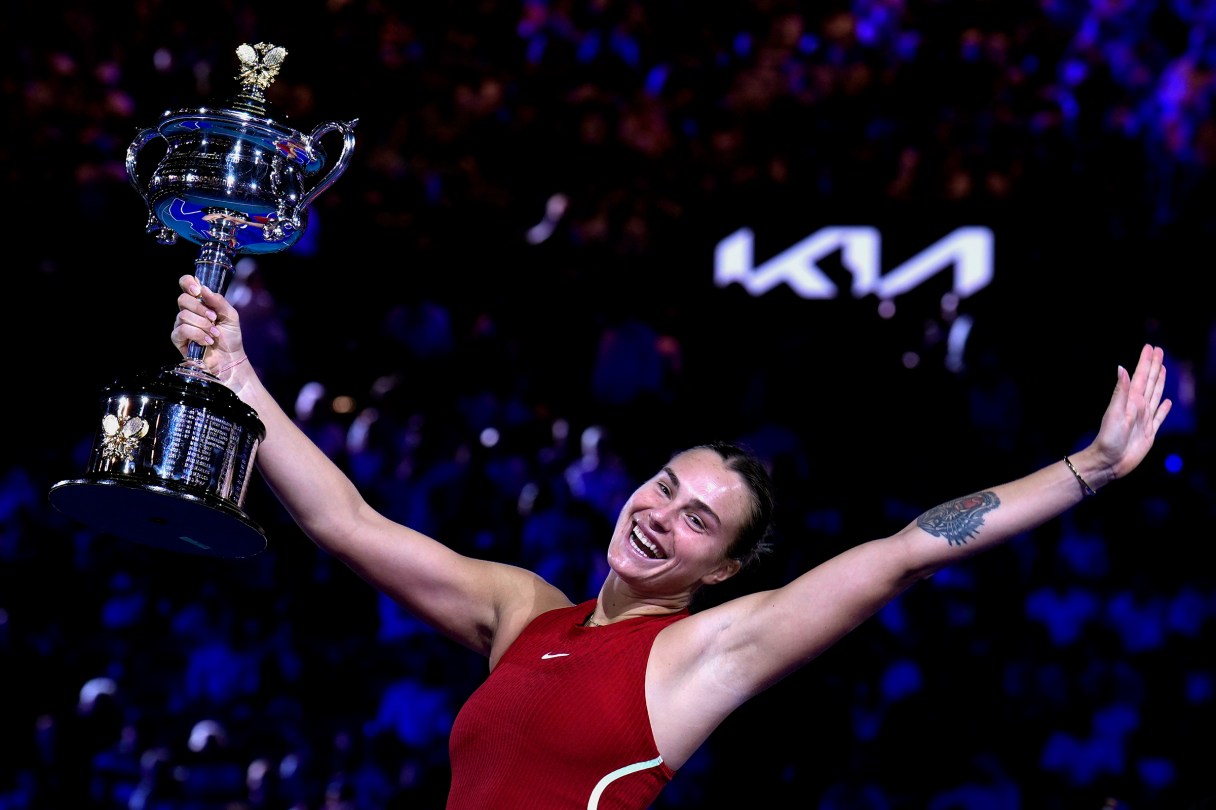
MELBOURNE, Australia — Aryna Sabalenka didn’t want to be, in her own words, that tennis player who wins a major title and disappears.
Earning her first Grand Slam singles crown in Australia a year ago gave her the confidence she could do it again. Losing the U.S. Open final last September gave her the extra motivation.
Sabalenka ensured she wasn’t a one-hit wonder by clinching back-to-back Australian Open titles with a 6-3, 6-2 win over Zheng Qinwen on Saturday in a one-sided women’s final that contrasted sharply with her comeback three-set victory over Elena Rybakina last year.
“I just wanted to show that I’m able to be consistently there and I’m able to win another one,” said the 25-year-old from Belarus. “So compared to last year, it’s a completely different me. Compared to the U.S. Open, once again, it’s a different me; I’m more controlled and kind of, like, don’t let the rest of the things come to my mind.”
Sabalenka has reached at least the semifinals in singles at the past six Grand Slam tournaments and eight of the past 11, a stretch that includes not being allowed to play Wimbledon in 2022 because the grass court major banned players from Belarus and Russia due to the invasion of Ukraine that February.
It was also that year when Sabalenka struggled so badly with her serve in tense moments that she doubted she could win a major. Now she’s relying on it to break down opponents. She didn’t serve a double fault in the final, and she didn’t face a break point.
Sabalenka set the tone at Rod Laver Arena with big, deep forehands and converted service breaks early in each set against Zheng, a 21-year-old from China who was in a Grand Slam final for the first time.
The journey and the destination were equally important for Sabalenka, who is No. 2 in the WTA Tour rankings and had the same seed at Melbourne Park. She did not drop a set during the two-week tourney, which included avenging her U.S. Open final loss to No. 4 Coco Gauff in the semifinals and beating 2021 French Open winner Barbora Krejcikova in the quarterfinals.
“I’m definitely a different person and a player, and I have more experience playing the last stages of the Grand Slams,” Sabalenka said, reflecting on the past 13 months. “There was some tough moments for me losing the U.S. Open final. That loss actually motivated me so much to work even harder.”
And that, she said, gave her more confidence in her game and more belief in herself.
“The first one is always special because I feel like it’s more emotional. For the second time, it’s just such a relief,” said Sabalenka, who owned a pair of major titles in doubles from the 2019 U.S. Open and the 2021 Australian Open even before her solo breakthrough in 2023.
Now she is the first woman since Victoria Azarenka in 2012-13 to win back-to-back Australian Open titles, and she is the fifth since 2000 to win the event without dropping a set.
“It’s an unbelievable feeling right now,” Sabalenka said.
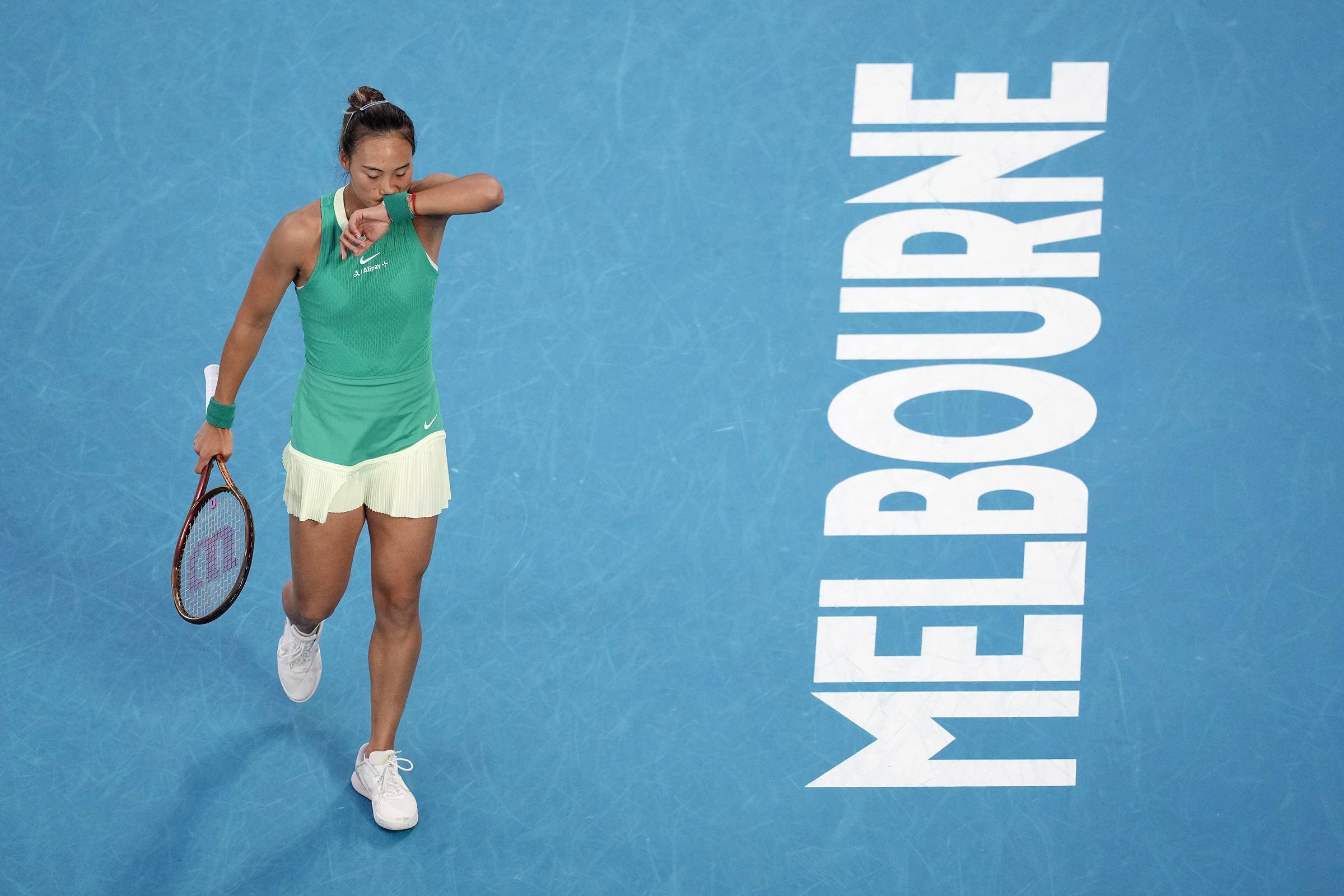 AP photo by Louise Delmotte / Zheng Qinwen wipes her face during a break in play in Saturday’s Australian Open women’s singles final. The 21-year-old Zheng, who was making her first appearance in a major final, lost in straight sets to No. 2 Aryna Sabalenka.
As for her opponent, a decade after Li Na held the Australian Open trophy aloft — now retired, she also won the 2011 French Open and remains the only Grand Slam singles champion from China — Zheng made her best run in nine majors to date, having never been beyond the fourth round until reaching the U.S. Open quarterfinals last year, where she lost to Sabalenka.
Zheng said she felt strongly supported in Melbourne because of the big Chinese community, and that played out for the final as the flags waved and she had the crowd behind her.
However, she was also the first player in four decades to advance through six rounds at a Grand Slam event without playing anyone ranked in the top 50, and she was only the third in the Open era to reach a major final without facing a seeded player. The step up in competition against Sabalenka proved too much.
“I didn’t perform my best. That’s really a pity for me, because I really want to show better than that,” Zheng said. “I think I can learn more with the loss today. And then I just hope next time I can come back as a better tennis player and come back, yeah, stronger.”
On Saturday, only two things slowed Sabalenka’s progress to a second Grand Slam singles title.
In the third game of the second set, with Zheng serving, the match was interrupted when an activist started yelling out. Play resumed after the man was escorted out by security.
Then, when she was serving for the match, Sabalenka had three championship points at 40-0 but missed two with unforced forehands errors and another with Zheng’s clever drop shot.
After giving Zheng a break-point chance, she bounced the ball away behind her in disgust. She recovered her composure to win the next three points.
When it was all over, the champion credited her support team for keeping her on track while also making sure she enjoyed the moment. Sabalenka made a habit of slapping and autographing the bald head of her fitness trainer, Jason Stacy, before each match in Australia.
After the final, Stacy, wearing a shirt with the message “Simplicity is the key to brilliance” printed on the back, held the trophy on the court as Sabalenka huddled with her team in a victory celebration.
“I’ve been under a little pressure these two weeks,” she said, “and I’m super happy that I was able to handle this pressure and compete on such high level.”