
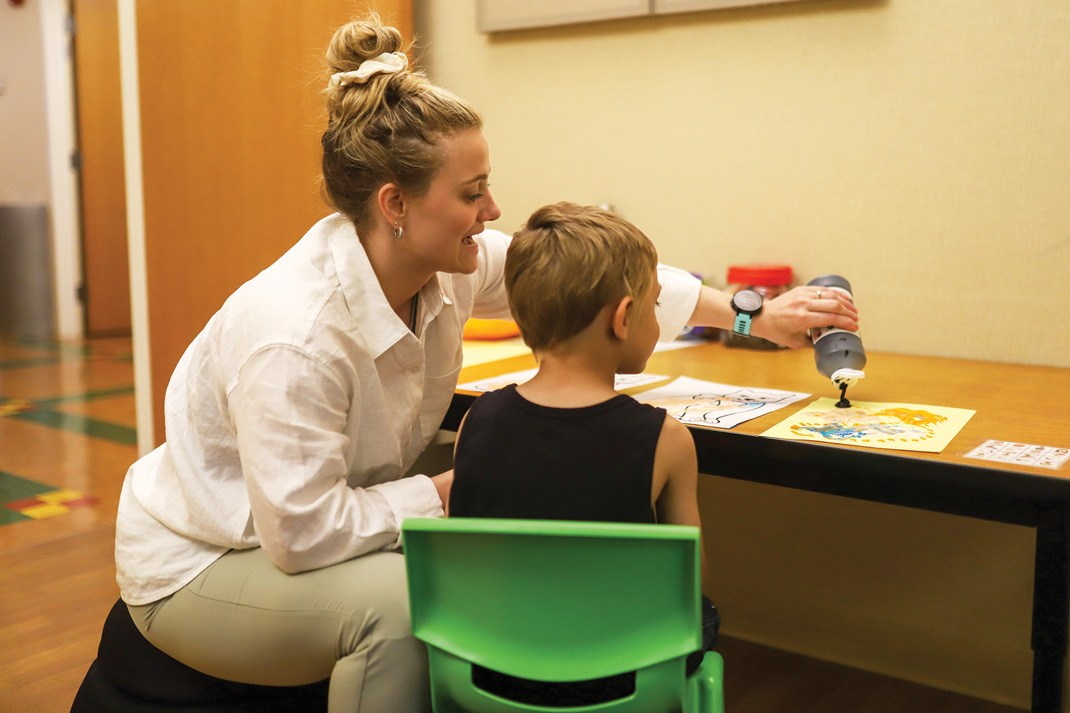
Siskin Children’s Institute works to improve the quality of life for children with special needs and their families. “The goal is to diagnose developmental delay issues as early as possible, then get involved with interventional services to help stop long-term effects that can develop, then help those children become the best they can be,” says Don Mueller, who took over in early 2024 as the Institute’s president/CEO.
HISTORY
Chattanoogan Garrison Siskin sustained a life-threatening injury in 1942 and was told by doctors that he would have to have a leg amputated. Siskin prayed, telling God that if his leg could be spared, he would devote himself to helping others. Siskin kept his leg, and he and his brother launched the Mose & Garrison Siskin Memorial Foundation in 1950. Siskin Children’s Institute opened soon thereafter, offering an early-learning center for children of diverse abilities. In 2009, the Siskin Center for Developmental Pediatrics was added to provide children and families access to medical evaluations, diagnosis and therapy services.
SCOPE
Siskin Children’s Institute partners with families to offer comprehensive developmental medical evaluations and specialized therapeutic interventions. The Institute works with families to address their priorities while celebrating each child’s unique strengths and maximizing their potential. “The world’s understanding of autism has increased dramatically in the last decade,” Mueller says, adding that improvements in “our ability to report and document” has resulted in “evidence-based” methods of treatment coming to the fore. The Institute treats patients as young as 18 months and makes Applied Behavior Analysis (ABA) Therapy available to children 12 years old and younger.