
ARLINGTON, Texas — Major League Baseball could test robot umpires as part of a challenge system in spring training next year, which could lead to regular-season use in 2026.
MLB has been experimenting with the automated ball-strike system in the minor leagues since 2019 but is still working on the shape of the strike zone.
“I said at the owners meeting it is not likely that we would bring ABS to the big leagues without a spring training test. OK, so if it’s ’24 that leaves me ’25 as the year to do your spring training test if we can get these issues resolved, which would make ’26 a viable possibility,” commissioner Rob Manfred said Tuesday during a meeting with the Baseball Writers’ Association of America. “But is that going to be the year? I’m not going to be flat-footed on that issue.
“We have made material progress. I think that the technology is good to a 100th of an inch. The technology in terms of the path of the ball is pluperfect.”
Triple-A ballparks have used ABS this year for the second straight season, but there is little desire to call the strike zone as the cube defined in the rule book, and MLB has experimented with modifications during minor league testing.
The ABS currently calls strikes solely based on where the ball crosses the midpoint of the plate, 8.5 inches from the front and the back. The top of the strike zone was increased to 53.5% of batter height this year from 51%, and the bottom remained at 27%.
“We do have technical issues surrounding the definition of the strike zone that still need to be worked out,” Manfred said.
(READ MORE: Chattanooga Lookouts players consider robo umps’ effect on sport)
After splitting having the robot alone for the first three games of each series and a human with a challenge system in the final three during the first 2 1/2 months of the Triple-A season, MLB on June 25 switched to an all-challenge system in which a human umpire makes nearly all decisions.
Each team currently has three challenges in the Pacific Coast League and two in the International League. A team retains its challenge if successful, similar to the regulations for teams in the majors with video reviews.
“The challenge system is more likely or more supported, if you will, than the straight ABS system,” MLB Players Association head Tony Clark said earlier Tuesday at a separate session with the BBWAA. “There are those that have no interest in it at all. There are those that have concerns even with the challenge system as to how the strike zone itself is going to be considered, what that looks like, how consistent it is going to be, what happens in a world where Wi-Fi goes down in the ballpark or the tech acts up on any given night.
“We’re seeing those issues, albeit in minor league ballparks,” Clark added. “We do not want to end up in a world where in a major league ballpark we end up with more questions than answers as to the integrity of that night’s game or the calls associated with it.”
Playing rules changes go before an 11-member competition committee that includes four players, an umpire and six team representatives. Ahead of the 2023 season, the committee adopted a pitch clock and restrictions on defensive shifts without support from players.
 AP photo by Carlos Osorio / Home plate umpire Marvin Hudson signals during the eighth inning of an MLB regular-season game between the Los Angeles Dodgers and the host Detroit Tigers last Saturday.
What to wear
MLB will consider going back to having players wear their team uniforms for the All-Star Game.
Club uniforms were used by the American League from 1933 to 2019 and by the National League from 1934 t0 2019. When the game resumed in 2021 after the pandemic-related cancellation in 2020, MLB had started a uniform contract with Nike and Fanatics, and players were outfitted in specially designed league uniforms that drew criticism from traditionalists.
This year’s AL uniforms had a sandy base with red sleeves and lettering, and the NL had a navy base with light blue sleeves and lettering.
“I’m aware of the sentiment on this issue,” Manfred told the BBWAA. “I think where my head is on it, it’s something we’re going to have a conversation about coming out of the All-Star Game. We’ve got a lot of uniform things going on. And, obviously, the conversations have to involve the players first and foremost but Nike, some of our partners. But I am aware of the sentiment, and I do know why people kind of like that tradition.”
MLB and Nike were criticized for club uniforms this year and said in May that uniforms in 2025 will have larger lettering on the back of jerseys and individual pant customization. Players complained this year that white pants worn by some teams are sheer enough to show tucked-in jersey tops.
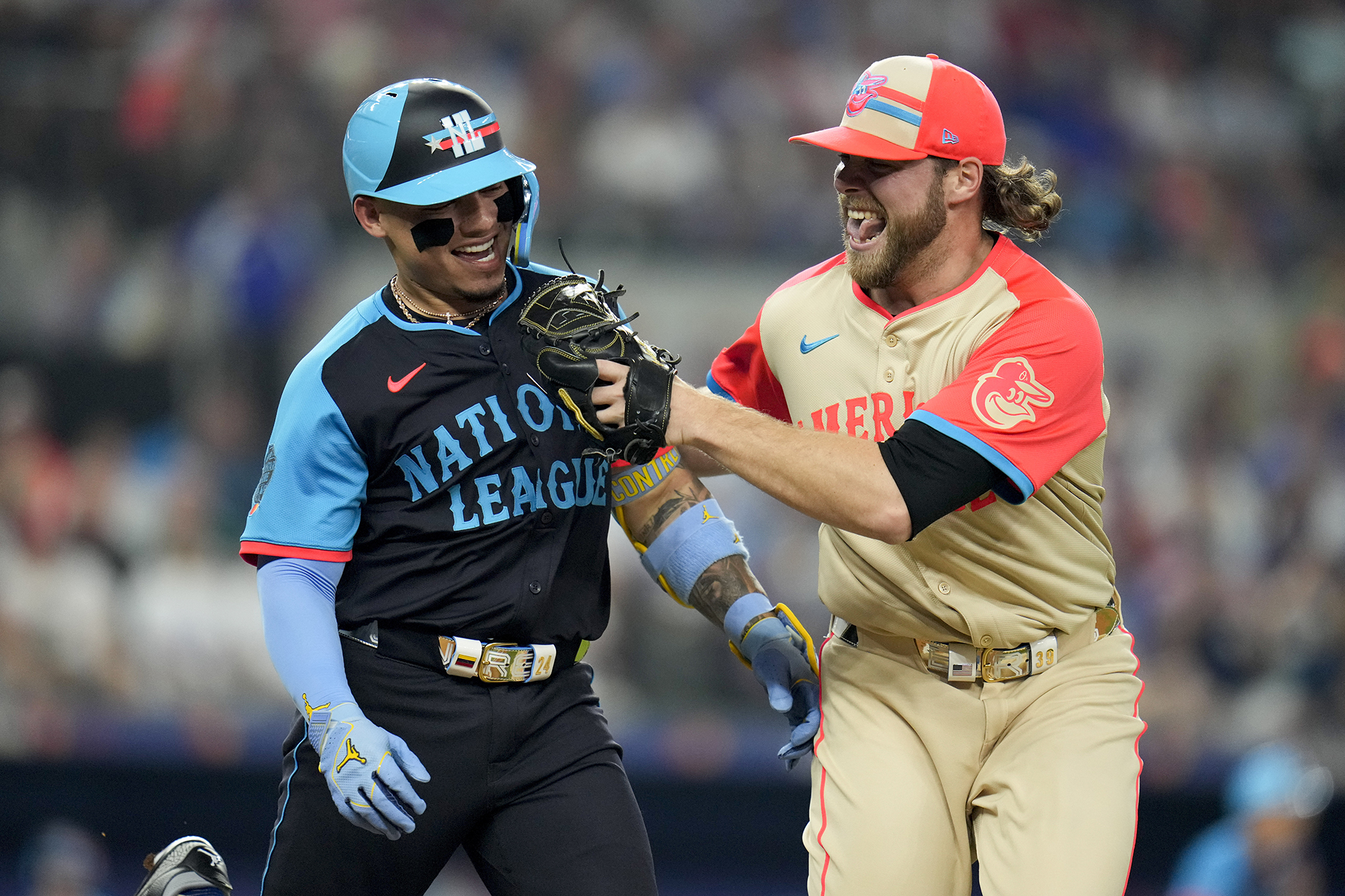 AP photo by Julio Cortez / American League pitcher Corbin Burnes of the Baltimore Orioles, right, jokes with National League catcher William Contreras of the Milwaukee Brewers after he grounded out during the MLB All-Star Game on Tuesday night in Arlington, Texas. Burnes and Contreras were teammates last season in Milwaukee.
Where to watch
Manfred said a national streaming package of local television broadcasts is a future possibility a regional sports networks struggle with viability.
“I could see a situation where we grow into a 30-club model. It might start on the digital side, where you have 14 or 15 clubs and you start with a digital product there as your first alternative,” he said.
“I was in Sun Valley last week, and I did the whole speed-dating thing with everybody who’s ever streamed anything. When you talk to people in the streaming business, they’re not really interested in buying the state of Wisconsin and two counties in Michigan,” Manfred added. “They want to be able to stream, quite frankly, all over the U.S. and Canada but, more broadly, internationally. So I think those conversations are a product of owners saying, ‘Holy cow, the RSN business is really deteriorating.’ We know the future’s going to be streaming. What we’re hearing from the streamers is they want a more national product, and we need to be responsive to what people want to buy.”
MLB took over production of Arizona Diamondbacks and San Diego Padres local television broadcasts last year after the bankruptcy of Diamond Sports’ Bally networks and said MLB will be available as an option for teams looking for new deals. He said Padres game are approaching 40,000 subscribers, which he called a good figure.
“Having said that, from a revenue perspective, it is not generating what the RSNs did,” Manfred said. “The RSNs were a great business. Lots of people paid for programming they didn’t necessarily want. And it’s hard to replicate that kind of revenue absent that kind of bundling concept.”
Is that a problem?
While offense is near half-century lows, it has picked up from early in the season.
“The decline in offense is something that we’re paying a lot of attention to and we’ll continue to monitor to make a decision as to whether we think we need to do something. You do hear a lot of chatter about the dominance of pitching in the game. That’s absolutely true.”
Back to Birmingham
After the success of the June 20 game between the San Francisco Giants and the St. Louis Cardinals at Rickwood Field, which paid tribute to the Negro Leagues, Manfred said MLB will return to the ballpark in Birmingham, Alabama, but the “exact form” had not been determined.