
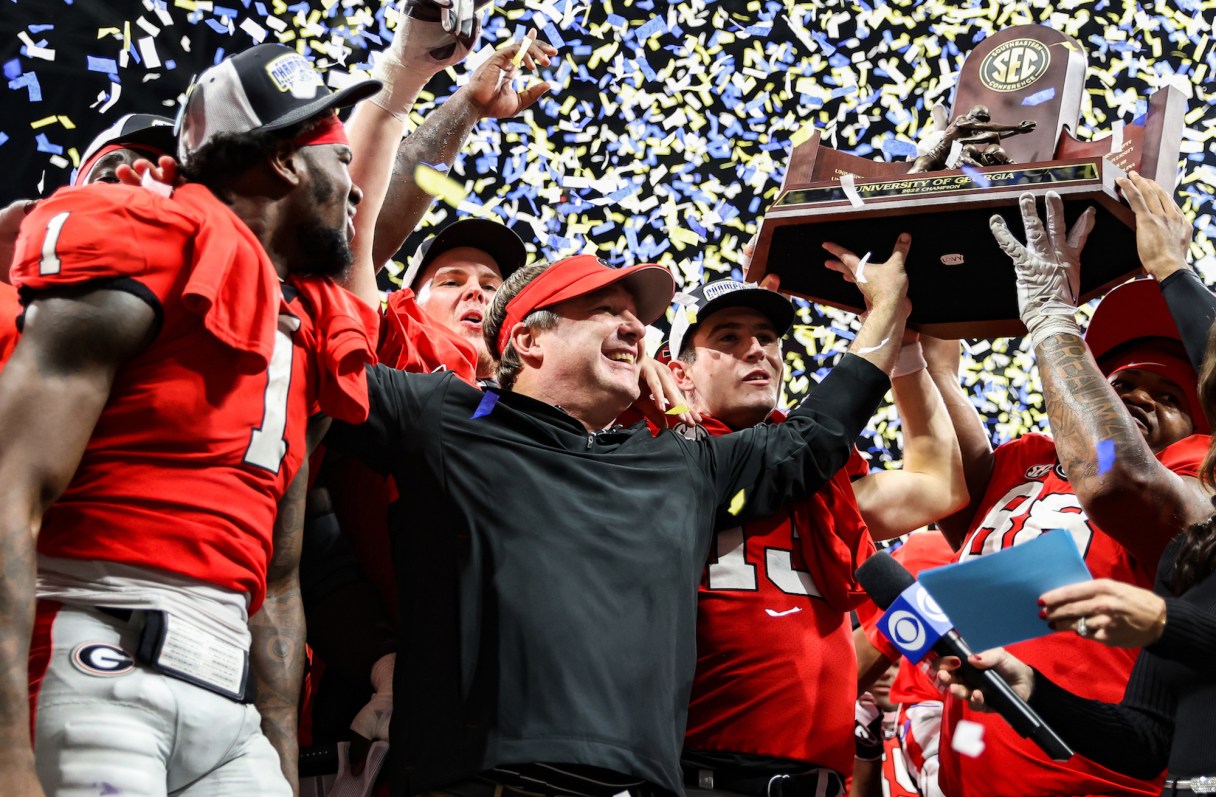

Georgia stumbled a year too soon.
Kirby Smart’s Bulldogs carried a 29-game winning streak into last December’s Southeastern Conference championship contest, but they fell from No. 1 to No. 6 in the rankings following a 27-24 loss to Alabama and missed out on the four-team College Football Playoff and a run at a third consecutive national title. Last year’s SEC championship was among the most impactful in the 32-year history of the event, but has its significance come to an end in this new 12-team playoff era?
Coaches were asked last week at SEC media days in Dallas whether it was even worth still having a league championship.
“I don’t want to see the conference championship go away,” Smart said. “I think it’s one the greatest venues in all of college sports — and in all of sports. The games we have played in Atlanta have been some of the best, most memorable games that I’ve ever been a part of.
“There are teams that look back at that SEC championship, and it’s very meaningful. I don’t want to take away from that meaning.”
The SEC championship game had significant meaning when it was implemented in 1992, as it gave the league an unquestioned winner. Sharing the crown had become nothing unusual, with the 1989 race ending in a three-way tie among Alabama, Auburn and Tennessee, with each going 1-1 against the others.
It served as a national semifinal three times during the final six seasons of the Bowl Championship Series that lasted from 1998 to 2013, with Florida defeating Alabama in 2008, Alabama whipping Florida in 2009, and Alabama surviving Georgia in 2012. It then became an unofficial quarterfinal for the four-team playoff when Georgia beat Auburn in 2017, Alabama topped Georgia in 2018, LSU clobbered Georgia in 2019, and with Alabama’s upset of the Bulldogs last year.
Had last season’s Alabama-Georgia scenario inside Mercedes-Benz Stadium unfolded later this year, both teams would comfortably be in the 12-team field.
“The game has hurt the league in the past,” Arkansas coach Sam Pittman said. “I remember it hurting us when I was an assistant at Georgia, and obviously this last year it hurt Georgia. It’s not going to now, obviously, but don’t you want to see the conference championship and who the winner is?
“I would personally hate to see that game go.”
The SEC hasn’t provided specific revenue breakdowns in its annual distribution announcements in more than a decade. Alabama’s thrilling 32-28 win over Georgia in 2012 generated $16.3 million, and the amount the league championship brings in now would be significantly higher.
Competing for the national championship after playing for a conference title required 15 games in a four-team playoff but will now require either 16 or 17 contests, depending on the seeding. A team that has played 13 games entering the playoff and is seeded among the top four teams would wind up playing 16 contests to have a shot at the national championship, while a team seeded fifth through 12th would wind up playing 17 games.
NFL teams currently play a 17-game regular-season schedule.
“In order to play 17 games at a winning level, you’re going to have to have competitive depth unlike anybody has really faced before,” Missouri coach Eli Drinkwitz said. “That is more challenging now than ever because of the transfer portal and players who leave to go play at another opportunity earlier.”
The revenue alone would seem to prevent the SEC championship from ever going away, and only time will tell if winning in early December will be celebrated like before or get replaced by seeding discussions. There is also the factor of potentially benefiting from not even making the SEC title game, which was the case in Alabama’s 2011 BCS national championship and its 2017 playoff title.
“I still think there is value in winning an SEC championship,” Smart said. “I’ve won two national championships (with Alabama in 2011 and Georgia in 2021) when I didn’t win an SEC championship, and it’s not supposed to happen that way.
“Do I worry about attrition in terms of having more games? I worried about attrition having four teams. Every coach worries about attrition, right?”
Contact David Paschall at dpaschall@timesfreepress.com.