
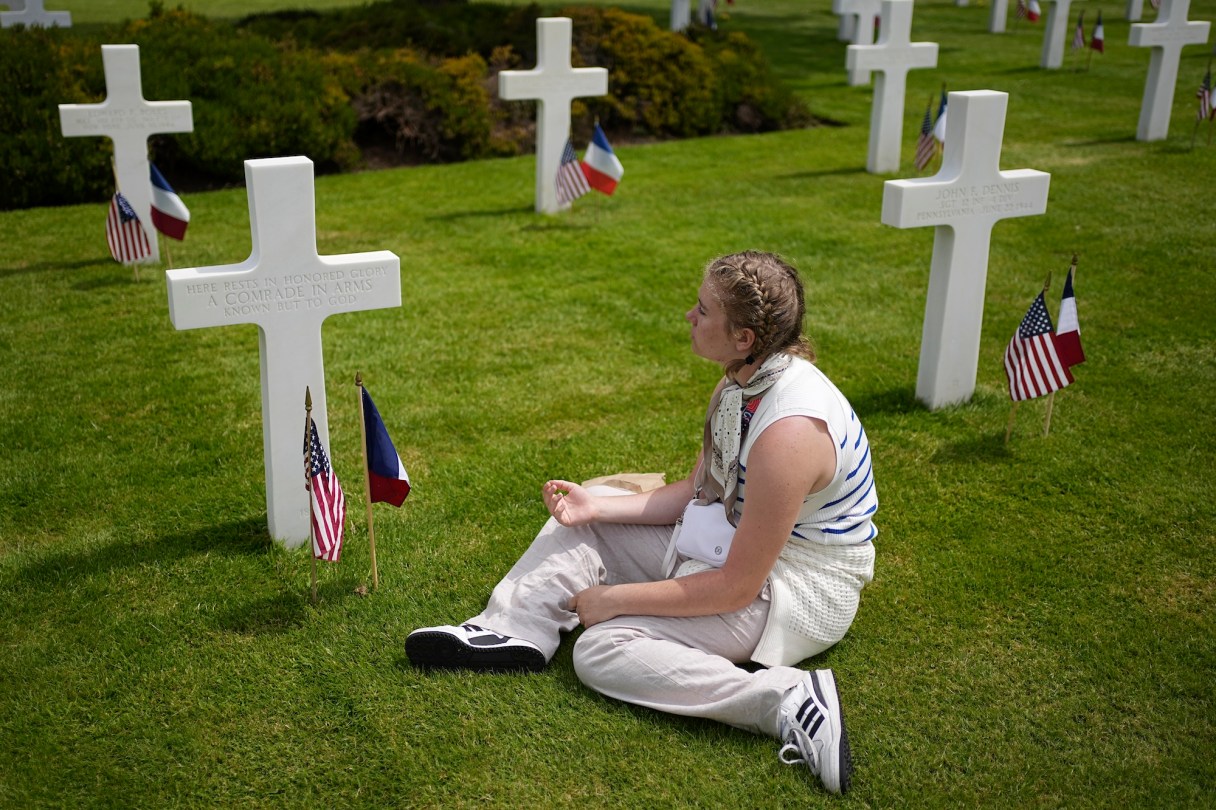
As the 80th anniversary of the invasion unfolded, I received a phone call from my cousin Sam, whom I hadn’t heard from in years. He wanted to know if my father had been involved in D-Day. That day, June 6, 1944, the British, American, Canadian and other Allied militaries launched an assault on Nazi-occupied France by sea, air and land. More than 4,400 Allied troops died that day, including about 2,500 Americans.
My family knew that Dad had served as a military intelligence officer in the U.S. Army, assigned to Europe, but the details were a mystery to many of my relatives. When I watched old photographs of Gen. Eisenhower meeting with the paratroopers shortly before they took off to help protect the troops invading by sea and land, Eisenhower apparently was discussing not the war, but going fishing with one of the paratroopers. Hardly a military conversation, but one that inspired me to tell Dad’s story to my cousin.
After training at the secret military intelligence camp at Fort Ritchie in Maryland, Dad was shipped out to Europe. He landed in England, where he was assigned to be the driver for generals and their staff. Not exactly a battle-heavy assignment, but it was a 24-7 job. In his letters to my mother, assuring her that he was OK, Dad explained that driving back to the barracks one night, he fell asleep at the wheel. His jeep veered into a ditch, and he broke his arm and several other bones. He was supposed to be in the Normandy invasion so that he could serve as an interpreter of French as needed. Instead, he landed in a military hospital — and missed the invasion.
Cousin Sam agreed with me that Dad might have been disappointed, but he was also incredibly lucky, and so was I. If he had been in the invasion, I might not be here at all.
Sam also wanted to know if Dad did get to serve with the Army in France, since he knew that Dad spoke French. Liberating France from the Nazis was not achieved overnight. My father did indeed get shipped to France when he recovered. His discharge papers labeled him as a “spy,” a label he never claimed during his lifetime. Sam was impressed and glad to have a new understanding of our family’s involvement in the war.
When my daughter called on the anniversary of D-Day, she expressed thanks that Dad, her grandpa, hadn’t actually seen action. When I told the story of how he and a fellow soldier were standing in the parking lot of a café in Paris when a bomb dropped in front of them, she was silent. Then I explained that while Dad survived, his comrade was blown to smithereens.
Over a recent meeting at Starbucks, a young colleague explained that watching the 80th anniversary clips on TV was inspiring, giving him new admiration for the “Greatest Generation.” Like many veterans, my father’s humility never would accept the “greatest” description. He said that he was just doing his job and that he received a medal only because there’d been an excess of medals and too few soldiers.
Dad and most of his comrades are gone now, so we must ensure that their wartime stories carry on. Let’s continue to teach our young generations to commemorate the brave sacrifices of our military and their families, and reject any denigration of their service (such as labeling them as losers).
Contact Deborah Levine, an author, trainer/coach and editor of the American Diversity Report, at Deborah@AmericanDiversityReport.com.