
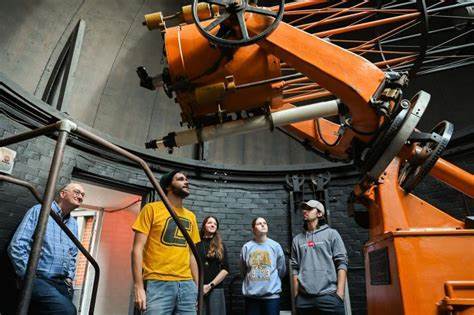
Clarence T. Jones and his vision for Chattanooga’s own observatory gained regional and national support as the plans became public knowledge. Commissioner of Education T.H. McMillan commented in December 1935 that “the time will come when the observatory will attract as many visitors as the Chickamauga Battlefields.” While that pronouncement might have been a bit optimistic, excitement had increased since the Barnard Astronomical Society had fronted the idea of an educational and community observatory, available without charge to those who wanted to know more about “the stars.”
Chattanooga had been the first city to honor the distinguished Tennessee astronomer, Dr. Edward Emerson Barnard of Nashville. Organization of the local Barnard Astronomical Society was followed by similar actions in Knoxville and Nashville. In a Nashville Banner column, amateur planetary observer Latimer J. Wilson applauded Chattanooga’s commitment to advancing astronomy and attaining leadership in the field. “Chattanooga, first to thus honor Barnard in this manner, is now to be congratulated on being the first to build an observatory for public education and recreation.”
Local leaders joined Wilson in congratulating the city for moving the “dream” to reality by applying for the WPA funding, using the technical skills of the society to lower construction costs, and designing and building an enviable telescope. S. Bartow Strang, in a letter to the Chattanooga Daily Times, reminded readers that local astronomers had longed for a real observatory after spending hours in Jones’ private facility in the Glenwood neighborhood. Strang believed that the “little gem” would “at a comparatively small cost … provide additional education advantages to our children that might produce another Barnard,” speculating that the observatory would be a “great” advertisement for the city.
As supporters were writing, the work had begun on the 20-inch telescope. While Chattanooga had gained national and some international acclaim as a “manufacturing hub,” the creation of a world-class telescope was a new arena. The lens, cast at the acclaimed Corning Works, which produced the 200-inch lens for the largest observatory in the world, had arrived in Chattanooga in March 1937, and Clarence Jones, aided by his sons Bruce and Arthur, was grinding the lens in preparation for its mounting in the giant frame being finished by a local foundry. With their efforts and expertise, Chattanooga would have an exceptional telescope at a fraction of the projected cost; instead of the $10,000 tag, Jones’ team would create and assemble the Barnard telescope for less than $1,700.
On March 17, 1937, reporters witnessed the first elaborate test of the lens, including the Ronchi procedure. The results indicated that the lens was “rapidly nearing perfection.”
As the observatory also neared completion, a conversation began among Chattanooga’s leadership about naming. Jones proposed that it be known as the Barnard Observatory in honor of Tennessee’s best-known astronomer. Instead, the leaders voted to title the observatory for Jones, only to learn that WPA funding could not be used to honor a facility for a “living person” — after they had commissioned and installed a stone pediment bearing the local astronomer’s name. Learning of Interior Secretary Harold Ickes’ ruling, the letters were hurriedly covered with stucco. But the name-game was not over.
Congressional members became involved, and Chattanooga received word that “Ickes’s ruling had been defeated” after McMillan mobilized Tennessee’s delegation. Dr. J.P. McCallie, a Ph.D. graduate in astronomy from the University of Virginia, applauded the change of action, suggesting that the stucco could be “chipped out in 10 minutes.”
But not everyone was happy about the change in plans. In a May 13, 1937, meeting, Jones stepped forward.
“I do have some rights in this matter, and I won’t have this observatory named for me,” he said, suggesting that the pediment could be replaced for less than $20, and he would gladly pay that cost. His comments drew, as the Times reported, a loud “round of no’s.” The meeting adjourned with three names being batted — Brainerd observatory, Jones observatory and Barnard observatory. Ultimately, Jones lost the argument, and the facility bore his name.
Reservation letters and telegrams began flowing in from “almost every state in the Union and from England, Canada and Romania.” On a dark, cloudless evening in January 1938, reporters from across the nation observed as the telescope focused on the moon, Saturn, “Sirius, the brightest of all stars, the red giants, Betelgeuse and Aldebaran,” and the great nebula in Orion. The media was joined by hundreds of visitors during the next three evenings.
Linda Moss Mines is Chattanooga’s and Hamilton County’s historian. For more on local history, visit chattahistoricalassoc.org.