
Friday, October 30, 2026Oct 30

This story is exclusive to subscribers.

Does the bread actually become Jesus? Divergent views among U.S. Catholics spawned a major initiative, and it’s coming to Chattanooga

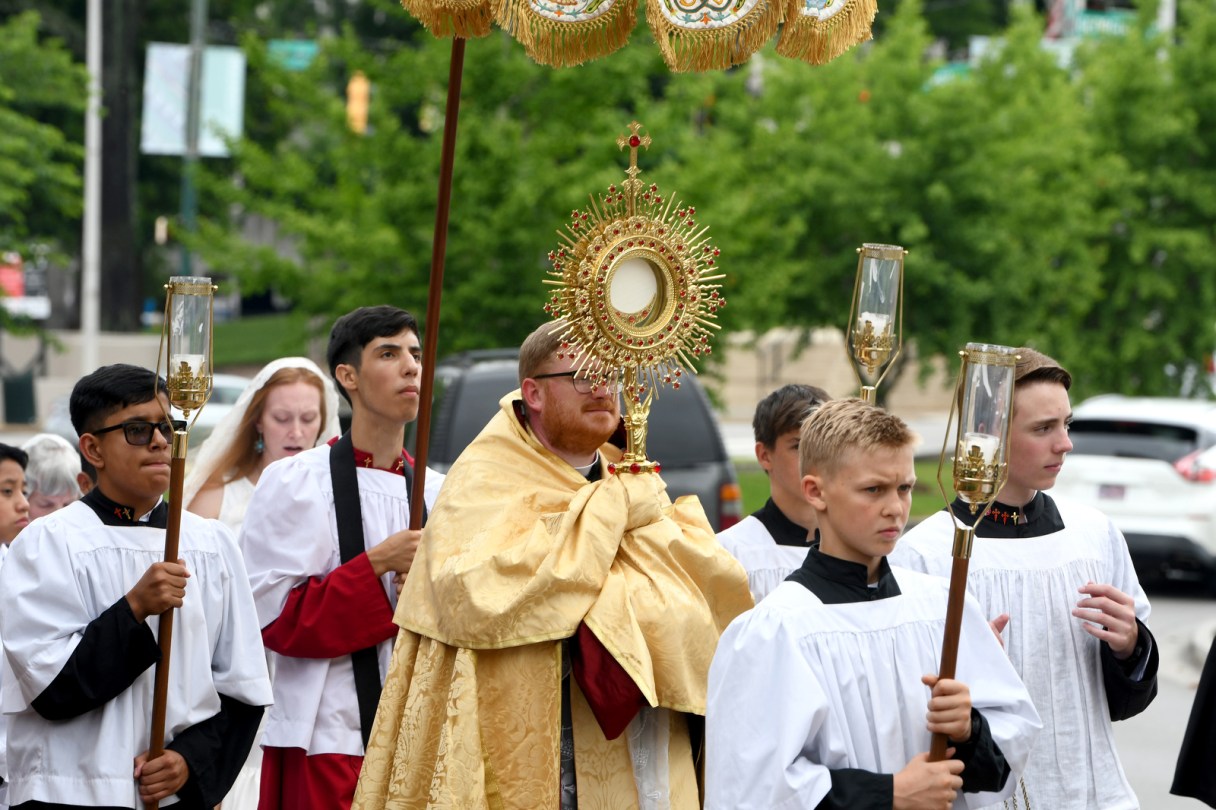
Staff Photo by Robin Rudd / The Rev. David Carter, pastor of the Basilica of Saints Peter and Paul, carries the monstrance containing the consecrated Host during a Corpus Christi procession on June 2.  The procession's route was along Eighth Street to Georgia Avenue, down McCallie Avenue and returning to the church by Lindsey Avenue.
Staff Photo by Robin Rudd / The Rev. David Carter, pastor of the Basilica of Saints Peter and Paul, carries the monstrance containing the consecrated Host during a Corpus Christi procession on June 2. The procession's route was along Eighth Street to Georgia Avenue, down McCallie Avenue and returning to the church by Lindsey Avenue. Staff Photo by Robin Rudd / The Rev. David Carter, pastor of the Basilica of Saints Peter and Paul, carries the monstrance containing the consecrated Host during a Corpus Christi procession on June 2. The procession's route was along Eighth Street to Georgia Avenue, down McCallie Avenue and returning to the church by Lindsey Avenue.

The Rev. David Carter keeps the photo close at hand: His first mass as a priest at St. John Neumann Catholic Church in Knoxville. He pronounced the words that he believes, through the power of the Holy Spirit, transformed the bread and wine before him into the flesh and blood of Jesus Christ.

Carter means that quite literally. But in 2019, a widely cited study found that most U.S. Roman Catholics are inclined to see the Holy Communion — during which they generally consume a consecrated wafer of bread in which Jesus is said to be present — as more of a symbolic affair.

Some felt that study had flaws and pointed to others with different findings. Some said its findings were actually nothing new.

Still, many traditionalists were moved to action by its core conclusion: Most U.S. Catholics held distinctly non-Catholic views of a foundational rite — a rite the church Catechism describes as “the source and summit of the Christian life.”

“There’s something about this particular survey that so perturbed people,” said Shane Owens, a theology professor at the Franciscan University of Steubenville. “I jokingly call it ‘The survey that launched a thousand initiatives.'”