
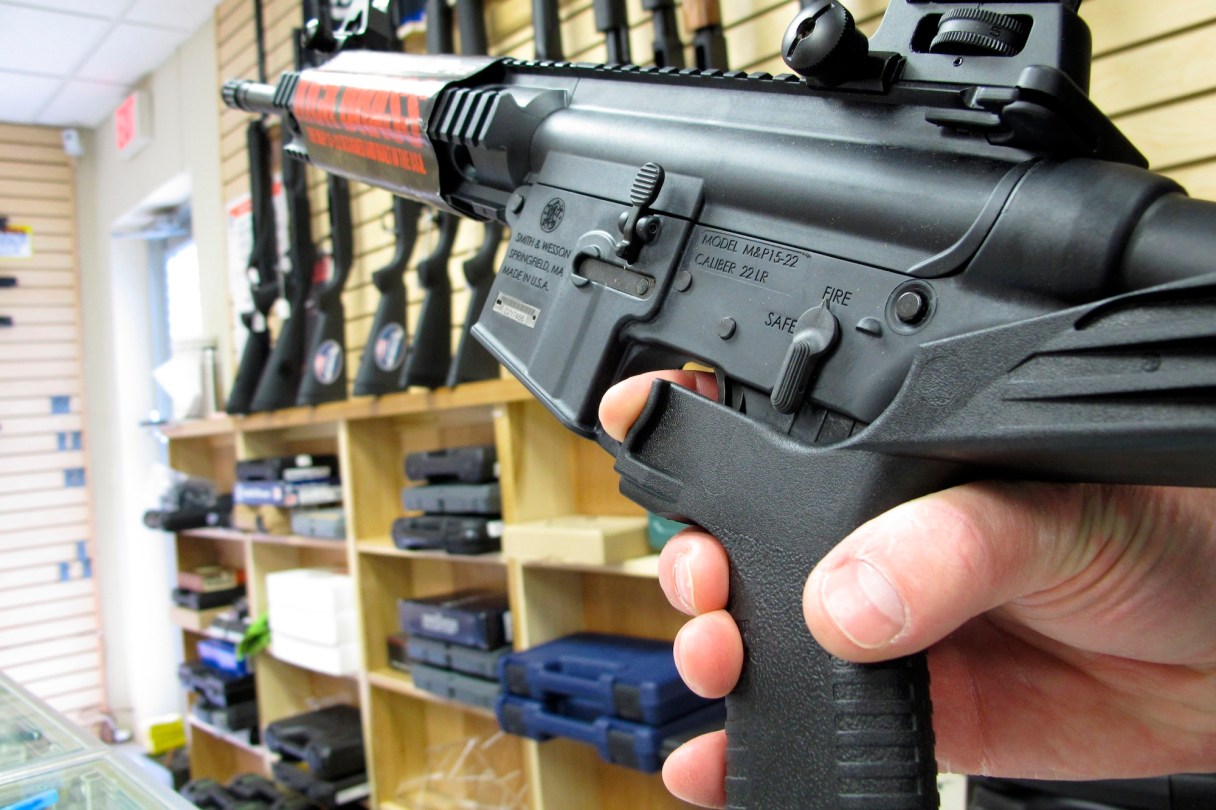
A semiautomatic rifle equipped with a “bump stock” can fire at a rate of up to 800 rounds a minute. Does that make it a machine gun? Joe Biden and Donald Trump have said yes. The Supreme Court appears divided.
Typically, when a shooter pulls the trigger of a rifle, it “recoils,” or kicks backward. A bump stock is a device that usually attaches to the back of the firearm and harnesses this rearward force, along with the forward pressure of the shooter, to push the trigger against the shooter’s finger multiple times, enabling them to fire faster than would normally be possible without assistance.
These technicalities are at the center of a case challenging a Trump administration ban on such devices, proposed months after a shooter employed them while killing 60 people and injuring hundreds at a concert in Las Vegas in 2017. Trump’s executive order — which banned the possession and sale of bump stocks, and required gun owners to surrender or destroy them — was enacted over the objections of some Justice Department officials, who said congressional action would be necessary.
The Supreme Court is now weighing the evidence. At issue is whether a firearm with a bump stock meets the legal definition of a machine gun —a weapon that fires more than one shot with a single “function of the trigger.” (In 90 minutes of oral arguments, the phrase was uttered no less than 81 times.) The Army veteran and gun-store owner who sued the government claimed that while bump stocks accelerate the rate of fire, they still require “multiple functions of the trigger” because the shooter’s finger pulls it repeatedly.
Defining a deadly weapon shouldn’t be this hard. A firearm that sprays bullets in this manner — whether a trigger is pushed, pulled, pressed or activated by myriad other “functions” — should be considered a machine gun. The federal government has heavily regulated machine guns since the 1930s and has previously banned other devices that convert a firearm into one.