
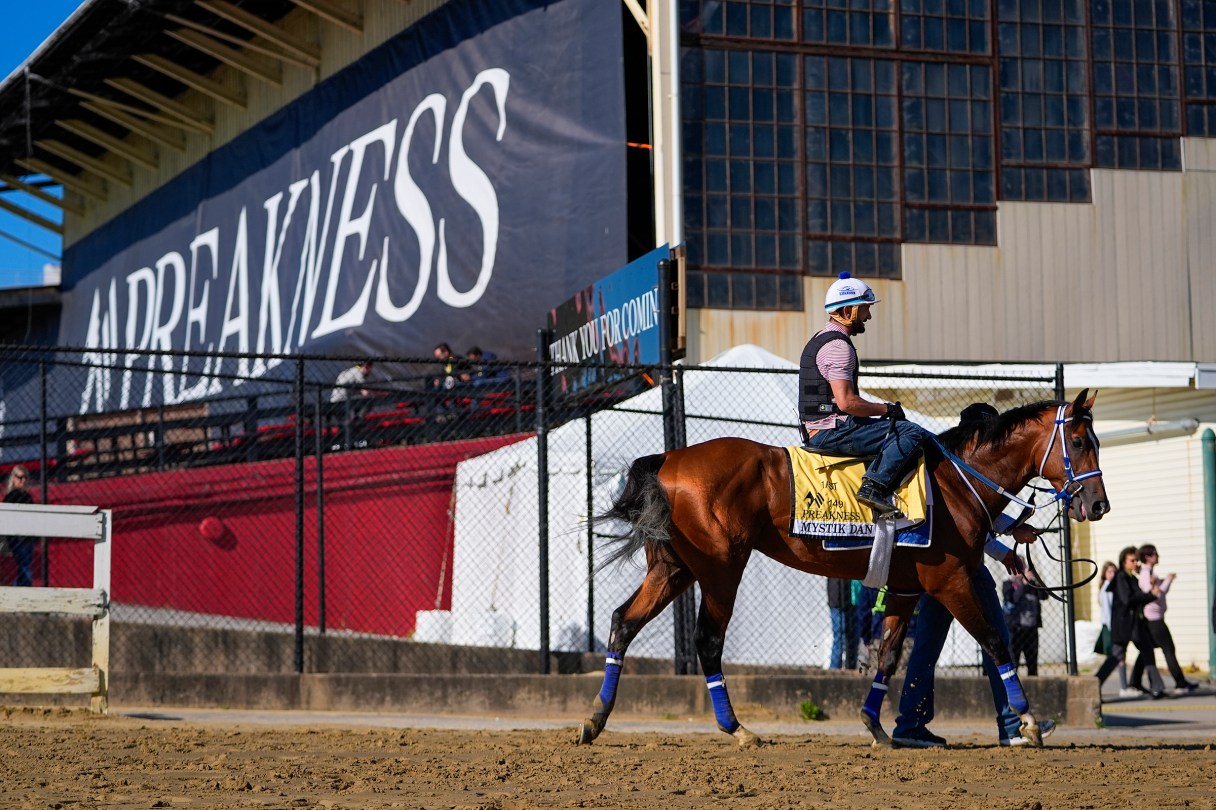
BALTIMORE — D. Wayne Lukas sat in his corner of the stakes barn at Pimlico Race Course earlier this week and pointed several stalls down.
“Thank God the Derby horse came,” the 88-year-old trainer and U.S. Racing Hall of Fame member said, referring to Kentucky Derby winner Mystik Dan running in Saturday’s 149th Preakness Stakes. “It isn’t always a cinch.”
It used to be automatic, something that until recent years made the Preakness a must-see event with a Triple Crown chance nearly always on the line. That was not the case from 2019-22 for various reasons, and the mere possibility of Mystik Dan skipping the Preakness has led to debate over whether the race should be moved back a week or more, as well as what can be done to restore the prestige it has had for the better part of 150 years.
Lukas, whose next two Preakness runners will be his record-extending 47th and 48th over more than four decades coming to Baltimore, said the thought of it becoming the “stepchild” of the Triple Crown doesn’t sit well with horsemen who love showing up.
However, he does worry about younger colleagues being reluctant to send their top 3-year-olds back from the Kentucky Derby on the first Saturday in May to the Preakness on the third Saturday in May, comparing the loss of big-name horses to having an NFL game without Kansas City Chiefs star quarterback Patrick Mahomes.
“I don’t know where they got that, but a lot of the younger trainers don’t want to come back in two weeks,” Lukas said. “If they extend that — I’ve been preaching this for 25 years, though — you would get a bigger field. Most of the Derby horses would come.”
Three such horses are set to take part in the Preakness on Saturday, up from one last year, two in 2022 and one in 2019. Except for 2020, when the Triple Crown was run out of order because of the COVID-19 pandemic, since 1969, the traditional spacing has been two weeks between the Kentucky Derby and the Preakness with the Belmont Stakes three weeks after that in New York.
Top thoroughbreds nowadays rarely run every 14 days or so, a development two-time Triple Crown-winning trainer Bob Baffert compared to pitch counts in baseball and analytics-driven alterations in other sports.
“It’s changed in a way,” said Baffert, who has won the Preakness a record eight times. “I remember when I first came in, the Preakness has always been a very historical race, and people liked to run in the Preakness — the Triple Crown and whatever. I’m probably old school when I came in, so now there’s a different approach to it where they want to give their horses extra time.”
Last summer, 1/ST Racing, which operates the Preakness, floated the concept of moving it back — possibly as far as four weeks after the Kentucky Derby. The New York Racing Association said at the time it had no plans to change the date of the Belmont from its spot in early June, with the idea of it pushing back to potentially conflict with Fourth of July celebrations a nonstarter.
Trainers often name the Belmont as a target destination for horses that run in the Kentucky Derby but also fall short of victory at Louisville’s Churchill Downs. The third jewel of the Triple Crown also has no concerns about prestige each of the next two years because of the novelty of the Belmont being run upstate in New York at historic Saratoga Race Course. The race is already a sellout, as well as a festivity many in the industry and area have been salivating over since reconstruction plans for Belmont Park on Long Island first emerged.
A similar project is coming to Pimlico, but a one-year shift to Laurel Park down the road halfway to Washington in 2026 is a Band-Aid, not something anyone is looking forward to. Even in Baltimore, something has to give to bring people back after the Preakness drew 42,000 spectators in 2022 and 47,000 last year — low attendance, even if weather-related, compared to crowds of 100,000-plus each year from 2011-19.
One argument to fix that, beyond the needed renovations, is having the Kentucky Derby winner and other prominent horses back from that race. The traditionalist side of Baffert does not want to see the timing of the Triple Crown change, but he and other veterans aware of the troubling trends are willing to consider different possibilities to make the Preakness desirable again.
“This is a very important race, and it’s an historical race, and it’s a very important race to win with a 3-year-old,” Baffert said. “You want to see the best horses competing in all three races.”