
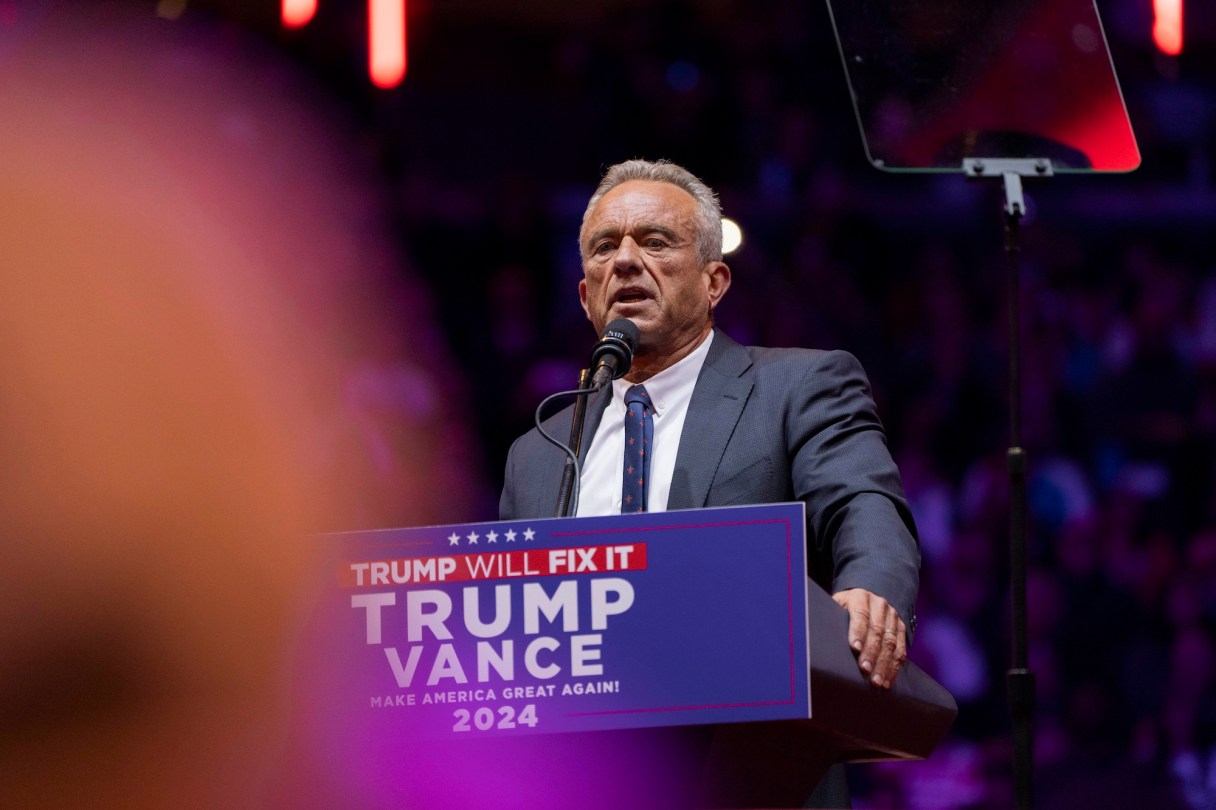
President-elect Donald Trump’s announcement of Robert F. Kennedy Jr. as his choice to be secretary of Health and Human Services has provoked a lot of objections, many of them explaining how he would be a danger to both scientific progress and public health. But too little has been said about the economic damage he could do as leader of one of the most significant branches of the administrative state.
Spending on health care constitutes more than 17% of the U.S. economy. The HHS secretary oversees reimbursement rates for Medicare, which accounts for about 14% of the entire federal budget.
One of the problems with an RFK Jr. ascendancy is that his core views, which run strongly against vaccines and pharmaceuticals, make it unlikely that any of these reimbursement revisions will be done in a rational or scientific way. The best evidence indicates that pharmaceuticals are a relatively cost-effective ways of saving lives. One of the main drawbacks of the U.S. health-care system is often described as overtreatment, yet some vaccines and drugs – the COVID vaccines, GLP-1 medications and HIV-AIDS treatments, to name just a few – are yielding very high returns.
The danger is that, with RFK Jr. at HHS, the U.S. would restrain health care spending in exactly the wrong areas. The human costs of such a mistake are obvious, but from a more narrow fiscal perspective, a sicker America would lead to even more serious budgetary problems.
HHS also oversees liability protection for vaccines. Most approved routine vaccines have had liability protection for almost 40 years, which makes it much easier to bring them to market. In the absence of such protection, vaccine manufacturers would be plagued by many more lawsuits, often trivial ones. Another scenario is that a vaccine with a strongly positive social value but side effects for some users could be pushed off the market.