
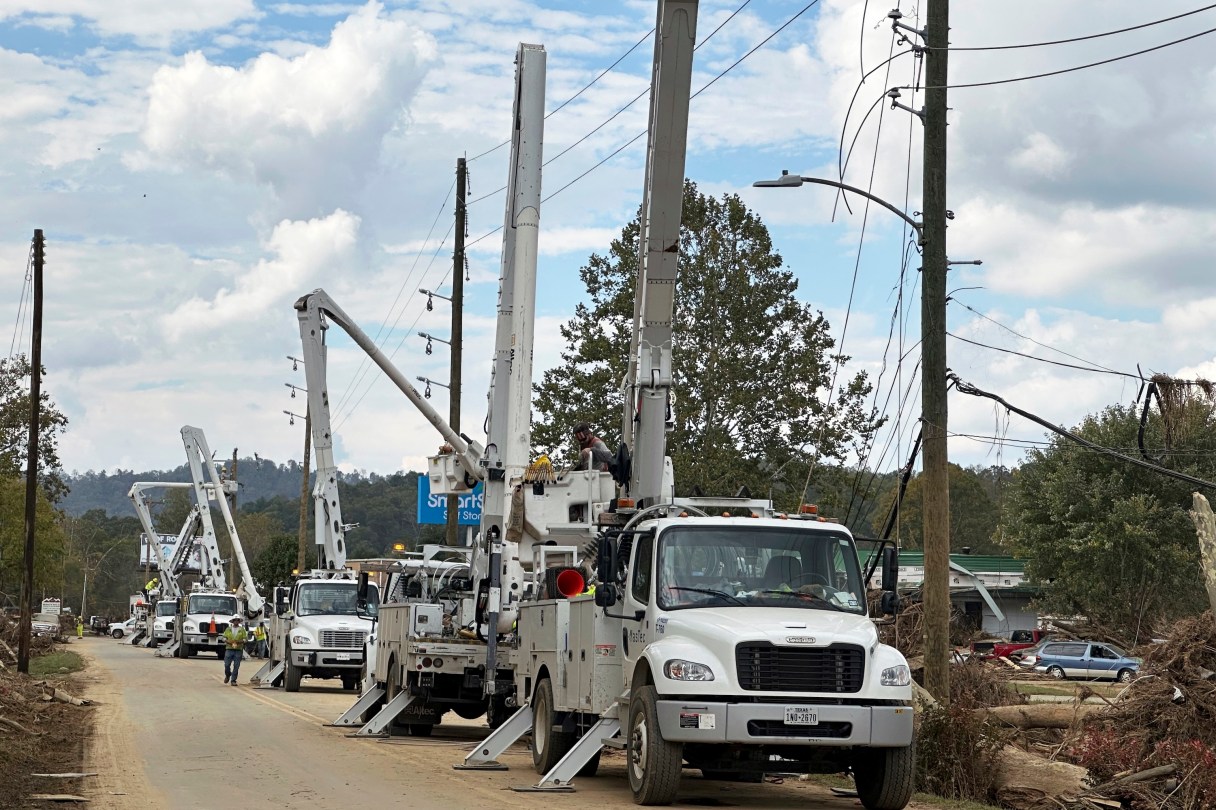
ASHEVILLE, N.C. (AP) — The weary and worn residents of Julianne Johnson’s neighborhood in Asheville have been getting by without electricity since Hurricane Helene tore through the Southeast last week and upended their lives. They’ve been cooking on propane stoves and using dry erase boards to keep up with local happenings while wondering when the lights would come back on.
Johnson, who has a 5-year-old son and works for a land conservation group, received a text from Duke Energy promising her power would be restored by Friday night. But as of midday, utility poles and wires were still draped at odd angles across the streets, pulled down by mangled trees.
“I have no idea what’s next,” said Johnson, whose family does have some power thanks to a generator. “Just the breadth of this over the whole region, it’s kind of amazing.”
She and her neighbors have been taking care of each other since Helene came ashore Sept. 26 as a Category 4 hurricane and carved a path of destruction as it moved northward from Florida, killing at least 220 people in six states, including at least 72 in Buncombe County, which includes Asheville. Block captains set out whiteboards with information about who can provide first aid and where to get tools repaired.
Nearly 700,000 homes and businesses — mostly in the Carolinas and Georgia — were still without electricity Friday, according to poweroutage.us. That’s an improvement over the more than 2 million customers without power five days ago, and Duke Energy, the dominant provider in North Carolina, said it hoped to have the lights back on by Sunday night for many of its affected customers. But for roughly 100,000 customers in places with catastrophic damage, it could be next week or longer, according to company spokesperson Bill Norton.