
NASHVILLE — The leaders of the Big Ten Conference and the Southeastern Conference want to see how the first year of the expanded College Football Playoff works before deciding what comes next.
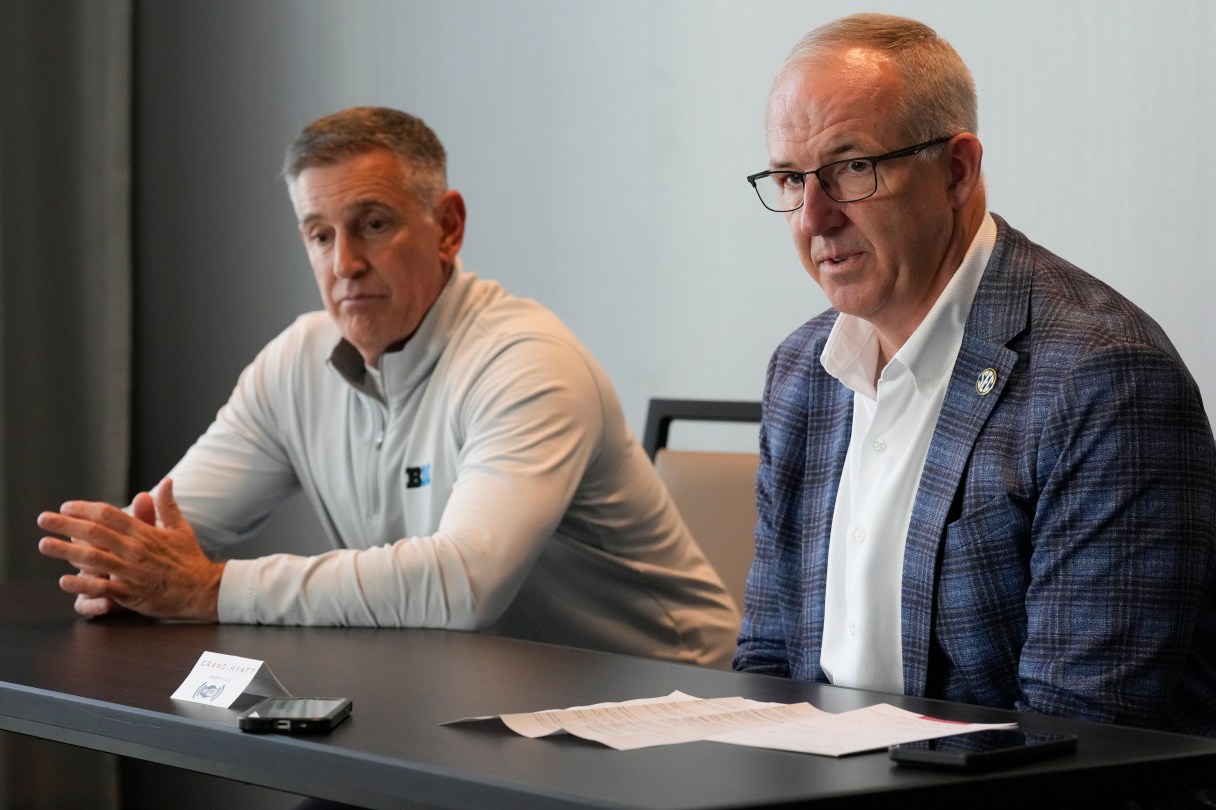
Representatives from both powerful leagues met Thursday with Big Ten commissioner Tony Petitti and SEC commissioner Greg Sankey to go over the changing landscape of college athletics.
College football’s 12-team playoff format, which debuts this season after a decade as a four-team event, was at the top of the list. Sankey made clear the school presidents and athletic directors want to see how this works first and didn’t spend much time talking about “what-ifs.”
“This just has to go incredibly well,” Sankey said. “This has to be a successful launch. This isn’t the time to talk about governance in ’26 or the format in ’26. But the immediate implementation is in front of us.”
There’s a chance two teams will be added to the CFP in 2026, when ESPN’s six-year, $7.8 billion contract to televise the event begins.
These two conferences have made little secret about someday wanting more than the single automatic bid each will be allotted this season and next. They have spoken about wanting more guarantees, and less unpredictability, most of which would stem from the selection committee that begins posting its rankings on Nov. 5 for this year’s CFP.
One of that committee’s key factors will be strength of schedule, and Sankey said his conference will be evaluating the committee’s work at the same time the committee evaluates the teams. Last year, the committee took heat when it left out undefeated Atlantic Coast Conference champion Florida State from the final four-team edition of the national championship bracket for the Football Bowl Subdivision.
“How the committee evaluates the strength of schedule is important, and I’ll be curious to see how teams are placed within the bracket,” he said. “I think that’s an important learning experience.”
Thursday’s session included a blank screen that will be filled out by the top five conference winners as ranked in the CFP committee’s selection poll on Dec. 8, followed by the next seven highest-rated teams. Currently, eight of the top 12 teams in the AP Top 25 are from the Big Ten and SEC.
Sankey said leaders scoured through the legal details about the playoff, and he spent hours on calls with SEC lawyers detailing the final points of what that CFP agreement looks like. Athletic directors were updated on those matters.
On another topic, Petitti and Sankey batted down the idea of college “super leagues” and private equity as options to tap new revenue. Sankey said he saw it as no coincidence that reports about the leagues surfaced ahead of this meeting of college sports’ two biggest conferences.
The SEC commissioner pointed to the NFL’s cautious handling of private equity as a lesson in just how complicated it can be. Petitti said he saw nothing “proprietary” in the plans for super leagues (leaving out the detail of the billions they could potentially inject into the sport).
“I have yet to see a single thing in any plan that contains things that we couldn’t do ourselves and do with other colleagues,” he said.
The leaders also talked about how the Big Ten and SEC could work together on scheduling more games between the conferences, which would boost the strength of schedule for their members.
Their leagues have met in four games already this season. Reigning SEC champion Alabama routed host Wisconsin in Madison, Texas went into Ann Arbor and thumped Michigan — the reigning Big Ten and national champion — and LSU lost a close game to Southern California in Las Vegas to open the season, then beat visiting UCLA in Baton Rouge in late September.
The commissioners said it would not take several years to add more such games to the schedule. However, Sankey said the SEC adding a ninth conference game, which would match the number that Big Ten teams play, isn’t seen as a dealbreaker for some scheduling agreements between the conferences.
Meanwhile, the lawsuit settlement that was temporarily approved earlier this week by a federal judge and could lead to schools making direct payments to athletes was a prime topic, though the leaders were limited in what they could talk about.
For instance, most of the biggest schools are expected to dole out $21 million in revenue to athletes, but if they talk specifics among each other, it could be viewed as collusion and get them in trouble with the court.
Asked about the NCAA’s future in governing athletics, though, Sankey said it has to change.
“The Division I Council doesn’t work given what’s changing around us,” Sankey said. “I think the board of directors at the Division I level has to change, and it has to change rapidly.”
This is the kind of talk that can stoke concern among smaller conferences who might worry that the Big Ten and the SEC, with their combined 34 teams and large share of decision-making power in football, could break away someday.
“I think that’s a created perception,” Sankey said, adding that “big problems are not solved in big rooms filled with people.”
He dismissed the thought that the conferences control every decision regarding the future of the playoff.
He believes there’s a role for the NCAA, especially when it comes to putting on national championship events.
“We also have to have a much different decision-making system and role for us in decision-making,” Sankey said.