
I glanced over at my buddy, and I could tell he was near the breaking point. Tiny beads of sweat were forming on his forehead, and his groans of pain were getting louder. He was clearly in bad shape, and I wondered how long he could last.
Was he being tortured by some evil people? Was he suffering on a hospital bed?
No, he was trying to assemble a tree stand. (Did I mention we were far out into the woods, with very poor tools? Yeah, it was great fun.)
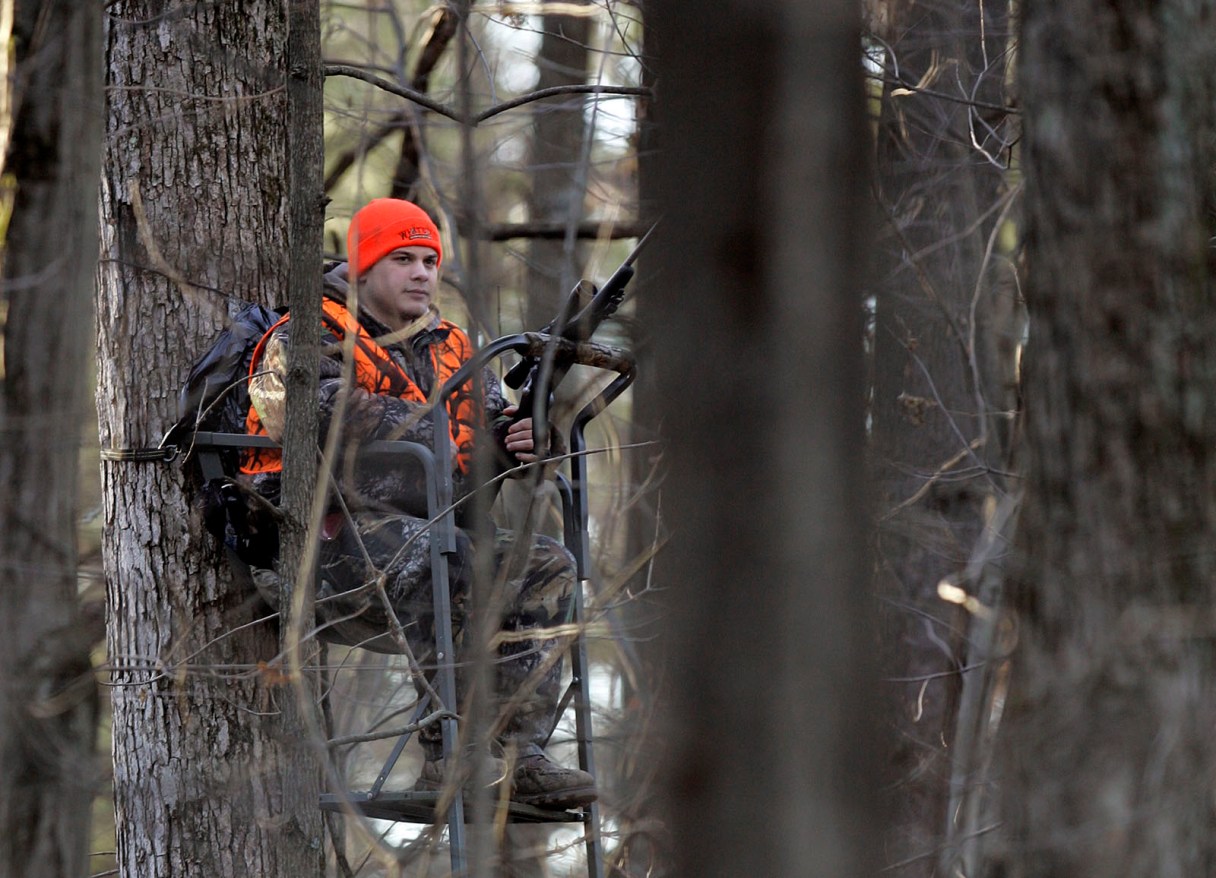
One of the things that have always fascinated me about deer hunters is their obsession for sitting up in trees. Now I understand why they do it (or at least I think I do), getting above ground and out of the wind currents so the deer can’t catch your scent and all that.
The whitetail deer, Odocoileus virginianus, (before you ask, I don’t have a clue how to pronounce that) is well known for having an incredible sense of smell. Their noses may be as finely tuned as that of our buddy the black bear, and deer hunters know that if you don’t play the wind, you ain’t gonna see that monster buck. This is the reason we have a multimillion dollar industry associated with tree stands.
Many deer hunters will not talk about a well-documented malady known as tree stand tedium (full scientific name: tree stand tedium infinitus boredoutofyourgourdus). The basic premise of the disease is this: You climb into your tree stand; it is a beautiful fall afternoon, and you are really stoked to be there and hopefully get a chance at the behemoth buck you have been seeing on your trail cam for a month (always at night, of course).
(READ MORE: Trail cams help hunters; do they hurt hunting?)
About the first hour and 15 minutes, things are great. You are the hunter becoming one with nature, soaking in all the sights and smells of the woods in early November. As you move into the third hour, though, you realize the seat in your tree stand is not as comfortable as you thought it was. Your discomfort aside, the warm sun, the peaceful setting and too much lunch is starting to take a toll. You are getting drowsy.
What we are witnessing here is the cause of maybe the most frequent tree stand accident. That is falling asleep and simply falling out of the tree stand. I know, it may sound kind of funny while we are here in the comfort of our living room and drinking coffee. When we are in the wild woods, miles from any help, it is not so humorous.
Maybe I have told you before, but when I wore the badge and gun for the West Virginia DNR, I investigated an accident where the hunter dozed off and fell out of the tree stand into a briar thicket. Twice in the same morning. Thankfully, he received no serious injuries.
(READ MORE: It’s a slippery slope, and I have the bruises to prove it)
Many other hunters are not so lucky every year. Here are some tips to think about to keep you safe this fall and winter.
— Get a good safety harness and wear it. (Every time you get in the stand!) There is no substitute for a good safety harness; it will keep you from falling and could save your life.
— Use a lifeline. A lifeline is a secured line that runs from the top to the bottom of your tree stand. You clip into it when you start from the ground to climb into your stand. It will save you from falling when climbing up and down and while in the stand. Use it.
— Always have two hands and one foot (or two feet and one hand) on the ladder while climbing. This is the three-point rule: three points of contact on the stand or ladder at all times.
— Use a haul line to get your bow or gun and other gear in and out of the stand. This eliminates carrying gear up and down the ladder.
— Inspect your equipment thoroughly at the beginning of hunting season, as well as during the season. Loose nuts and bolts, frayed straps and ropes, and other wear and tear on tree strands are not your friend. Check this often, and carry the appropriate wrench or ratchet in your day pack to make tuneups in the field. This could keep you from falling!
— Make a plan for your hunt, and make sure someone knows where you are and when you come in and out of the woods. During my DNR days, many times we were called to look for a hunter after dark, and friends and family had no idea where he was hunting.
Well, those are the high points, and experienced hunters out there know there are many other factors to consider to have a safe and successful season. If you are unclear about this, it is a good time to engage the help of an experienced hunter as your mentor. Hunter-ed.com is also a great source of information about tree stands and many other hunter safety topics.
Be safe and wear that blaze orange and safety harness!
“Guns & Cornbread” is written by Larry Case, who lives in Fayette County, W.Va. You can write to him at larryocase3@gmail.com.