
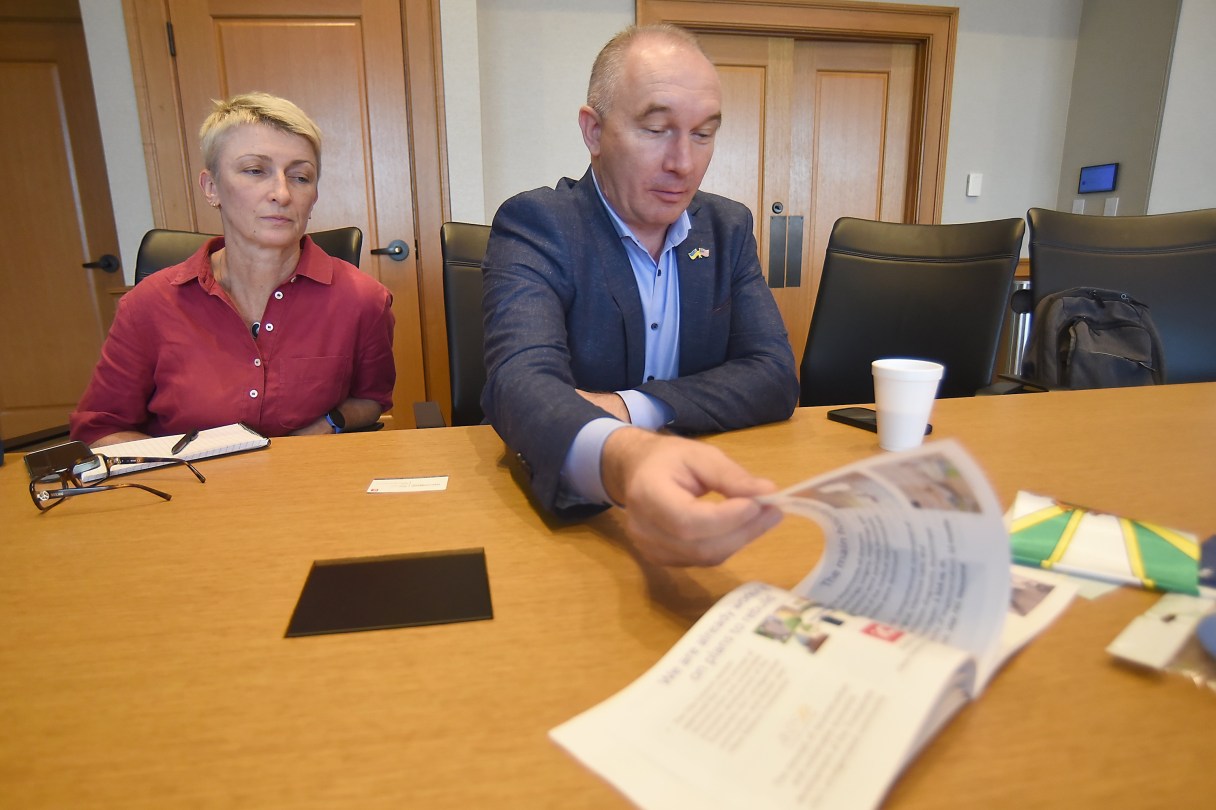
Always a fan of international projects, I attended a recent reception marking Chattanooga’s new collaboration with the Ukraine city of Trostyanets. What a pleasure to meet its mayor, Yuriy Bova. Chattanooga Mayor Tim Kelly had formalized a cooperative agreement with the war-torn Ukrainian city that’s only 20 miles from the Russian border.
Speaking with Bova and his interpreter, I was delighted when he mentioned his desire to be online. I told him about my podcast and asked if he’d like to do an interview. Never imagining that he would say yes, I held my breath as his staff made the arrangements to connect my office in East Ridge with his in Ukraine. Would this actually happen?
I’m reminded of what I learned interviewing Holocaust survivors for a documentary I made more than 30 years ago. My videographer asked, “Are you sure you’re ready for this?” I assured him that I’d read dozens of history books and was ready. “It’s different when you hear these stories in person.” I said I’d be OK. And I was. But I was never the same. Those stories remain embedded deep inside me decades later. Bova’s stories of the month-long occupation in 2022 by Russian troops will always be with me, too.
The troops who occupied Trostyanets were special forces that Putin had assigned to head the parade celebrating the Russian takeover of Kyiv, Ukraine’s capital. During that month, the Russian troops killed civilians for amusement: folks walking in the street, grocery shopping, going to a doctor’s appointment. And they stole everything: groceries, clothing, kitchen items and hospital equipment. Not one computer was left.
Angry that Trostyanets had a modern hospital, the troops demolished it. They did the same to schools, stores, apartment buildings and homes that they didn’t take over as living quarters. Its historic monuments were badly damaged, including the train station that had made Trostyanets one of Ukraine’s earliest railroad hubs. Bova noted that seeing this every day is traumatic. Most of Trostyanets citizens fled, and Bova described the result as gut-wrenching. “We need to restore everything and fight for every person who should return.”