
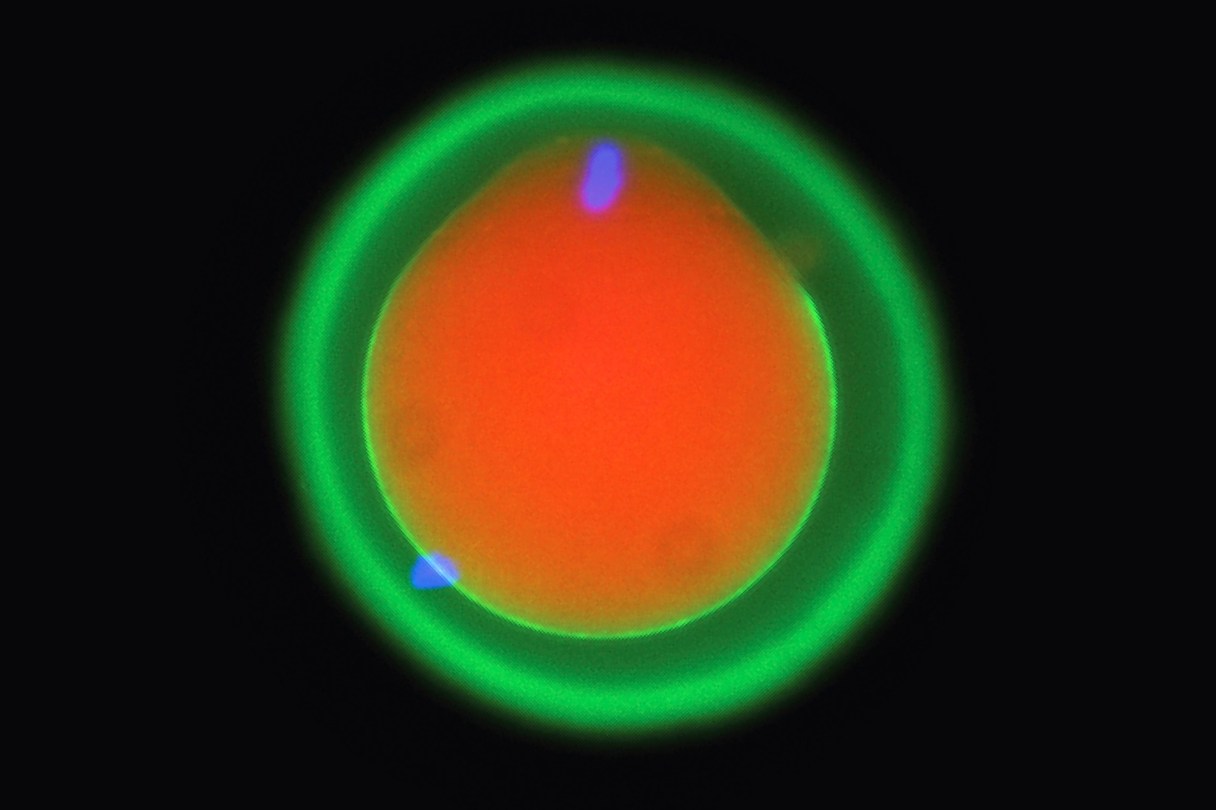
How a sperm and an egg fuse together has long been a mystery.
New research by scientists in Austria provides tantalizing clues, showing fertilization works like a lock and key across the animal kingdom, from fish to people.
“We discovered this mechanism that’s really fundamental across all vertebrates as far as we can tell,” said co-author Andrea Pauli at the Research Institute of Molecular Pathology in Vienna.
The team found that three proteins on the sperm join to form a sort of key that unlocks the egg, allowing the sperm to attach. Their findings, drawn from studies in zebrafish, mice, and human cells, show how this process has persisted over millions of years of evolution. Results were published Thursday in the journal Cell.
Scientists had previously known about two proteins, one on the surface of the sperm and another on the egg’s membrane. Working with international collaborators, Pauli’s lab used Google DeepMind’s artificial intelligence tool AlphaFold — whose developers were awarded a Nobel Prize earlier this month — to help them identify a new protein that allows the first molecular connection between sperm and egg. They also demonstrated how it functions in living things.