
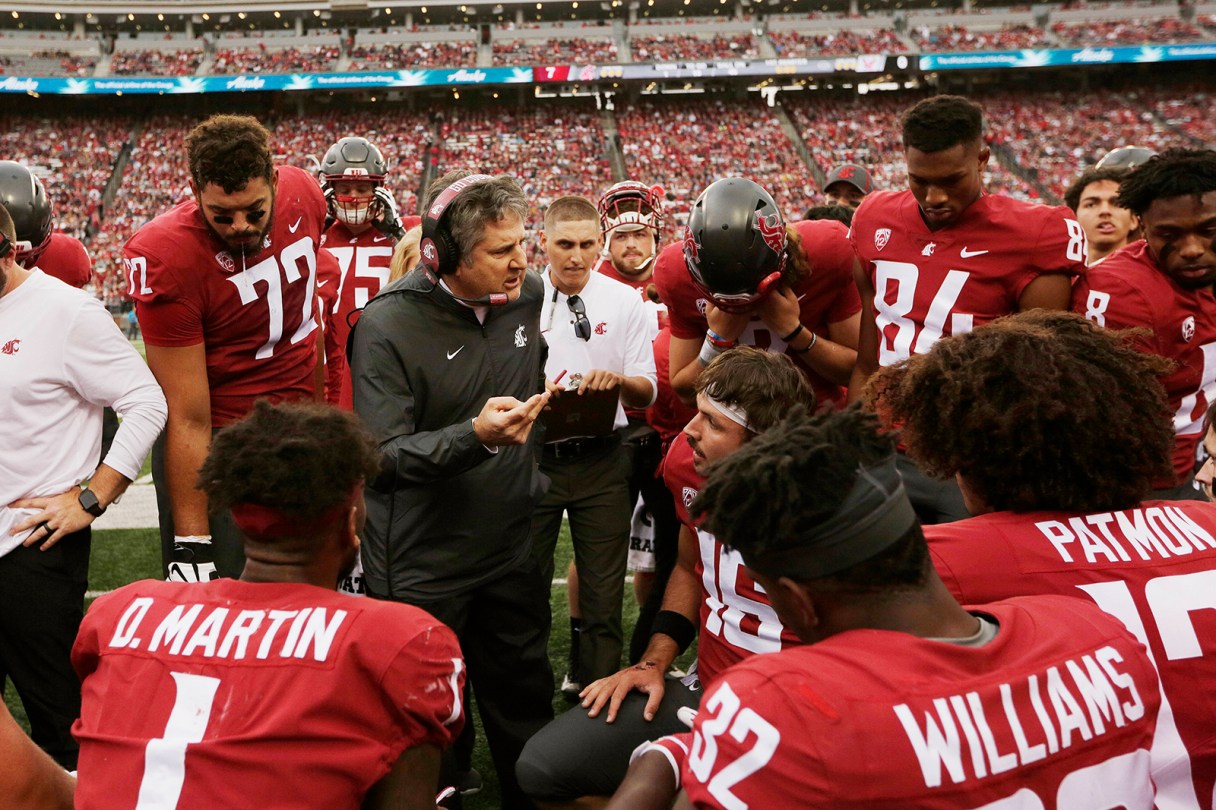
PULLMAN, Wash. — Sitting on the mirrored glass shelf inside the office of the head football coach at Washington State University is a small reminder of what the late Mike Leach meant to the school.
Jake Dickert’s workspace includes the prominent display of a crimson helmet emblazoned with the Cougar-shaped WSC logo in metallic gray, but the famous design is accompanied by something very Leach-esque: a pair of swashbuckling pirate swords underneath.
“I truly believe Coach Leach taught everyone around here that they can believe again, and he did it in his own unique way that is Washington State,” Dickert said.
Leach’s name and his legacy will be part of the storyline Saturday night when Washington State (1-0) and Texas Tech (1-0) — two schools he is particularly associated with — face off in Pullman. While it’s not a weekend on the Palouse officially dedicated to Leach, who was the head coach of the Red Raiders from 2000-09 and led the Cougars from 2012-19, his history is an overarching piece to the matchup.
Leach is part of the class being inducted into the Washington State Athletics Hall of Fame this weekend, joining the similar honor he already had from Texas Tech. His family is back in Pullman for the celebration, was honored during the induction Friday night and will be again at Saturday’s game.
The weekend is also an opportunity to rekindle the discussion of Leach’s overall place in the history of the sport after he died in December 2022 — at age 61 and near the end of his third season as Mississippi State’s head coach — and if he’ll eventually have a spot in the College Football Hall of Fame.
“Coach Leach, in my mind, and I believe in most of the people in this room, is a no-doubt Hall of Famer,” Missouri coach Eli Drinkwitz said during the SEC’s football media days event this summer in Dallas. “He impacted our game more in the last 50 years than a lot of other people, not only with his legacy, but also with his football acumen.”
Technically, Leach isn’t eligible for induction yet, said Steve Hatchell, the president and CEO of the National Football Foundation and College Football Hall of Fame. Leach would need to be nominated by one of the schools where he coached — which seems a formality — and be three years removed from when he last coached to be considered.
There is one area where Leach’s eventual candidacy will force a decision to be made by the NFF. Leach finished his career with a 158-107 record, a winning percentage of .596, and coaches must have a .600 winning percentage to be considered for inclusion on the voting ballot, according to the current guidelines.
And it’s not as simple as just rounding up.
“It’s broader than just one person,” Hatchell said.
The situation is personal for Hatchell because he considered Leach a friend, someone the NFF would turn to for advice about college football and someone with whom he would exchange book suggestions.
And he’s also someone who would have provided strong opinions about the state of college football in 2024.
“He was a great friend, and you could ask him a lot of things. He didn’t just go with the flow. He would be very quick to tell us, which helped us a lot; it would be this doesn’t work or this works,” Hatchell said. “He could be a contrarian, but a lot of times if you’re going to push back and be sharp-elbowed to talk about the good in the game, you need people to give you some really good introspection, and Mike was that way.”
Hatchell expects the Leach debate to continue, especially because he was so close to winning 60% of his games. It could be that all coaches with a .595 winning percentage or above are eventually looked at for possible inclusion on the ballot if they meet other requirements.
Saturday’s matchup of two of his former teams is just one moment where his name and his impact will again be in the spotlight. And even if he isn’t inducted the College Football Hall of Fame down the road, his legacy — which includes his pass-happy “Air Raid” offenses that paved the way to today’s spread schemes — is secured.
“I wouldn’t be here with all these things and this building without Mike Leach,” said Dickert, who came to Washington State as an assistant in 2020, served as interim head coach for the final six games in 2021 and was officially promoted to the job that December. “And I never met him personally, but the impact he’s made on the game of football, I think most coaches can only dream of that.”