
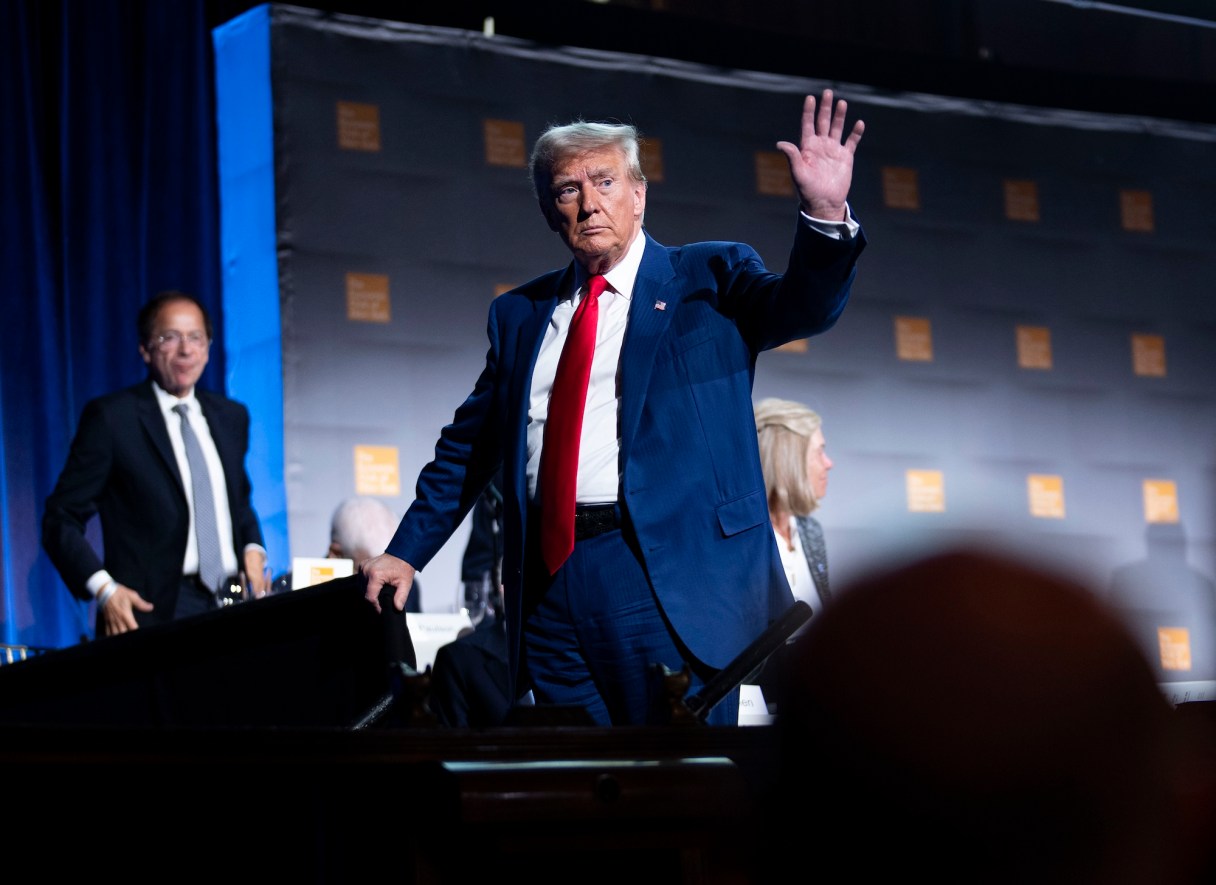
Listening to former President Donald Trump speak to the Economic Club of New York, you could be forgiven for thinking that the economy has been such a disaster since he left office that the stock market is in a perpetual free fall. And yet, the benchmark S&P 500 Index is up 64% since the 2020 election through Wednesday, topping the 60% gain at the same point in the Trump administration.
There’s an old saying that the stock market is not the economy, and that’s true in the short run. Over the long run, stocks do reflect economic fundamentals, and the evidence shows that investors like the policies of President Joe Biden more than those that Trump offered up when he occupied the White House from 2017 through 2020. And yet, in laying out his economic agenda last week, Trump doubled down on the chief policies of his administration — mostly tariffs and lower corporate taxes.
The reality is that the tariffs Trump imposed on China and other countries damaged U.S. manufacturers. And big companies used the money from lower corporate tax rates not to invest in and innovate their businesses but rather to buy back their own stock and pay dividends to shareholders — all while denying the U.S. much-needed revenue and causing its debt load to blow out 16% to $23.2 trillion by the end of 2019.
That explains why consensus was building heading into the last year of Trump’s presidency that the economy was struggling. The odds of a recession in the following 12 months doubled to 35% toward the end of 2019 — well before COVID-19 showed up on anyone’s radar — from 15% in 2018, according to data compiled by Bloomberg. Analysts were busy slashing their growth forecasts as employers added less than 2 million jobs in 2019, the fewest since 2010.
And, no, Trump’s tariffs didn’t improve the fortunes of U.S. manufacturers. In fact, the Institute for Supply Management’s widely watched index of manufacturing activity cratered starting in mid-2018 all the way through 2019. Things got so bad for manufacturers that the ISM’s index suggested the sector was in a recession in the final four months of 2019. And yet, Trump says he wants to impose a 10% across-the-board tariff on all imports and 60% duties on Chinese goods if he wins re-election, casting the idea as a “pro-American trade policy that uses tariffs to encourage production here.”