
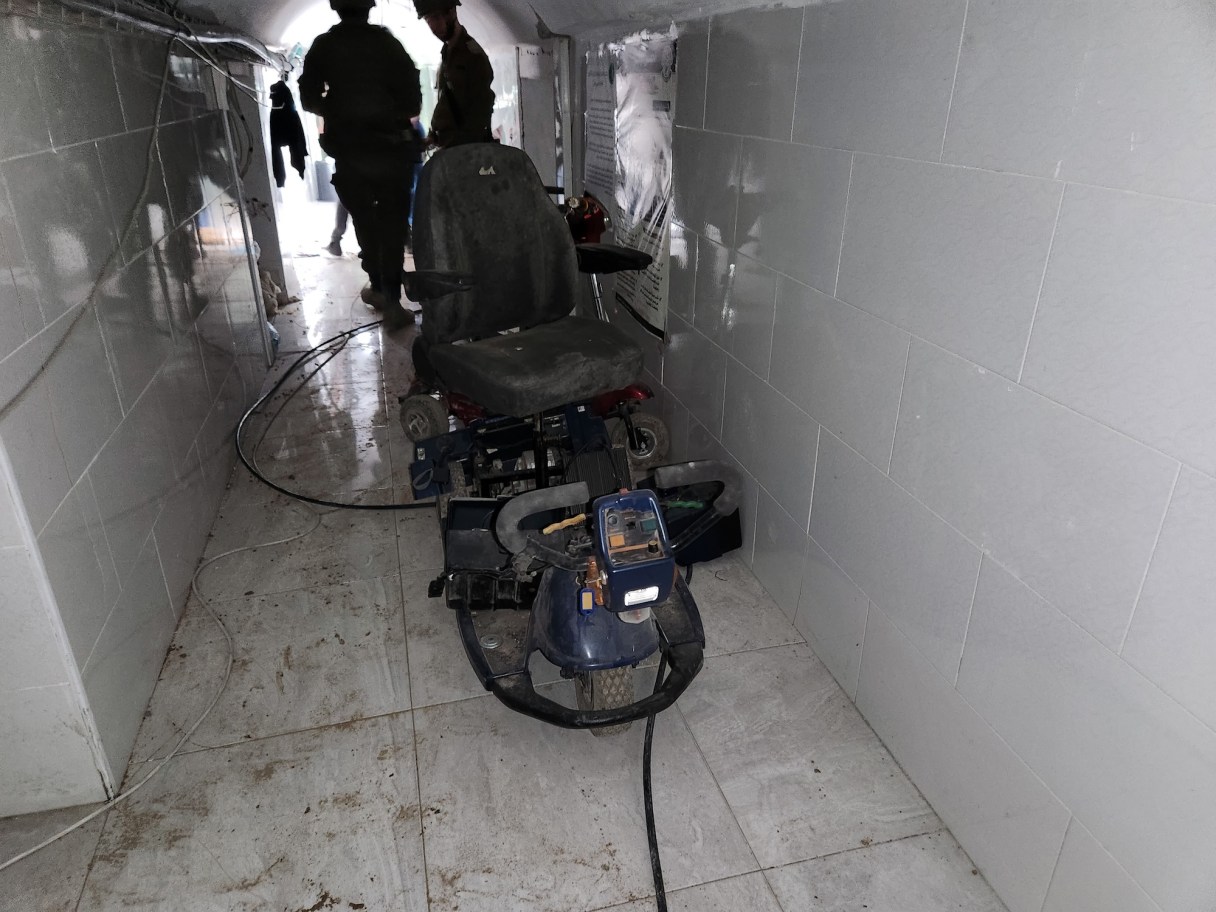
A year into Israel’s fight against Hamas, it has become clear that the military “center of gravity” – the most important element of the conflict – is not the missiles or manpower of the terrorist group. Rather, it is the 400-plus miles of tunnels carved out under the Gaza Strip. From those tunnels, Hamas and its sponsor, Iran, were able to train, equip, organize and launch the horrific attacks of Oct. 7.
The Israel Defense Forces have now publicly released a handbook captured from Hamas in 2019 that details how the group sought to maximize the lethality of capabilities it painstakingly built up underground and out of sight. The group trained forces to fight in the subterranean environment using cover of darkness, night-vision goggles, split-second timing, GPS trackers, elaborate camouflage and protective blast doors.
It is easy to believe that Hamas did so in a burst of unique creativity, and that we are seeing the emergence of a new style of warfare. In fact, the use of tunnels in war has a long history.
Recent excavations found that the Jewish rebels of Judea used hundreds of miles of tunnels connecting villages in their revolt against the Romans two millenniums ago. The ancient Chinese and Ottoman Turks both used tunnel complexes, notably in undermining cities under siege.
Tunnels played an important role in World Wars I and II. Today, the most elaborate system of tunnels dedicated to war are probably in North Korea. These are deeply buried, probably impervious to even the largest conventional bomb or missile strikes. U.S. and South Korean forces conduct extensive training designed to enter and ultimately destroy such complexes. The North Korean tunnels are much larger, better defended and full of weapons far more advanced than those in Gaza.
So, what lessons can war planners learn from the Israeli military’s struggle to win control of Hamas’ underground maze?
First, traditional intelligence systems must put greater emphasis on the tunnel systems of Iran (concealing its nuclear program), North Korea (hiding not only nuclear weapons but also the launchers to deploy them) and terrorist groups. Technical means – mobile-phone monitoring, cyber surveillance – and human intelligence (embedded operatives) have to shed more light on what is happening in the darkness.
U.S. and allied troops will need better preparation for combat operations underground: training for the destruction of tunnel networks of significant size; engineering integration with combat units to include not only explosive means but, for example, flooding tunnels with water; practice with night-vision devices in highly confined spaces; and use of special forces as shock troops underground (similar to the “tunnel rats” of Vietnam).
Another key lesson of Gaza is that we need to apply new technologies. These include intelligence systems that can detect and measure tunnel complexes from space or using long-dwell drones. Also necessary are unmanned above-ground capabilities – sonic, infrared and light-detecting – that can operate ahead of human troops to reduce casualties.
Obviously, the presence of dozens of Israeli hostages in Gaza makes using all such means far more difficult. So, count on other adversaries to take a page from Hamas’ book and start conflicts by kidnapping a substantial number of civilians or military personnel.
Tunnel warfare is terrifying, and preparing for more of it will unfortunately be a crucial element of the 21st-century battlefield.
James Stavridis, a retired U.S. Navy admiral, is former supreme allied commander of NATO, and dean emeritus of the Fletcher School of Law and Diplomacy at Tufts University.