
With the Trump administration targeting foreign-born college students across the country for deportation, Vanderbilt University faculty are still mostly in the dark about how they are supposed to respond to potential immigration enforcement on campus. Professors said that school officials have not widely distributed official guidance, and the university has not issued any recent public statements on the matter.
A Jan. 30 email obtained by the Nashville Banner informed staff that the school’s general counsel “is working with multiple departments to be prepared if (Immigration and Customs Enforcement) shows up on campus” and that “concrete plans will be shared when they’re available.”
Neither Vanderbilt spokespeople nor the office of the school’s general counsel responded to inquiries from the Banner. Between the university and its medical center, Vanderbilt is the largest employer in Nashville.
In the two months since, Trump administration officials have revoked hundreds of student visas, appearing to single out those who were involved in pro-Palestinian campus protests last year. Last month, ICE agents arrested Mahmoud Khalil, a Palestinian activist and graduate student at Columbia, at the university-owned apartment where he lived with his pregnant wife. Weeks later, plainclothes agents took Tufts University PhD student Rumeysa Ozturk, a Turkish national on a student visa, off the street near her home in a startling arrest that was captured by nearby surveillance cameras.
The administration’s severe policy also has affected international students at the University of Tennessee. Chancellor Donde Plowman informed school staff that three current UT students and a former student who works on campus had their visas revoked and are now facing deportation. Plowman also outlined the school’s policy for how faculty and staff should respond if they encounter ICE agents on campus, which is more likely after the Trump administration rescinded guidance that considered school campuses protected areas. The policy essentially instructs UT employees to cooperate with federal agents, make note of their names and badge numbers if possible and inform university law enforcement.
(READ MORE: How immigration enforcement has changed under Trump, in Tennessee and beyond)
At Vanderbilt, faculty have been asking for information about how they should handle potential encounters with ICE agents and how the school will respond if the Trump administration targets Vanderbilt students. International students make up around 10% of the school’s undergraduate student body and about 24% of doctoral students, according to the university.
Terry Maroney, a legal professor of medicine, health and society, told the Banner that the university’s law school has not received any guidance from Vanderbilt officials. She said she had heard from colleagues in other departments that the general counsel’s office has given presentations about the issue. Maroney said none of her students have been affected yet by visa revocations.
“Clearly, students on campus are concerned,” she said. “I think every student in America who’s here on a student visa is concerned.”
Other professors from various schools in the university reached by the Banner said they had also not received any guidance about immigration enforcement. All declined to comment further on the record.
A March 18 editorial by two editors from the campus newspaper, the Vanderbilt Hustler, urged university officials to at least join Metro Nashville Public Schools in stating that it would require ICE or any other law enforcement officials to have legal authorization before taking any action on campus.
(READ MORE: Hamilton County Sheriff’s Office applies to work with ICE)
A week later, the paper reported on student concerns and cited a university statement that there had not yet been “any visits by the U.S. Immigration and Customs Enforcement agency to campus.”
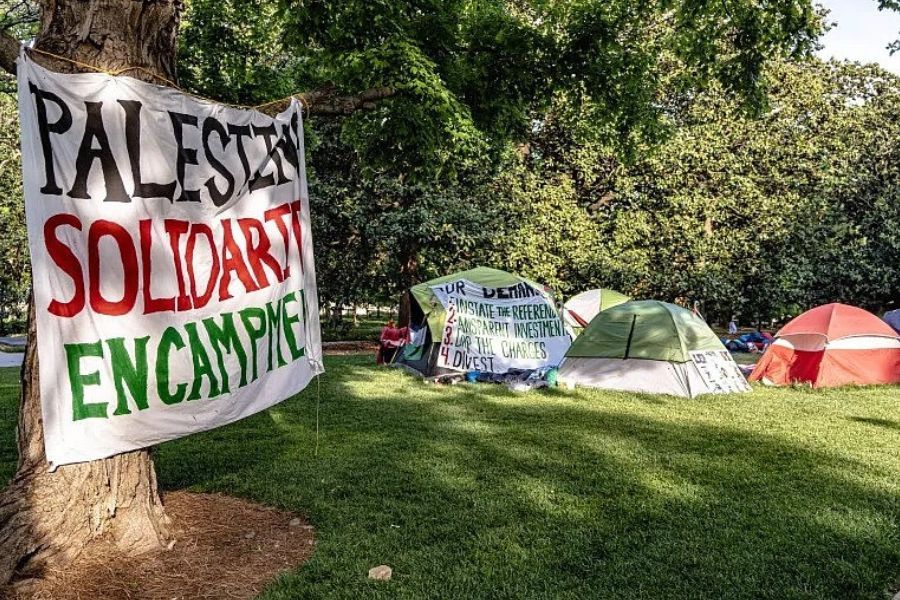
The Vanderbilt campus was the site of protests last year over the U.S. government’s support for Israel’s deadly bombardment of Gaza following the Oct. 7 terrorist attacks by Hamas. Four students were criminally charged, and a Nashville Scene reporter was arrested after more than two dozen students pushed past security and entered the school’s Kirkland Hall in an attempt to speak to Chancellor Daniel Diermeier. A smaller group of students set up tents and occupied the area in front of Kirkland Hall for more than a month after that, until the end of the spring semester.
The Department of Homeland Security announced Wednesday that it will begin screening the social media accounts of immigrants seeking permanent residence status or applying for other benefits for what it described as “antisemitic terrorist organizations such as Hamas” and others. Advocacy organizations expressed alarm at the development, emphasizing how the Trump administration has falsely framed some criticism of Israel’s war in Gaza as antisemitism.
This article first appeared on Nashville Banner and is republished here under a Creative Commons Attribution-NoDerivatives 4.0 International License.