
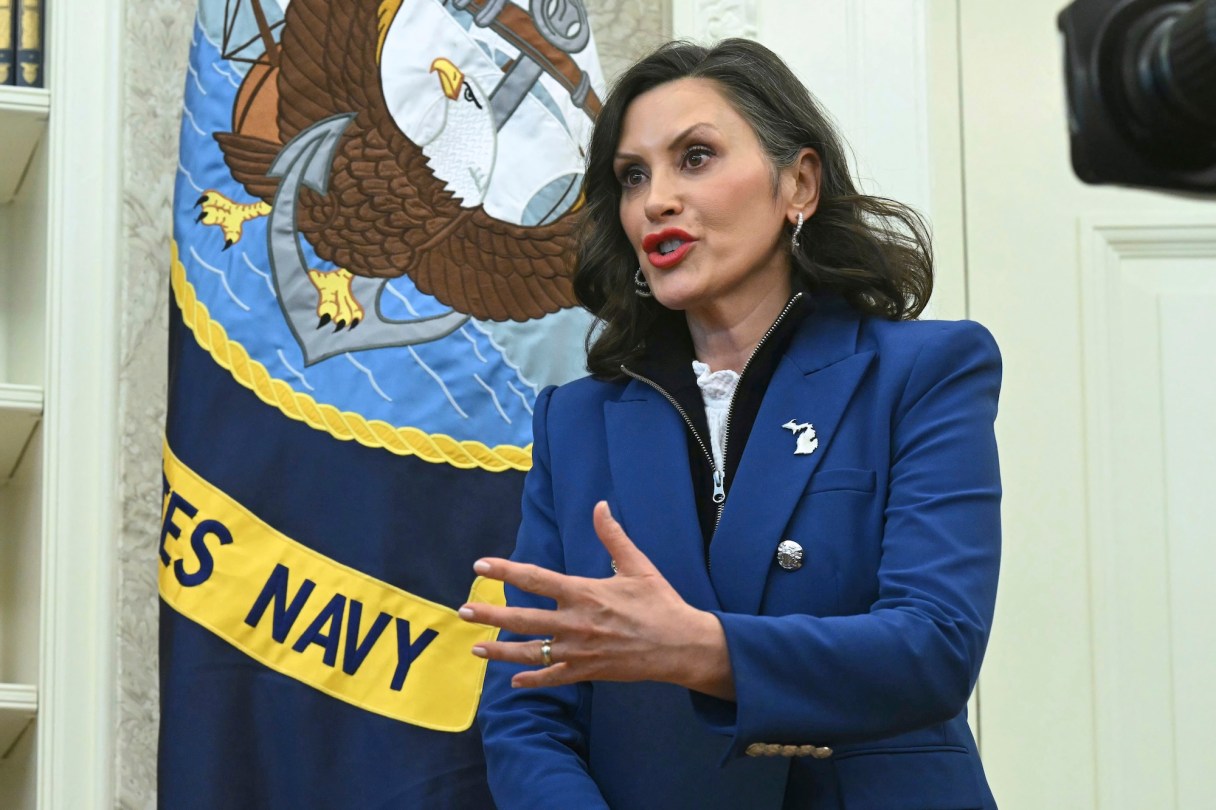
Kudos to Michigan Gov. Gretchen Whitmer. She managed to generate the most negatively iconic photo of a Democrat since Michael Dukakis wore a helmet atop a tank.
Whitmer, long considered a promising presidential prospect by Democratic insiders, was at the White House to discuss state business. But when President Trump’s aides whisked her into the Oval Office, it was not for the planned one-on-one with the president, but for a photo op during which Trump signed executive orders targeting two perceived political enemies for criminal investigation. Realizing that she was in a political tiger pit, Whitmer opted for the Ostrich Maneuver. Lacking sand to stick her head in, she hid her face behind some binders.
The photo perfectly encapsulates Democratic dysfunction. Her White House visit was wholly defensible, but because she was in the room when Trump was doing something indefensible, she’s being vilified by her own side for enabling Trump, generating more “Dems in disarray” drama in the process.
Of course, the Dems really are in disarray.
If you just go by the topline 2024 presidential election returns, it’s not obvious they should be. Kamala Harris lost by 1.48% of the popular vote, the fifth closest election since 1900.
And yet, Democrats are a mess. In March, the party hit its all-time low in popularity.
The main driver of the Democrats’ plight is that the party that likes to see itself as the party of the little guy is perceived, not inaccurately, as the party of urban and coastal elites by the largest chunk of the electorate: white voters without a college degree. More broadly, voters remain profoundly distrustful of elite institutions, and progressives have dominated most of those institutions for decades.
What the Democrats can do to fix themselves and voters’ perception is the subject of intense internal debate. At least four options have emerged.
The first is to replay the “Resist!” theatrics of the first Trump term. The second is the “Fight the Oligarchy!” tour headlined by Sen. Bernie Sanders and Rep. Alexandria Ocasio-Cortez.
Option 3: “Abundance” is the buzzword and book title for a technocratic theory of “supply-side liberalism” that seeks to clear away the red tape and interest-group NIMBYism standing in the way of government planners who want to expedite the delivery of public services — housing, high speed rail, etc.
This course has the most to recommend it. But it has three political weaknesses. First, the bureaucratic bottlenecks are closely guarded by progressive constituencies. If you want to bulldoze through the Clean Water or Endangered Species acts, you won’t be picking fights with a lot of Republicans. You’ll be antagonizing well-heeled Democrats and a liberal-dominated media that reflexively casts such efforts in a negative light. Second, national Democrats are powerless in the Republican-controlled House and Senate. Last, it essentially represents a bunch of elite eggheads saying, “Trust us, we’re different now,” when no one trusts them.
Ironically, the fourth option is symbolically close to what Whitmer did: Hide. Or, as James Carville puts it, “Play dead.” Keep your head down and powder dry while Trump self-immolates.
I think this is, by far, the wisest course in the short term.
The problem is the long term. Our politics are broken because both parties have given up on the idea of being majority parties. When out of power, they rely on turning out their bases and the unpopularity of their incumbent opponents to squeak out narrow victories, only to squander power on fan service to their bases once elected. This cycle can be broken only by a party that, when elected, opts to build a majority from the center out. I see no sign of that happening anytime soon.