
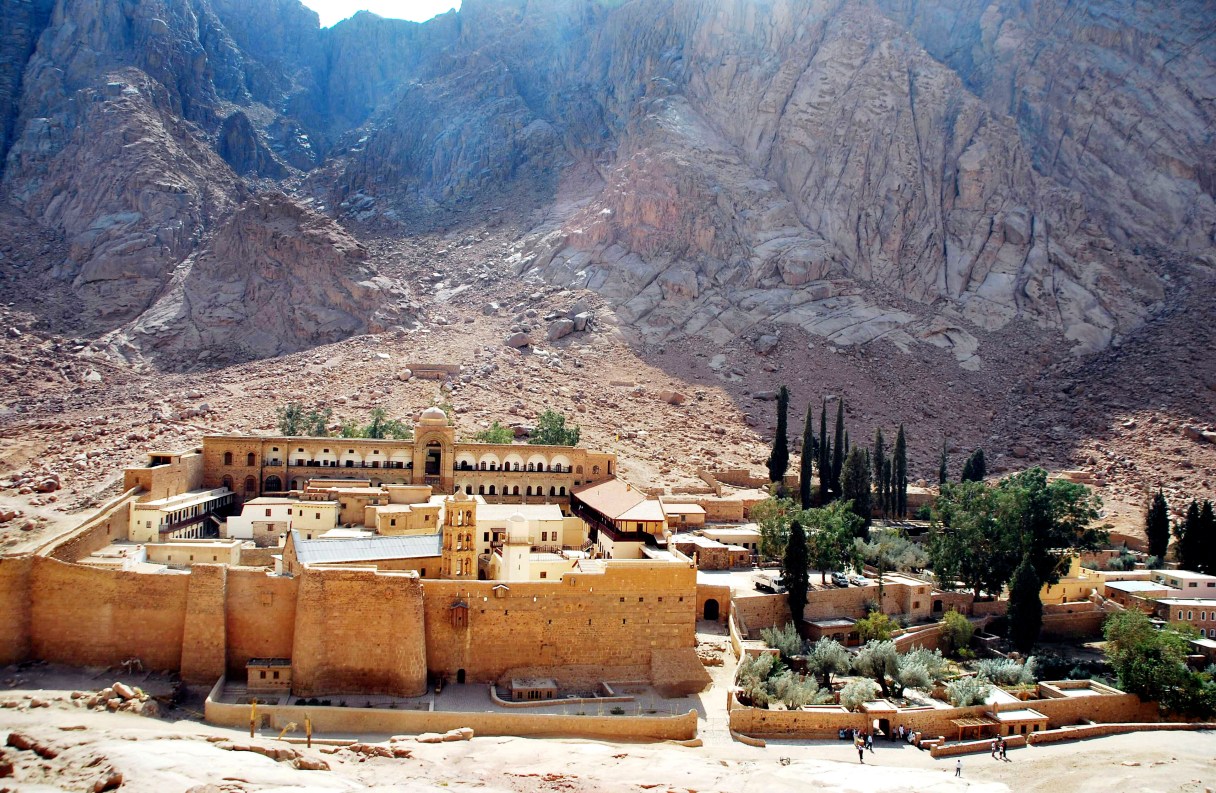
After 1,500 years of continuous Christian service, the world’s oldest monastery is being forced to close its doors. According to several sources, St. Catherine’s Monastery will be annexed by the Egyptian government and turned into a museum and tourist attraction. Though the monks won’t be kicked out yet, the ruling is the latest incident in the already precarious situation of Christians in the Middle East.
Founded as a respite for wandering worshipers under Emperor Justinian in 527, St. Catherine’s sits at the foot of Mount Sinai. It has been a center of Christian identity since shortly after the fall of the Western Roman Empire, 70 years before there was an archbishop of Canterbury and nearly a full century before the founding of Islam. And, of course, it resides at one of the most significant places of the Old Testament.
A claim at the heart of this case was whether Christianity is a Western intrusion into an indigenous Muslim area and, therefore, whether foreign Christian monks are occupying Egyptian land. It is true that after Christianity made the West what it is, missionaries were sent around the world. However, Middle Eastern and African Christians were building churches when the ancestors of Westerners were still worshiping pagan gods like Tiw, Woden and Thor.
The areas that now make up North Africa, Egypt, Israel, Syria, Lebanon and Turkey were once the heartland of Christianity and only lost after centuries of conquest and persecution by Muslim overlords. Today, in almost all of these nations, Christians are in trouble. And yet, as Philip Jenkins noted in his book “The Next Christendom,” the Church is a global phenomenon that spans cultures, languages and history.
Last year, on Pentecost Sunday, I asked our youth Sunday School class about the significance of the day within Scripture and church history. A young man with autism, who is both a sweet kid and faithful member of the body of Christ, shouted out: “It’s the church’s birthday!” I could not have said it better. As Luke recorded in Acts 2, it was at the first Pentecost where the proclamation of the good news first went out to all nations.
According to the account, Peter and the Apostles preached Christ crucified to: “Parthians and Medes and Elamites and residents of Mesopotamia, Judea and Cappadocia, Pontus and Asia, Phrygia and Pamphylia, Egypt and the parts of Libya belonging to Cyrene, and visitors from Rome, both Jews and proselytes, Cretans and Arabians.”
Yes, Egypt. At Pentecost, there is the first indication that the scattering of the nations at the Tower of Babel will be reversed. It is the fulfillment of God’s promise to Abraham (in Genesis 12), that “[I]n you all the families of the earth shall be blessed.”
It is the foretaste of what is described in Revelation 7, “[A] great multitude that no one could number, from every nation, from all tribes and peoples and languages, standing before the throne and before the Lamb, clothed in white robes, with palm branches in their hands.”
As my young friend described it, Pentecost was indeed the birthday of the Church, the redemptive instrument of God that proclaims that Christ is risen and is the true King of heaven and Earth.
As Christ’s Church is persecuted around the world, remember, we live in the age of Pentecost. God is renewing his world by his Word through his Church. We are not just bystanders. We are part of that renewal.
From Breakpoint, July 17, 2025; reprinted by permission of the Colson Center, breakpoint.org.