
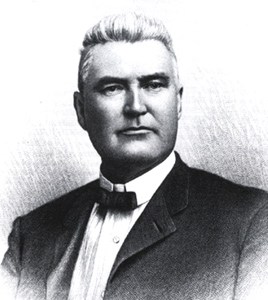
Chattanoogans learned on Saturday, March 21, 1925, that Zeboim Cartter Patten died after a lengthy illness at his home, Ashland Farm, in Flintstone, Georgia. With him were Patten’s wife, Sarah Key; his daughter, Elizabeth Olive (Mrs. J.T.) Lupton; his son, Cartter Patten, home from Cornell University; other relatives; and his physicians, Dr. J.D.L. McPheeters and Dr. H.H. Hampton.
Tributes poured in from across the country, while newspapers collected biographical information. Prominent citizen and president of Volunteer State Life Insurance Company, Patten would have celebrated his 85th birthday two months later in May.
Funeral services were held the following Sunday afternoon at 2 p.m. at Ashland Farm with St. Paul’s Episcopal Church pastor, the Rev. John D. Wing, presiding, and the Rev. Thomas S. McCallie assisting. His nephews, Z.C. Patten Jr., George H. Manker, John A. Patten Jr., George H. Patten, Tarbell Patten and Lupton Patten, served as pallbearers at the burial in Forest Hills Cemetery.
The entrepreneur/philanthropist was born at Vilna in upstate New York, May 3, 1840, to John A. Patten and Betsy Elizabeth Cartter Patten. The younger Patten enjoyed genealogy and often recounted that his ancestors had accompanied William the Conqueror to England and participated in the Battle of Hastings. He listed among his distinguished forebearers William Patten, who was bishop of Winchester, bishop of Waynflete and chancellor of England during Henry V’s reign, and founder of Magdalen College in Oxford. William’s brother, Richard, started the direct line that led to Zeboim. Descendant Nathaniel Patten chartered a ship, The Charles, in 1640 that brought the family across the Atlantic Ocean.
Zeboim Cartter Patten was educated at Lowville Academy in Lewis County, New York. When the Civil War broke out, he enlisted in the Union Army and served with the 115th Illinois Infantry. He was wounded at the Battle of Chickamauga. After his recovery, Patten was commissioned as a lieutenant in the 149th New York Infantry by Gov. Horatio Seymour and rejoined the Union in time to serve at the Battle of Kennesaw, Georgia. He was remembered as “another of that worthy group of northern soldiers who served under Grant, Buell and Thomas in the campaigns of Chattanooga.” When the U.S. Civil War ended, Patten returned to Chattanooga and begin building the city he loved.