
This story was originally published by the Nashville Banner. Sign up for their newsletter at nashvillebanner.com/newsletters.
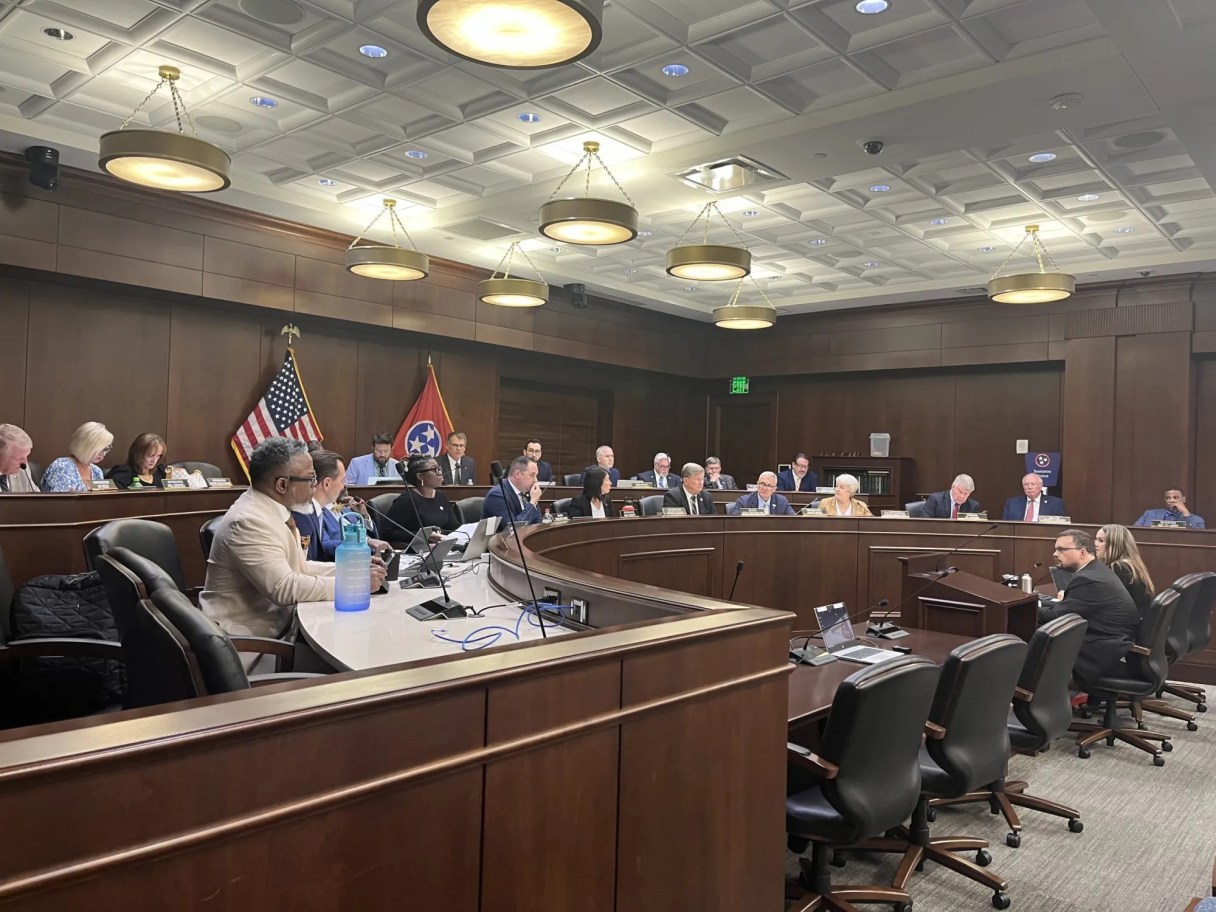
As Tennessee’s tuition grant program goes into effect for the 2025-26 school year, Democratic members of the Senate and House Committees on Government Operations questioned members of the State Board of Education on its implementation.
Under the Education Freedom Scholarship Act passed by the General Assembly in January, Tennessee residents can use public funds to pay for K-12 education expenses, including tuition and fees, at private schools. The program made 20,000 scholarships available for this school year, with 10,000 reserved for families whose household income does not exceed 300 percent of the federal free or reduced-price lunch guidelines.
Students seeking grants do not need to disclose their previous school enrollment, meaning the Department of Education cannot gather data on how many voucher recipients already attended a private school. Without this information, the state will not be able to track whether the voucher program will meaningfully expand access to private schools for public school students.
This, Rep. John Ray Clemmons, D-Nashville, said, contradicts the “spirit of the law.”
“The governor of Tennessee traveled all over the state of Tennessee representing that this law would provide opportunity to children that wouldn’t otherwise have it,” Clemmons said during a Joint Government Operations Committee rule review Wednesday.
General Counsel for the State Board of Education Rachel Suppe responded that this point was raised when the bill was under deliberation in the General Assembly and intentionally excluded from the final text.
“When we’re making rules, we have to obey the wording of the letter of the law,” Nathan James, deputy executive director for legislative and external affairs for the state board, told the Nashville Banner. “And so I think we did that with fidelity.”
Representatives also questioned the absence of restrictions on the types of textbooks, curricula and instructional materials that private schools can teach. The state bars K-12 public schools from teaching certain “divisive concepts,” specifically in regard to race, gender and other social issues. But these restrictions do not extend to private schools, including those that are eligible for the tuition grants.
Clemmons noted the “hypocrisy” that public funds can now potentially be used to teach these “divisive concepts” in private schools.
Rep. Antonio Parkinson, D-Memphis, extended this line of questioning to religious instruction: “So the Nation of Islam,” he asked, “could open up a school and teach things as they see fit to teach them without any backlash from the state of Tennessee?”
Suppe responded that the board “can’t take religion into consideration” when reviewing applications from private schools seeking funds. She paused, then added: “Let me clarify that to say we can’t discriminate on the basis of someone’s religious viewpoints.”
Representatives also pressed the board on the standards by which participating private schools will be assessed. The Department of Education plans to assess these schools through a sample of Tennessee Comprehensive Assessment Program scores from students grades 3-8. TCAP is the statewide end-of-year exam in English language arts, math, science and social studies.
However, private schools eligible for tuition grants are not required to administer the TCAP. They also have the option to use a nationally standardized achievement test aligned to its instructional program.
Rep. G.A. Hardaway, D-Memphis, raised concerns that school assessments will be based on a statistical sampling of student test scores, rather than the entire student population or even every grant recipient. Tennessee Education Association President Tanya T. Coats told the Banner that this could result in private schools selecting which students take the standardized tests.
Additionally, officials noted the incongruence between the timelines for private school admission and grant applications. Sen. Charlane Oliver, D-Nashville, stated that many private schools begin their admission cycles in the fall and accept applications for tuition assistance in December, prior to the start of the next school year. Due to this lengthy enrollment process, which can take up to a year, public school parents may have missed the window to apply to private schools for this school year.
“It appears that this program is by design for parents that are already in private schools,” Oliver said.
The grant amount for this school year is $7,295, which is higher than the state funding available for each public school student under the Tennessee Investment in Student Achievement Act funding formula.
The state has allocated about $6.8 billion toward public schools for this fiscal year, which is about $7,023 for each student across the state. In Davidson County, the state share of TISA funding — which is split between the state and local governments — is $359 million for 82,000 students, which is about $4,300 per student.
“We want parents to know that we want a fair and equitable process,” Coats told the Banner. “Taking public dollars from students that are in public school and giving them to private schools will never be acceptable in the state of Tennessee.”
This article first appeared on Nashville Banner and is republished here under a Creative Commons Attribution-NoDerivatives 4.0 International License.