
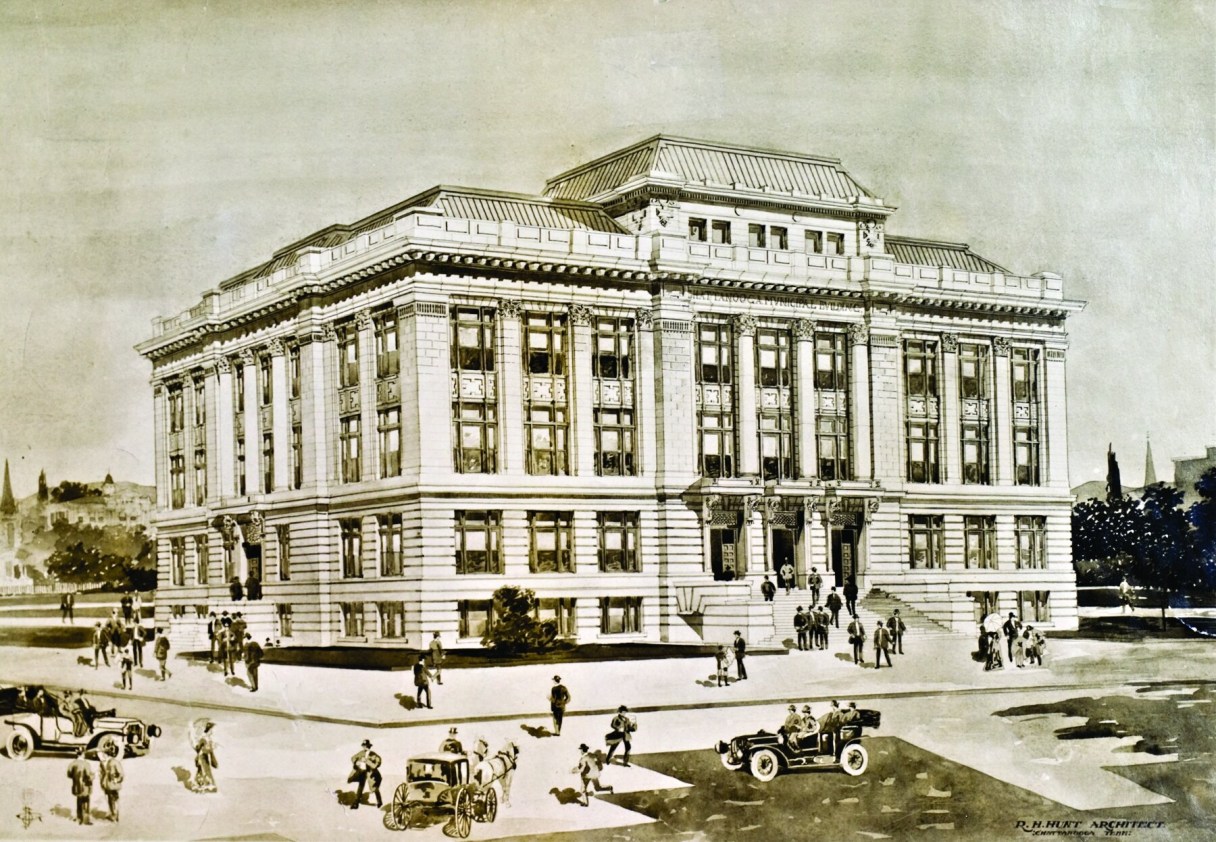
As the Chattanooga mayor and City Council planned the dedication ceremony for the new City Hall, a bit of controversy arose. Council members Frank A. DeGeorgis, Thomas P. McMahon and Ben Howard were appointed by the Council to arrange details of the cornerstone and its inscription, including names, articles and manuscripts to be placed inside the stone. T.F. Sweet, associate of architect R.H. Hunt, stepped forward and presented a rendering of the cornerstone with the proposed words, “Anno Domini, MCMVIII,” explaining that the stone would be too small to include all the names of the mayor and councilmen. He suggested that a bronze plaque be installed on an interior wall with the names of officials and committee members.
At the next meeting of the City Council, Alderman Capt. Henry A. Chambers, well-known attorney and member of the Upper Board of the Chattanooga City Council, addressed members explaining that he did “not think much of the Romans” or “veni, vidi, vici … Et tu Brutus,” and saw “no reason why the tangle of Latin nouns, pronouns, verbs … should go on the cornerstone of Chattanooga’s new City Hall.” Instead, he suggested that the Council vote to “put plain United States English that all of us can understand on that stone.” A wag of his finger toward the other members indicated that he was serious about his comments. The matter was referred to a subcommittee.
The cornerstone ceremony was held on April 24, 1908, with Capt. Chambers presiding. The Chattanooga News reported that the dedication exercises were “especially impressive by a parade of city officials, headed by a platoon of police” lead by Chief John T. Moseley and six mounted deputies. After the police, a series of carriages carried current and former city officials including, in order, Mayor William Riley Crabtree, former Mayors William. L. Frierson and Alexander W. Chambliss, Alderman Capt. Chambers, City Auditor J.M. Payne, and Aldermen W.H. Weatherford. Those were followed by Thomas W. Fritts and Councilmen V.E. DeGeorgis, S.P. Ivins, Norris Headrick, Frank Moore, R.O. Bennett, W.H. Terrell, G.N. Walkley and J.L. Molesdale.
A second series of carriages appeared after a break in the parade, conveying Chamber President Noah H. Grady; Chattanooga Manufacturers’ Association President H.F. Temple; Captain J.P. Fyffe, editor of the Chattanooga Star; J.R. Pound of the Chattanooga News; and a number of others. Police Chief William Toomey and the entire rifle department with wagons and engines followed. The parade members took a circuitous route from the old location, just south of Sts. Peter and Paul Catholic Church, to the new City Hall, and were greeted by “a large part of the school children of the city, cheering wildly … the most imposing and inspiring feature of the day’s program.”
Capt. Chambers called the assembly to order at 2:45 p.m. Schoolchildren, joined by Superintendent Gilbreath and with school flags flying high, “sang with much glee several inspiring songs.” Dr. J.W. Bachman, “Chattanooga’s Pastor,” gave the invocation, and the band played “The Star-Spangled Banner.” Chambers explained that each speaker had been allocated no more than five minutes.